Home & Garden
B-Flat with a Shovelnosed Guitarfish
During Sharktober we think of great white sharks, but there are many species of sharks in the Bay area, including this strange looking ray.

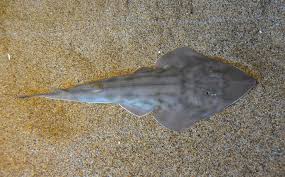
When we here shark during the Sharktober months we think of great white sharks. But there are many species of sharks, skates and rays inhabiting our coastline and the San Francisco Bay.
The Shovelnose guitarfish is a flat shark belonging to the group of skates. It that has the wing-like pectoral fins of rays but a flat body that is more shark like. They have a tapered disc and long tail with two dorsal fins without spines. A brown or gray coloration helps them blend into the bottom mud and the sandy habitat they inhabit.
This species was considered to be intermediate between sharks and rays but recent studies confirm that the guitarfishes are most closely related to the group of rays, the Batoidae. This unusual looking ray ranges from the San Francisco Bay to the Gulf of California.
Find out what's happening in Pacificafor free with the latest updates from Patch.
Like other rays, the shovelnose guitarfish have the ability to pump water over their gills, so they are able to remain perfectly motionless in the benthos.
They are an ambush predator, waiting for prey such as crabs and flatfish before bounding from the sediment and eating their prey. It can also use the shovel-like rostrum to burrow into the mud for worms, clams and other shellfish. The California Department of Fish and Wildlife report the largest individual at 5 feet 1.5 inches and 40.5 pounds.
Find out what's happening in Pacificafor free with the latest updates from Patch.
Females enter the San Francisco Bay and other estuaries before the males arrive, giving birth to their young after an 11-12 month gestation or pregnancy period. Like other species of small sharks and rays, the San Francisco Bay’s shallow and warmer waters are ideal for gestation and as a nursery.
Female shovelnose guitarfish are abundant in San Francisco Bay in the spring to give birth. Females can give birth to as many as 28 pups. Males follow in early summer when mating occurs, and the species appear to migrate offshore into deeper waters in the fall and winter.
Large sharks like sevengills and California sea lions are known predators of Shovelnose Guitarfish.
Shovelnose guitarfish are directly targeted in small fisheries and by recreational anglers throughout much of their range. They are also captured as bycatch in gillnet and trawl fisheries with a targeted fishery in Mexico. Other man-made threats include pollution, habitat loss and dredging of shallow water bays and estuaries, the animal’s nursery grounds.
The International Union for Conservation of Nature (IUCN) Red List lists the shovelnose guitarfish as “near threatened,” due to commercial fishing in Baja and the Gulf of California. Genetic differences may suggest a separation in the species and will have management concerns for the southern population.
©2015 David McGuire, Shark Stewards is dedicated to conserving our ocean resources by saving sharks. Shark Stewards is a non-profit project of the Earth Island Institute.
Please volunteer or consider donating so we can keep fighting for sharks.