Traffic & Transit
Recycled Tires Being Used To Repair Coachella Valley Roadways
The City of Indian Wells was among 19 California communities to receive funding to repair local roads using discarded tires.

January 31 2020
SACRAMENTO – Nineteen California communities will receive $4 million in infrastructure funding to repair local roads using some of the roughly 51 million waste tires generated in the state each year. The California Department of Resources Recycling and Recovery (CalRecycle) announced the awards through its Rubberized Pavement Grant Program, which funds local road improvement projects that use recycled tires in place of traditional materials.
Find out what's happening in Palm Desertfor free with the latest updates from Patch.
“Old tires can be transformed into a valuable resource for California to make our communities safer while reducing costs for local infrastructure projects,” said CalRecycle Acting Director Ken DaRosa. “These are some of the projects that help California recycle nearly 19 million waste tires and keep them out of our landfills each year.”
CalRecycle’s Rubberized Pavement Grant Program promotes markets for recycled-content products derived from California’s waste tires. The program conserves resources and decreases environmental hazards created by illegal disposal and stockpiling, such as tire fires that give off toxic smoke. Turning recycled tires into rubberized pavement also helps reduce costs for local governments since, in most applications, the material can be applied at half the thickness of conventional asphalt overlays while lasting up to 50 percent longer.
Find out what's happening in Palm Desertfor free with the latest updates from Patch.
CalRecycle awards Rubberized Pavement grants for projects using rubberized asphalt concrete (RAC) and rubberized chip seal.
- RAC is made by blending ground tire rubber with asphalt binder, which is then mixed with conventional aggregate materials. Typically applied as a 2-inch overlay to existing roadways, RAC is ideal for high-traffic areas and uses approximately 2,000 waste tires per lane mile.
- Chip seal is less expensive than RAC and more appropriate for low-traffic roadways. The rubberized asphalt binder is applied to existing pavement and followed by a layer of aggregate chips. Chip seal is most effective as a new surface on a sound roadway and uses approximately 500 waste tires per lane mile.
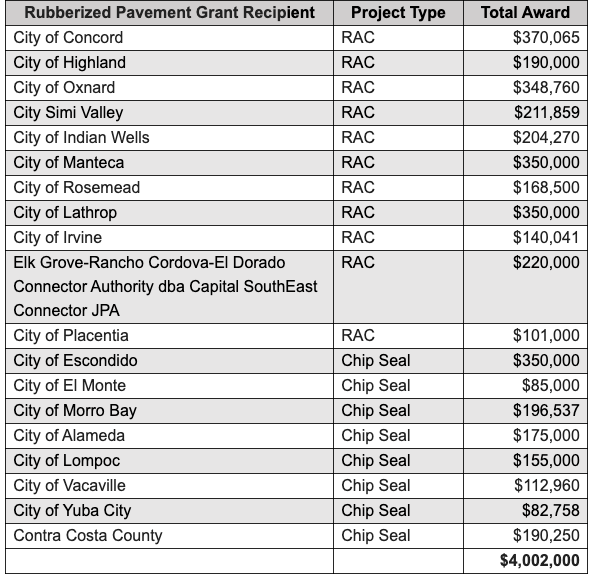
California communities can receive direct notifications about funding availability, applicant and project eligibility, and application due dates by joining CalRecycle’s Rubberized Pavement listserv.
Grants are funded through a portion of the $1.75 fee consumers pay on each new tire purchased in California. For more information about CalRecycle’s tire recycling and cleanup grants, including application criteria and maximum award amounts, see the department’s Tire Recycling, Cleanup, and Enforcement Grants webpage.
This press release was produced by the CalRecycle. The views expressed here are the author’s own.