Business & Tech
Allowing the Masses to Reach Out and Touch Someone
In 1985, the omnidirectional antenna was introduced, which was able to send signals out in all directions, though with limited coverage. It was, though, the genesis of a technology that continues to evolve.
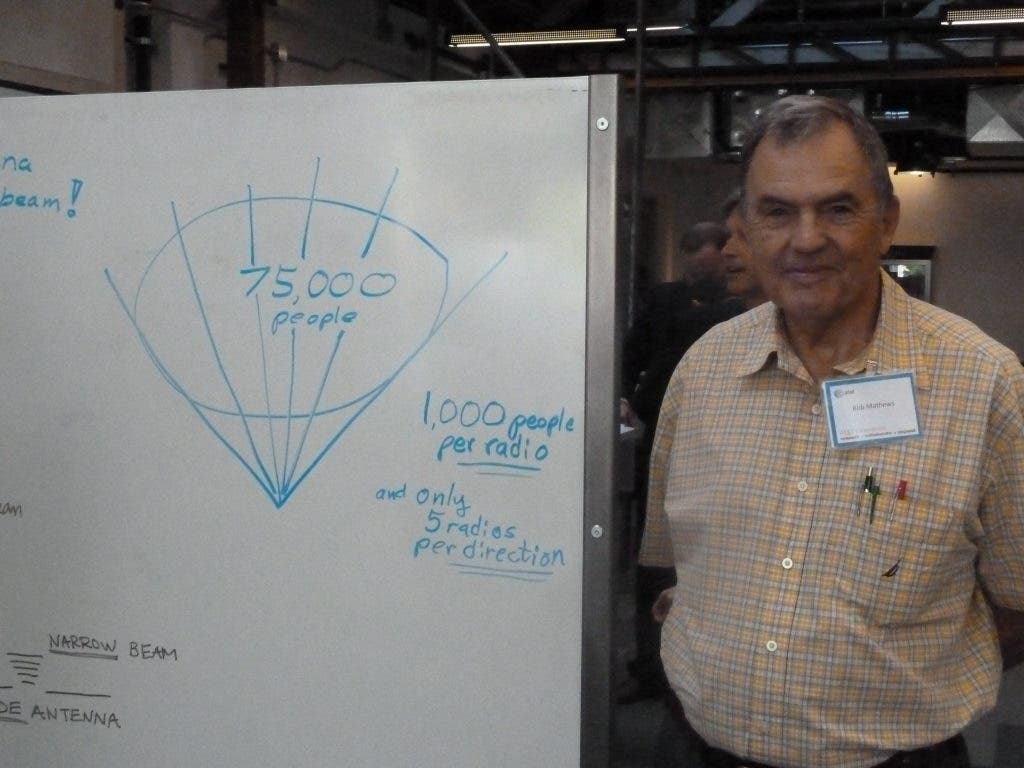
Bob Mathews has all the traits of that favorite neighbor down the street who can fix anything and gets excited talking about it.
The Radio Frequency Engineer at AT&T has been tinkering with things since working with a ham radio during his youth and he's still at it decades later.
Mathews and Gary Chow were experiencing the same problem at different sites. Once they put their minds together, it all became clear.
Mathews introduced Chow to the five-beam, multi-beam antenna, a smaller yet more effective tool than the single-beam antenna and the problem was solved.
Mathews and Chow are responsible for the vastly improved system that allows those in attendance at music festivals, or other big events, to sned and receive photos, tweets, texts and calls.
Instead of trying to use a wider beam to cover a small area, Mathews and Chow came up with the idea to narrow the beam and divide it into five distinct areas, with no overplay and no dead spots.
In 1985, the omnidirectional antenna was introduced, which was able to send signals out in all directions, though with limited coverage. It was, though, the genesis of a technology that continues to evolve.
Mathews, a PhD in physics (University of California), has evolved right along with it. He and Chow work on AT&T's Network Special Events Team, which is tasked with the challenge of finding solutions for a large number of customers using mobile devices within a small area, like a football stadium or a concert hall.
Mathews and Chow were on hand at the AT&T Innovation Day last week in Palo Alto to explain their system.
"People are using 20 times as much data as they were four years ago," Mathews said. "We support what customers want and that is increased data consumption."
Mathews helped put together a system that would cover the Los Angeles Coliseum recently, and he only had a few days to solve the issue.
On the other hand, Vice President of AT&T’s Antenna Solutions Group Chad Townes has helped design the Distributed Antenna System for more permanent functions at places like AT&T Park, where he worked with Giants' Senior Vice President and Chief Information Officer Bill Schlough to put in a DAS in San Francisco's premiere sports venue.
A DAS network, housed in a special space all of its own, contains a multitude of antennas shaped to precisely match the areas of a building or venue where boosted service is needed.
"We can shape it to the stadium," Townes said. "We have separate antennas on every level and we can place access points where it is needed most, like where media sits."
The Giants run to the 2010 World Series Championship presented unique problems all its own as media representatives were scattered all over the stadium, and sometimes jammed into small rooms under the stands.
"Opening Day is typically your biggest day of the year," Schlough said. "2010 was the first year of the new DAS and opening day wasn't perfect, but we had time to solve the problems. When we got to September we were good to go and built for a much higher capacity.
"The World Series was like nothing we could have imagined," Schlough continued. "We were totally caught offguard. If they make to the World Series this year, I'm not nervous at all. We're ready. We have all the infrastructure ready to go."
There are, basically, 58 mini cell towers that cover AT&T Park and most of them go unnoticed by the public.
Townes also oversees the DAS at Stanford Stadium, which has its own set of problems due to the limitations of access points.
"It's all physics," Townes said.