Community Corner
Military Kids Day - Purple Up on April 15
April is Military Child month - show your appreciation for military families and children in particular by wearing purple this Friday.

April is Military Child month, and the San Mateo County of Veterans Services is encouraging everyone to wear purple on Friday to show their support and gratitude for the sacrifices and strength that military families, and in particular, children, make when a parent volunteers to protect and defend all Americans. The premise of Purple Up day is based on the symbolic meaning of the color in the military world. Purple represents the concept of “unit” or of “all branches” of service. If you “mix” the blue of the Air Force and Navy, green of the Army, and red of the Marine you get purple — a color associated with spirituality, service, commitment to a higher purpose, truth, knowledge, self-respect, dignity, and integrity.
A recent report by the Veterans Administration indicates that the number of deaths from the coronavirus has now surpassed the total number of deaths from the Iraq and Afghanistan wars, with males aged over 50 years accounting for 64 percent of all death. To put it simply, in excess of 11,000 veterans have died from COVID-19. The grim milestone is further underscored by the 240,000 plus veterans infected with COVID-19 to date. Consequently, this year’s Purple Up day is more important than most.
Failure to Recover
Thankfully, the Department of Defense (DoD) reports that about 90-95 percent of veterans have “recovered” from COVID-19, a statistic that we should all undoubtedly celebrate. However, even in light of the high recovery rate, a significant number of veterans fail to recover from COVID-19. The initial viral infection recovery period set by the Centers for Disease Control (CDC) was two weeks, in line with other viral infections. However, COVID’s sizeable viral load, accompanying autoimmune response, and the multiorgan impact resulted in the “normal” recovery period being extended to twelve weeks.
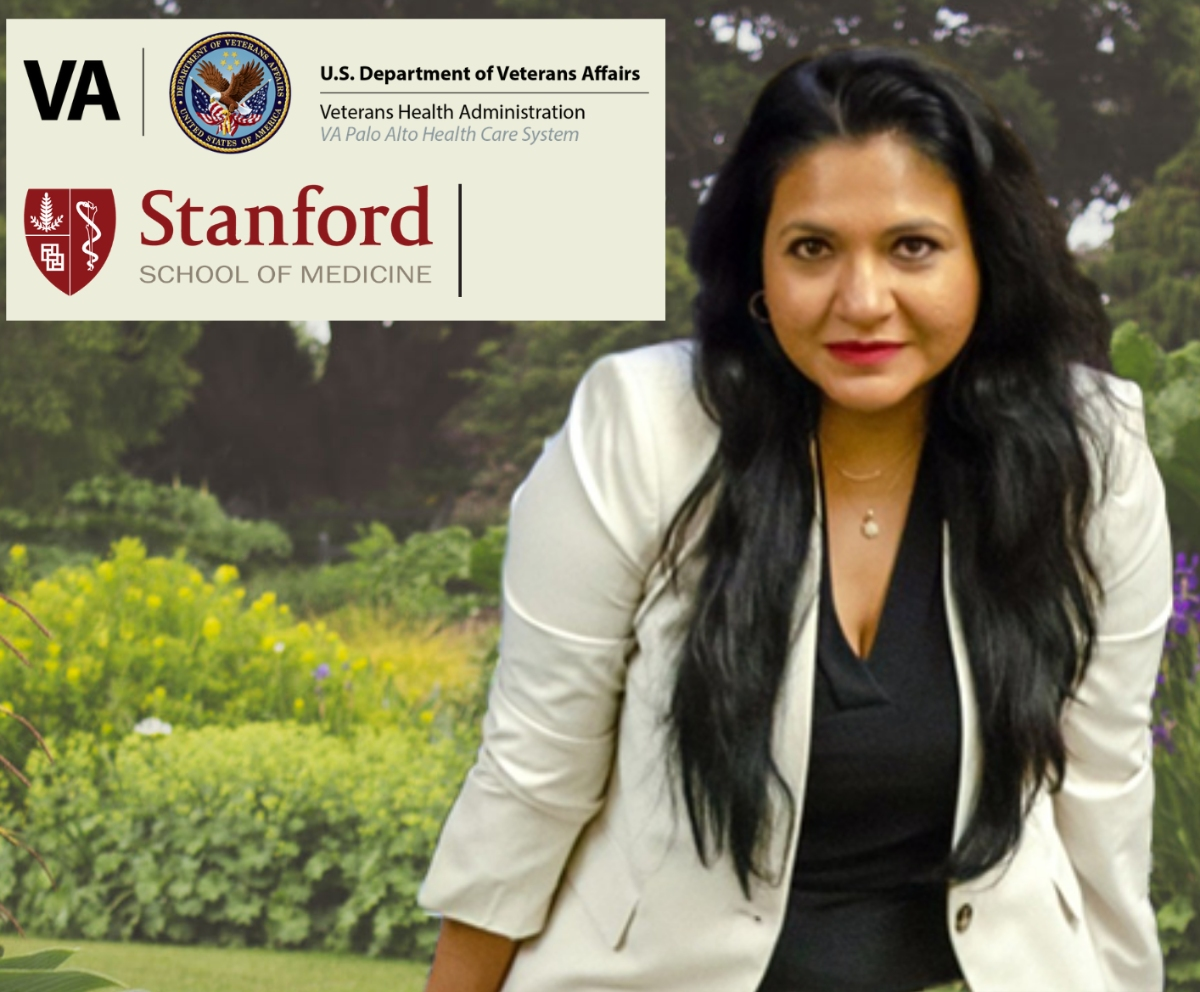
Maheen Mausoof Adamson, Ph.D. is a clinical associate professor (affiliated) of Neurosurgery at Stanford School of Medicine and Clinical Research Director for Rehabilitation Services at VA Palo Alto, and part of a global team of researchers exploring the psychological, neurological and cognitive impact of COVID.
She said: “The sequelae of the SARS-Co-V2 virus remains an enigma. We simply don’t know why some infections result in severe, at times even fatal complications, while others are virtually asymptomatic. What seems clear is that a substantial number of patients go on to develop chronic and debilitating symptoms,”
Find out what's happening in Palo Altofor free with the latest updates from Patch.
Veterans and civilians who report chronic or long-term COVID symptoms such as tiredness, fatigue, aches and pains, headaches, “brain fog,” disrupted sleep; in time even anxiety and depression are being labeled as “long-haulers” or as having “long-COVID.”’
History Repeating
The lack of epidemiological data means the prevalence of long-COVID is uncertain. However, the cluster of symptoms associated with long-COVID is not without precedent. Thirty percent of veterans of the 1991 Gulf War reported a virtually identical cluster of symptoms. As Dr. Adamson explained: ”Indeed the persistent symptoms of long-COVID and Gulf-War syndrome are remarkably analogous and suggestive of a possible overlapping mechanism of action. However, long-COVID appears to be temporally coupled to a viral infection and Gulf-War syndrome to chemical or nerve agent exposure, which would suggest different causal pathways. What is clear is that patients are often unable to return to work or resume normal activities for several months or even years as symptom clusters wax and wane, appear and fade, and range in severity from mild to incapacitating resulting in significant societal and financial burden.”
Scientists continue to search for an underlying causal mechanism for both disorders in addition to developing novel treatments. Congress allocated $22 million in federal funds in 2020 alone to support research, and the NIH has earmarked $1.15 to support research into what is being collectively referred to as PASC (Post-Acute Sequelae of SARS-CoV-2 Infection) syndrome.
Readers struggling with symptoms similar to those of Gulf War illness or long-COVID will be glad to know that Adamson and her team are conducting a clinical trial on a medication-free treatment. Dr. Adamson said: “Chronic conditions such as Gulf War illness and traumatic brain injury (TBI) are inherently intractable. Patients experience significant reductions to their quality of life, due to persistent pain, headache, and cognitive impairment, and conventional pharmacological treatments are seldom effective. My team is conducting research on the suitability of an FDA-approved non-invasive treatment for depression and obsessive-compulsive disorder (OCD) known as repetitive transcranial magnetic stimulation (rTMS) for these very symptoms. Our preliminary results are very promising.”
The researchers are seeking study volunteers. Veterans and non-veterans are encouraged to visit the website adamsonlab.stanford.edu or contact the Research Coordinator Kaitlly Zhu at (650) 374-299 or Kaitlly.Zhu@va.gov.
Find out what's happening in Palo Altofor free with the latest updates from Patch.
Conclusion
COVID-19 has highlighted our need for science and scientific discovery. The prospect of scientists finally finding an effective treatment for Veterans with Gulf War illness and or others with similar symptoms such as long-COVID would be a poignant and appropriate way to mark the 30th anniversary of the Gulf War. For now, remember to wear purple on April 15th to celebrate the military child, we owe them a debt of gratitude.