Arts & Entertainment
New Guinea Sculpture Garden Hidden In Plain View
Artistic and cultural crossroads converge at the corner of Lomita Drive and Santa Teresa Street
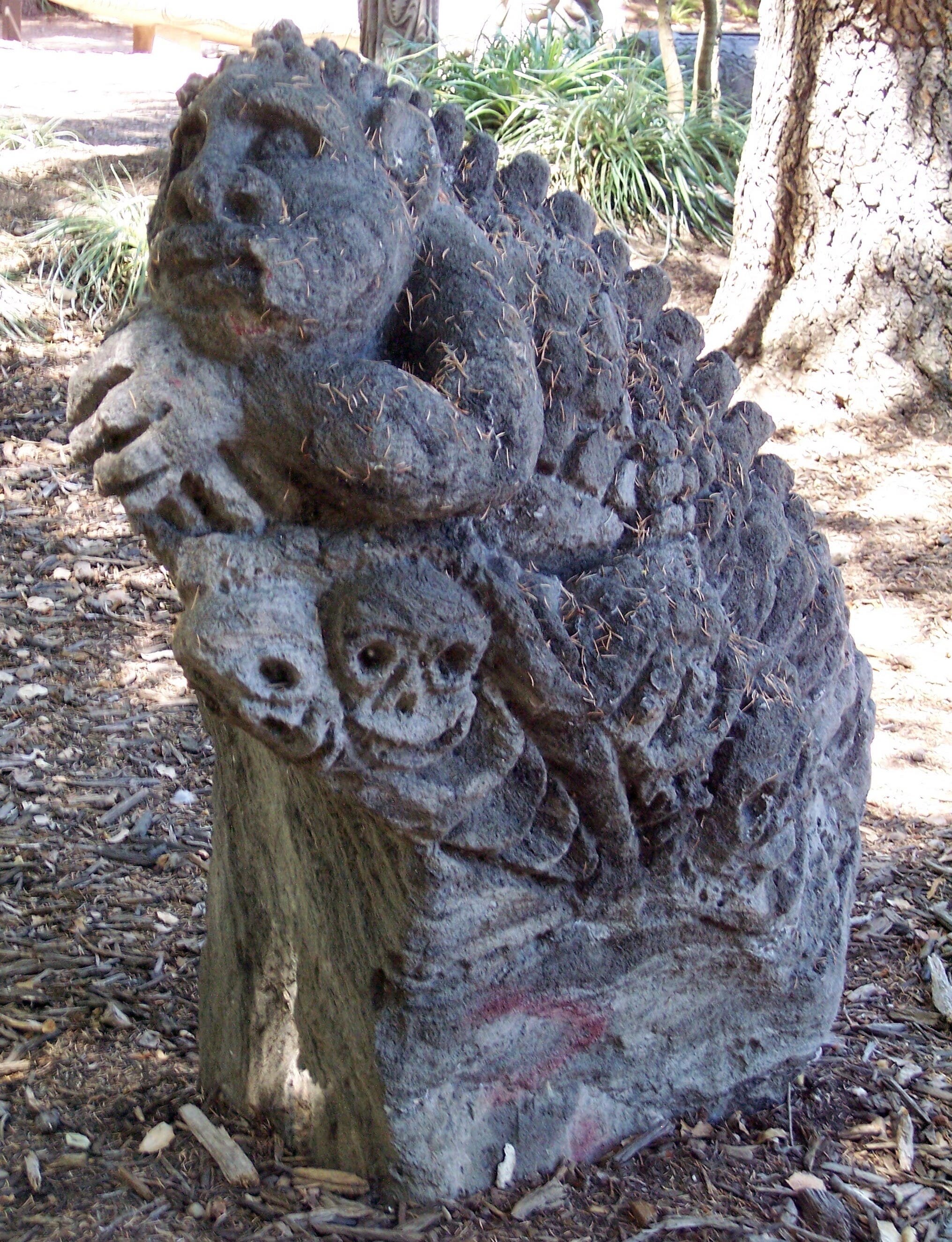


Numerous cars pass by it daily, pausing at the "Stop" sign on the corner of Lomita Drive and Santa Teresa Street, proceeding on without even glancing over and into the oak and cedar grove, dense with not just trees, but also chiseled stone creatures, flying wooden birds, elaborate totem polls, and other pieces that combine to create the New Guinea Sculpture Garden.
This particular patch of campus ground is much more than a picnic area with some artistic additions; it is an outdoor visual forum bringing together artistic schools and cultures. All of it born from the vision of an anthropology student with a desire to bring the artistic process to life. The student's name was Jim Mason and his creation is called the New Guinea Sculpture Garden.
In 1990, while conducting anthropological fieldwork in the Middle Sepik River region of Papua New Guinea, Mason was approached by two artists from the local Kwoma society whom, according to the project's official website, recently completed an installation at the Woyndabyne International Sculpture Garden in Australia. The Kwoma artists mentioned to the Stanford student that they wished to "organize similar venues for direct artistic production, interaction, and self-representation in other western countries."
Find out what's happening in Palo Altofor free with the latest updates from Patch.
Four years later, in May 1994, funding was secured and the "Visions of the Present" project was underway. At the time, Mason issued a statement on the project's website explaining that he saw the challenge of realizing the artist's vision as "an opportunity to experiment with and reinterpret New Guinea aesthetic perspectives within the new context of a Western public art space."
Under the guidance of project manager Mason, 10 artists (Naui Saunambui, Yati Latai, Membor Apokiom, David Kaipuk, Gutok Yantaka, David Yamanapi, Yarame Mambegawi, Simon Marmos, Joseph Kandirnbu, and Teddy Balangu) hailing from both the Kwoma and their neighboring society, the Iatmul were flown to California, taking up residence on campus in order to fully immerse themselves in the four month process.
Find out what's happening in Palo Altofor free with the latest updates from Patch.
In order to prepare their natural canvas, the men worked with New Guinea landscape architect Kora Korawali and American landscape architect Wallace Ruff to design the garden's landscaping and layout as well as create visitor information signage.
Although the garden's foliage-rich surroundings are reminiscent of the lush New Guinea landscape, the "Visions of the Present" project was not meant to simply recreate the artists' Southwest Pacific homeland. Rather, Mason said, he envisioned a fusion of the two cultures. It also gave the community the invaluable opportunity of interacting with the group of master carvers while they stayed on campus, witnessing the creative process from start to finish.
By day, in front of enthralled visitors, the carvers would work on creating ancestral figures, garamut slit gongs, large relief poles carved from trees brought from their home region, and other works – a total of 40 pieces. When night descended upon the project site, the men would put down their chisels, comfortable in their culture, and engage their audience in native New Guinea dance and song. The entire day a constant give and take of two communities from opposite ends of the world.
Mason noted that one of his main "Visions" objectives was to present the campus community with a group of men from the Sepik River region as highly skilled expert artisans, challenging the savage stereotype all too commonly affixed to native peoples. Brought together at the intersection of Lomita and Santa Teresa, the intent being to involve the public in the live process of an art exhibit being created before them on the familiar ground. This interaction between artist and audience also refuting the fallacy that legitimate art must be created solitarily in a studio then displayed within the confines of a gallery.
Mason would go on to participate in a larger scale version of this artist to audience interactive project, the cultural phenomenon known as Burning Man, described by its official website as "an annual art event and temporary community based on radical self expression and self-reliance in the Black Rock Desert of Nevada."
From the anatomically correct totem characters to the grinning, anthropomorphic alligator carving, the organic, "Origin of Man" aesthetic permeates the garden's collection of woodcarvings and stone sculptures. The style of its pieces proving that art is not a modern invention nor the result of an educated theory. Unlike learned skills such as language and mathematics, artistic abilities are innate to human intelligence, complex thoughts naturally occurring even before man knew it could think.
Further exploring the idea of "primitive" versus professional was project artist Teddy Balangu who, upon being shown photos of neighboring campus art attraction, Rodin's "The Thinker", stated, "This is nothing. We can do better than than," and proceeded to carve a wooden version of the famous bronze sculpture.
The interaction of the carvers and the community as well as the meshing of past and modern artistic styles was exactly what Jim Mason had envisioned for his project. By bringing the artists to live on campus during the process, he introduced the concept of not performance art but "real time" art, where the viewer sees the entire creative process and the creators as one.
The physical presence of the hands-on master New Guinea craftsmen and their captive audience may be gone but the spirit born during the four month creative process lives on in the tree shaded artistic oasis.
"I actually stumbled across [the sculpture garden] when I was searching for a quiet place to study," said second year undergraduate student Xavier Asher. "I take every chance I can to swing by, even if it's just taking a short cut through here when I'm biking to class."
Asher noted that he sees something new in the garden every time he visits, appreciating not just the tranquility the lush grove offers, but also its ability to constantly reveal further layers of meaning.
Vermont residents Laura and Ray Watson discovered the New Guinea Sculpture Garden while touring campus with their son, Wyatt, an incoming freshman.
"At first, you think it's just a plot of trees, but once you find yourself under the canopy of leaves, surrounded by the bold pieces, you become lost, immersed," said Ray Watson. "I told my son to remember this place whenever he gets overwhelmed with studying or annoyed with his roommate."
The New Guinea Sculpture Garden is located at the corner Santa Teresa and Lomita Drive. It is always open to visitors. The Cantor Arts Center provides free, guided tours on the third Sunday of the month. Contact the center for more information at (650) 721-6585.