Schools
The Debate Over Project Safety Net (Part One of Two)
The Palo Alto Unified School District has been at odds with members of the community over whether enough progress has been made toward implementing Project Safety Net, meant to prevent teen suicides and promote the mental health of local students.




When Patrick Grogan and his family were preparing to move from the East Coast to the Bay Area around four years ago, they spent much time researching the best neighborhood to move into, with the best schools for their two children.
After much thought, they chose Palo Alto for their new home.
“The single biggest factor in choosing Palo Alto for our residence was the quality of the public education system,” Grogan said.
Find out what's happening in Palo Altofor free with the latest updates from Patch.
However, Grogan said he and his wife began to question that decision as their son moved up in grades.
“Our kids were young and had a wonderful time at , and quite frankly, we complimented ourselves on our great decision until last year,” he explained. “As our elder son moved to Jordan last year, the ‘Pleasantville’ experience began to crack. From a caring, supportive learning environment at Walter Hays, he was catapulted in one short summer to an environment energized by the elitism of academic stress, as the principal so clearly articulated to us at a parent meeting. [We were told], ‘we all know that [Jordan] is the 'high school' that feeds the 'junior college' at Paly.’”
Find out what's happening in Palo Altofor free with the latest updates from Patch.
Grogan is not alone in his worries about the amount of academic pressure placed upon today’s students. It seems one cannot go a single day in Palo Alto without hearing the phrase “student stress.” It would be an understatement to say it is at the forefront of many parents’ minds in the local community.
Some say student stress is an epidemic—one that needs a cure, right away. That's where Project Safety Net (PSN), formed in response to the cluster of five teen suicides that took place between May 2009 and January 2010 in Palo Alto, comes in.
Recently, there has been a lot of buzz over a specific area of the PSN plan, called “P-8,” or the “Supportive School Environment” initiative. Specifically, “P-8” makes recommendations for changes local schools can make to help reduce student stress, which many feel will help prevent future suicides.
Some members of the community are upset and say that the Palo Alto Unified School District (PAUSD) has not done enough to implement the recommendations of “P-8,” and to help reduce student stress. Some of the most vocal members of this opinion belong to an independent local group, called “We Can Do Better, Palo Alto (WCDBPA).” The roughly 75 active members include parents, students and former students of the district's schools, and other concerned community members. The group holds monthly meetings and discussions in town. Most recently, it met at the Cubberley Community Center on May 17 to discuss homework loads and other potential causes of student stress. The group has a mailing list of more than 200 community members.
“We are concerned about rising rates of depression and anxiety among our student population,” the group’s website states. “Many of us have had that concern for many years as the result of our experiences, or those of our friends, with PAUSD. Others of us came to that concern as a result of the highly publicized suicide cluster afflicting our community in 2009-11.”
Grogan said he decided to join WCDBPA because he felt the social and emotional well-being of local students has too long been forsaken in favor of top academic performance.
“Based on my personal experience and the publicly available body of evidence, I am advocating, as is ‘We Can Do Better, Palo Alto,’ for a return to consciousness about the social and emotional well-being of our children, and for the opportunity for all children to thrive and learn in the Palo Alto school system.”
WCDBPA is headed by the husband and wife team of Michele and Ken Dauber, who are all too familiar with the tragedy of teen suicide—their daughter, Amanda, a 2006 graduate of the Rhode Island School of Design, died by suicide in 2008. Michele is a law professor at Stanford, and Ken is an engineer for Google.
WCDBPA cites its two biggest goals as advocating for district staff to make more progress toward implementing “P-8,” and .
The Project Safety Net Plan
Between May of 2009 and January of 2010, five students, who were all connected to , died by suicide at or near a local railroad crossing. Then, in January of this year, a sixth suicide took place—this time, it was a senior, and the tragedy took place at the student’s home.
The mission of PSN is to develop and implement an effective, comprehensive, community-based mental health plan for the overall well-being of youth in Palo Alto. The plan includes education, prevention and intervention strategies that, together, provide a “safety net” for youth and teens in Palo Alto, and defines the community’s teen suicide prevention efforts.
The “P-8” section of the PSN plan makes recommendations for changes schools can make to reduce academic stress.
One such recommendation was to switch first-semester finals to before winter break, allowing for a more relaxing, work-free vacation. That change . Other recommendations include giving students less tests, and block scheduling to reduce the chances of “test stacking,” or students having too many assignments due or tests scheduled on the same day, among others.
Amy Drolette, co-chairwoman of PSN and the coordinator of student services for PAUSD, presented an update on the Supportive School Environment initiative during the May 26 meeting of the PAUSD Board of Education.
Drolette listed many things that have been done in the district over the past several months.
PSN’s “Supportive Schools Update,” which is available for download on its website, states that Paly has recently approved a later start school start time, as well as a modified block schedule to help prevent “test stacking.”
Just announced Monday morning, Gunn High School will start a full 30 minutes later next year, at 8:25 a.m. instead of 7:55 a.m. Principal Katya Villalobos cited student health as the main reason for the change.
Drolette also listed several seminars that have taken place recently, to help educate parents and students about dealing with academic stress. Specifically, the district invited Denise Clark Pope of Stanford University and the organization Challenge Success to speak, first at JLS about how to redefine the definition of success, and second at Gunn to discuss peer academic stress and competition. Both talks took place in May.
Drolette also reported that “Student Gatekeeper Training” has been going well in the district. This is a peer counseling program that teaches students the method of “Question, Persuade, Refer,” to help identify and offer support for social and emotional distress issues in fellow students and to help prevent suicides. In addition, Drolette congratulated students from Gunn who are involved in the program—they were recently awarded Project Cornerstone’s “Peer to Peer” award for their work.
Asset-building is another area Drolette said the PSN executive committee is working hard on. Drolette said they are working with several groups, including the Palo Alto Council of Parent-Teacher Associations, on brainstorming ways to build more developmental assets in local youth.
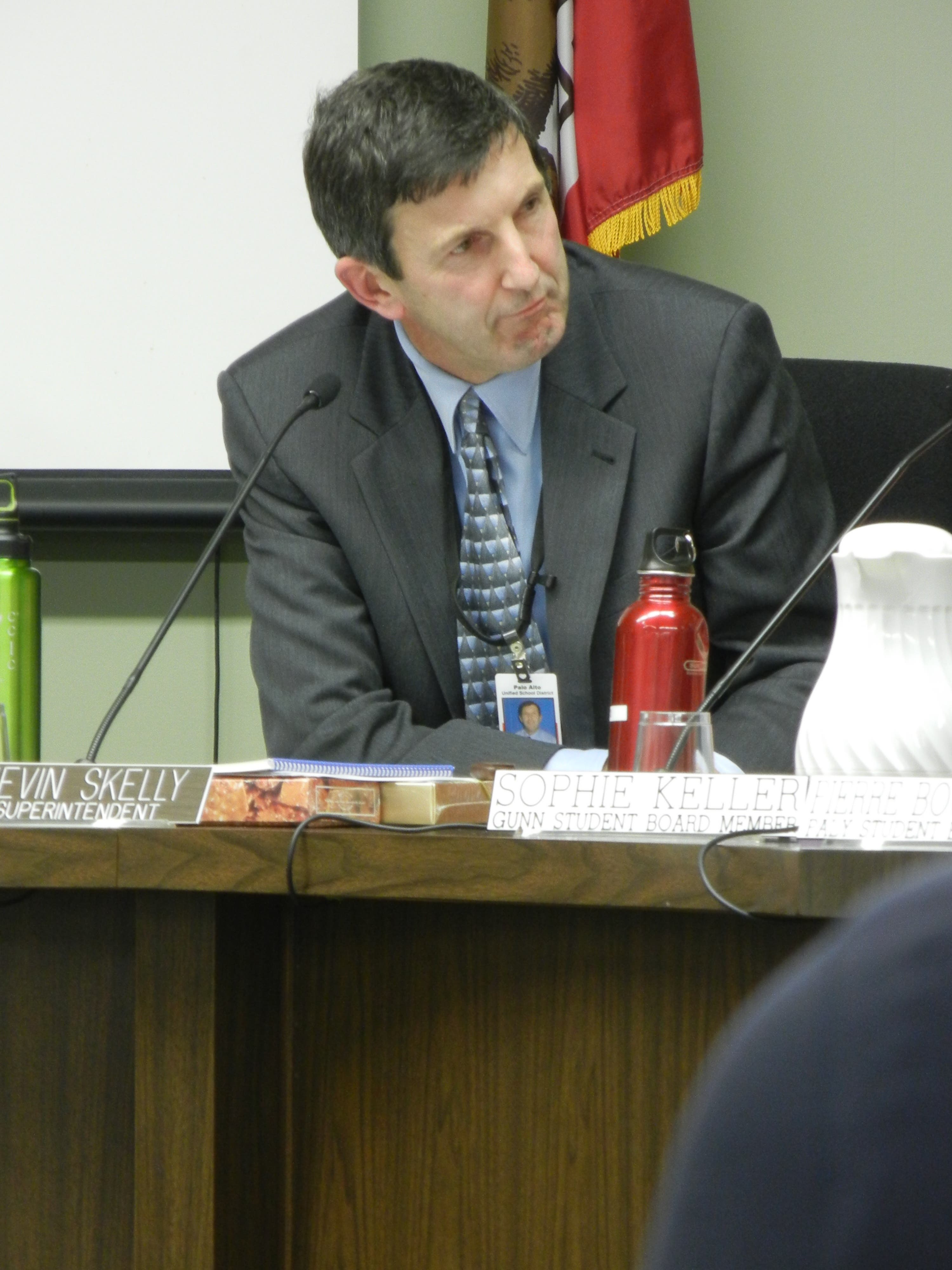
PAUSD Superintendent Kevin Skelly said he is very proud of all the hard work toward implementing PSN.
“I think we’re making good progress on this,” he said last week. “There will always be people who want you to do it more and quicker. I think our work is to try and understand the organization and have things done in a way that fits that organization. We have to work through those pieces. I’m proud of the work our high schools are doing, like the bell schedule at Paly—a lot of research went into that, and the start time at Gunn. So I’m really proud of the school and communities and what they’re doing with this.”
Has the school district made enough progress implementing the recommendations of Project Safety Net and attempting to reduce student stress? Be sure to read 'The Debate over Project Safety Net [Part Two of Two]'
Get more local news delivered straight to your inbox. Sign up for free Patch newsletters and alerts.