Community Corner
Petaluma: Failing to Accommodate a Better Parking Solution
An outdated perspective exacts an inappropriate toll on some who live in places with a modern approach to parking.

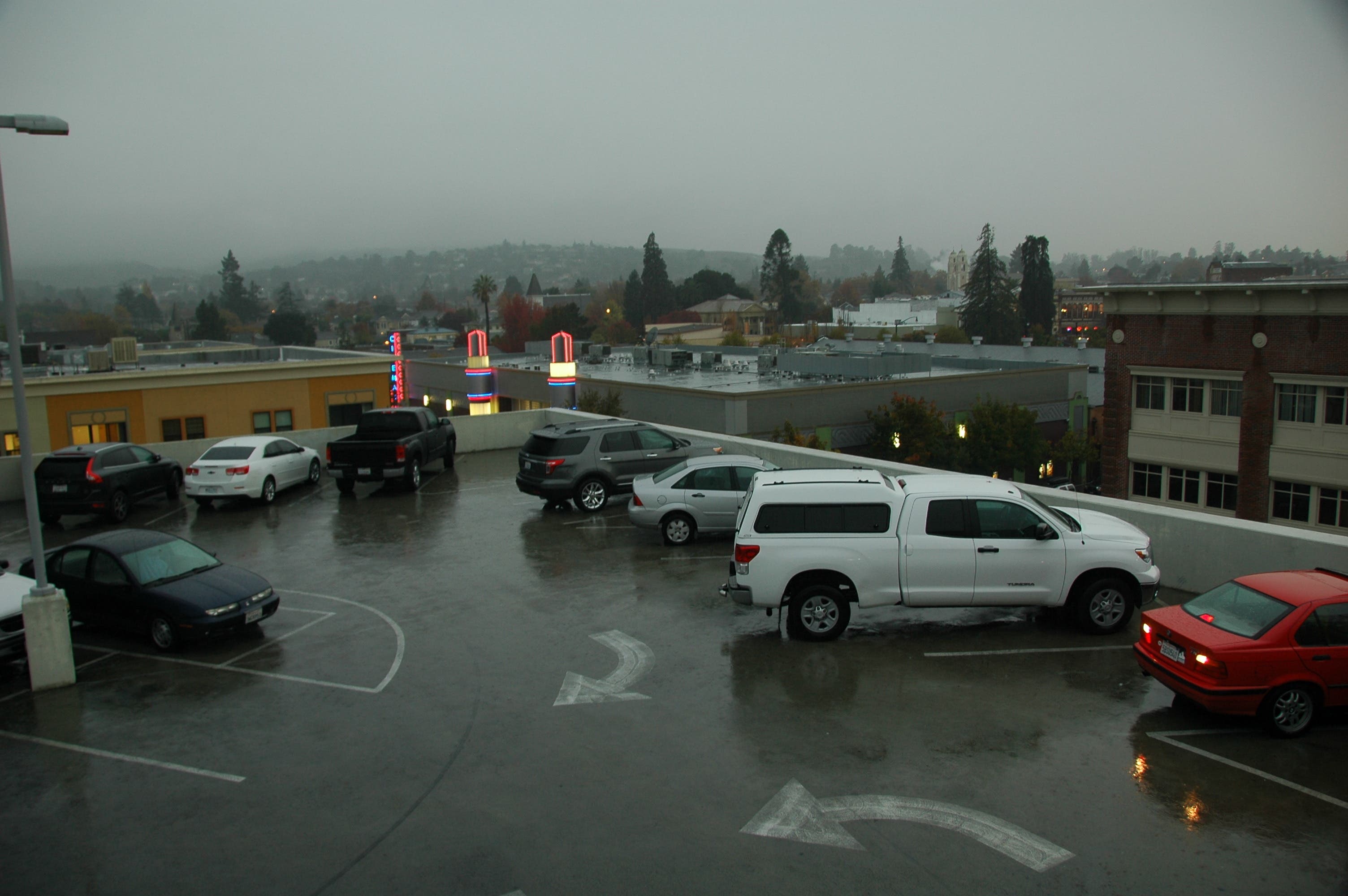
In my New Year’s resolutions for 2014, I committed to delving deeply into a pair of urbanist topics of personal interest, senior living and parking. It took me much of the year to get around to the senior living issue, but I finally tackled the subject in a number of posts in September and October. (This one and this one were the most popular of the senior living posts.) My coverage wasn’t complete, so it’s a subject to which I must return in future posts, but at least I gained a foothold.
I didn’t do as well on parking, which is a shame because it’s a subject that’s at least as important to urbanism as senior living. (I continue to be stunned when I ponder the sea change that occurred in the 20th century, when the concept that customers would only patronize a shop if a free holding space was provided for their 3,000 pounds of steel and plastic. As other observers have noted, the 20th century was the first time in history when we gave greater consideration to our machines than to our children.)
Nor will I be able to embark upon my consideration of parking during December as I already have a well-populated writing plan for the holiday season. But at least I know what resolution will be on the top of my 2015 list.
Find out what's happening in Petalumafor free with the latest updates from Patch.
However, I can offer a parking insight today that will help set the scene for my 2015 efforts.
A significant change that has begun to take hold in the world of parking is a decoupling between homes and parking. Twenty years ago, virtually any new home that one could buy would be bundled with a parking space or two. Both zoning codes and the market demanded it.
Find out what's happening in Petalumafor free with the latest updates from Patch.
But gradually the idea took root that some buyers no longer wanted the parking space and would prefer to purchase a home that didn’t include the cost of the parking space.
In rough numbers, a surface parking place has a cost of $5,000 to $10,000, which includes both the land cost and the pavement. For structured parking, the cost would be at least $20,000, with much higher number possible depending on the structure.
Including a $20,000 cost for a parking place, a similar cost for a car, and reasonable allowances for insurance, gasoline, maintenance, and parking when away from home, a homeowner could spend perhaps $300 per month on bus passes, ZipCars, Uber, and the occasional car rental and still come out ahead. It’s a trade-off that interests an increasing number of home-buyers.
So many recent buildings in urban settings include two types of parcels, individual living units and individual parking places. Buyers can decide how many parking places to include in their purchase, much like ordering sides for a meal.
It’s a very reasonable and appropriate solution to parking in modern cities. Except when reason falls apart.
In recent years, voter-approved parcel taxes have become a common approach to funding specific needs through increased property taxes. (Personally, I still favor ad valorem taxes and don’t understand the lean toward parcel taxes, but that’s not today’s topic.)
In 2008, San Francisco voters approved a $259 parcel tax for the San Francisco Unified School District. And the County Assessor began collecting the tax on residences and parking places. Someone who owned a home and a parking place in a multi-family building with a modern, leading-edge approach to parking paid for the privilege with a new tax that’s twice the amount charged to single-family home with a three-car garage.
It would seem to be fixable problem. And indeed San Francisco City College when faced with the same situation found a way to refund the second tax payment. But somehow the Unified School District thus far hasn’t gotten to the same solution, instead trying to pass the buck to the Assessor.
I don’t want to paint this situation as another form of anti-urban bias. It’s fairer to describe it as an unintended consequence at the confluence of property taxes and emerging urban thinking. Even if legislative action is required, I hope and expect that a remedy will soon be in place. But it illustrates the myriad unexpected challenges to be overcome in moving to a more urban world.
Urbanism is never easy.
Next time, I’ll write about the “urbanist” solution being proposed for the former site of Candlestick Park. The quotation marks should offer an insight to my thoughts.
As always, your questions or comments will be appreciated. Please comment below or email me. And thanks for reading. - Dave Alden (davealden53@comcast.net)
Recent columns:
Petaluma Urban Chat On: Sonoma Marin Fairgrounds Re-Use and Sorting Through the Options
In Petaluma The Futile Search for ‘Achievable Alternatives’: Defining the Problem
In Petaluma: Moving Forward After the Vote
Petaluma’s Measure Q: No Matter Who Designs It, the Sack Won’t Be Big Enough
In Petaluma: Increasing City Fees as a Symptom of a Flawed Land-Use Model
Petaluma’s Dave Alden: Not Every Expenditure Is an Investment, Even If It Involves Beer
Petaluma’s Dave Alden On: Balancing Vision with Incremental Steps
Petaluma Urban Chat: Rebooting the Fairgrounds Vision Effort
Dave Alden is a Registered Civil Engineer. A University of California graduate, he has worked on energy and land-use projects in California, Oregon, and Washington. He was also the president of a minor league baseball team for two seasons. He lives on the west side of Petaluma with his wife and three dogs. The blog that he writes can be found at Where Do We Go from Here. He can also be followed on Facebook, LinkedIn, Twitter, and VibrantBayArea.