Community Corner
New USGS Earthquake Forecast Says 'The Big One' Is More Likely Than Ever
Have you been creeped-out by the 'San Andreas' movie trailer? Wait until you hear the new USGS prediction.


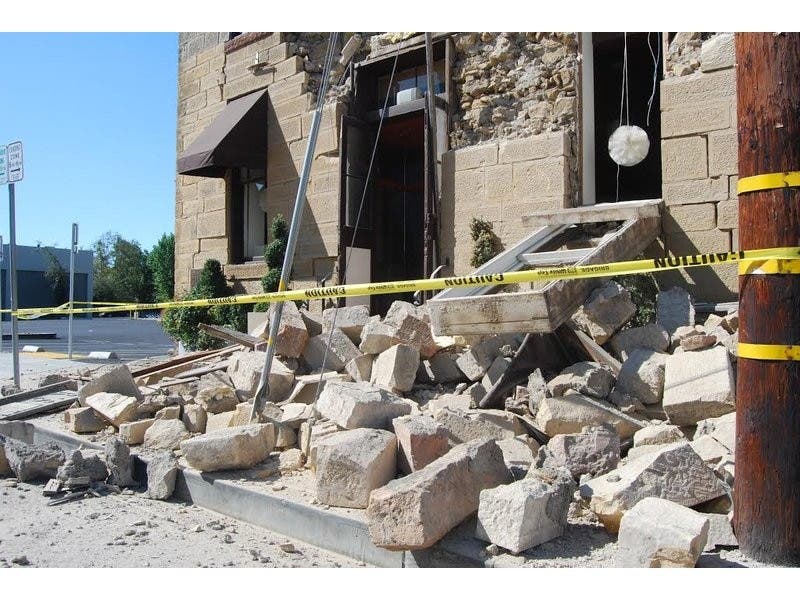
Photo: : A Napa building damaged in August quake. Credit: Al Francis.
--
The rate of magnitude-6.7 earthquakes expected to hit California in coming years was reduced in a new forecast released by the U.S. Geological Survey, however, the likelihood of a magnitude-8 or larger temblor striking in the next 30 years jumped from 4.7 percent to 7 percent.
Find out what's happening in Petalumafor free with the latest updates from Patch.
“The new likelihoods are due to the inclusion of possible multi-fault ruptures, where earthquakes are no longer confined to separate, individual faults, but can occasionally rupture multiple faults simultaneously,” according to USGS scientist Ned Field. “This is a significant advancement in terms of representing a broader range of earthquakes throughout California’s complex fault system.”
In 2008, the USGS estimated that quakes of about magnitude-6.7 -- the size of the 1994 Northridge quake -- were expected to hit the state once every 4.8 years. The latest report estimates one such quake every 6.3 years.
Find out what's happening in Petalumafor free with the latest updates from Patch.
The 2008 report found that the likelihood of a magnitude-8 or larger quake hitting in the next 30 years was 4.7 percent. The new report puts the likelihood at 7 percent.
“We are fortunate that seismic activity in California has been relatively low over the past century,” according to Tom Jordan, director of the Southern California Earthquake Center. “But we know that tectonic forces are continually tightening the springs of the San Andreas fault system, making big quakes inevitable.”
Are YOU Prepared?
Following the 6.0 magnitude earthquake that struck American Canyon, just miles from Napa, in August, the American Red Cross offered these tips to help all California residents prepare in the event of an earthquake.
- Become aware of fire evacuation and earthquake safety plans for all of the buildings you occupy regularly.
- Pick safe places in each room of your home, workplace and/or school. A safe place could be under a piece of furniture or against an interior wall away from windows, bookcases or tall furniture that could fall on you.
- Practice “drop, cover and hold on” in each safe place. If you do not have sturdy furniture to hold on to, sit on the floor next to an interior wall and cover your head and neck with your arms.
- Keep a flashlight and sturdy shoes by each person’s bed in case the earthquake strikes in the middle of the night.
- Make sure your home is securely anchored to its foundation.
- Bolt and brace water heaters and gas appliances to wall studs.
- Bolt bookcases, china cabinets and other tall furniture to wall studs.
- Hang heavy items, such as pictures and mirrors, away from beds, couches and anywhere people sleep or sit.
- Brace overhead light fixtures.
- Install strong latches or bolts on cabinets. Large or heavy items should be closest to the floor.
- Learn how to shut off the gas valves in your home and keep a wrench handy for that purpose.
- Learn about your area’s seismic building standards and land use codes before you begin new constructionKeep and maintain an emergency supplies kit in an easy-to-access location.
Find a full Earthquake Safety Checklist here.
Related stories:
- Napa Earthquake Survey Results Now Available
- Earthquake Hits Saturday Morning Near Gilroy, Morgan Hill
--City News Service contributed to this report.
Get more local news delivered straight to your inbox. Sign up for free Patch newsletters and alerts.