Business & Tech
Worms: The Way to a Zero Waste Future?
Two young entrepreneurs say their worm farm can reduce the need for landfills by returning food scraps back to the soil...in a matter of days.


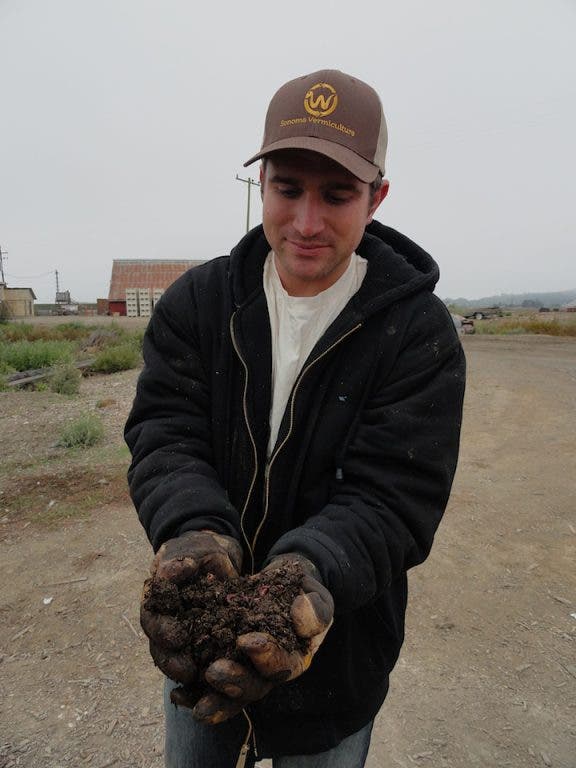


On the southernmost tip of Sonoma County, where the San Pablo Bay meets the Petaluma River, two young entrepreneurs have launched a company they say will revolutionize the way people look at waste.
With a background in finance and backing from venture capital, these confident young impresarios are banking not on technology, but something much more elemental: worms. About 6 million of them.
Launched last year, Sonoma Vermiculture is a worm farm that is already diverting 120 tons of food scraps a month from local landfills and compost bins and instead feeding them to worms, who turn it into soil in a matter of days. The worms’ excrement is then used as fertilizer on nearby Carneros Ranch, which grows grapes, olives, tomatoes and other produce.
“Only 2 percent of food waste is captured through composting, while the rest goes to landfills,” said Daniel Stitzel, the 27-year-old co-founder of Sonoma Vermiculture, who grew up in San Rafael and attended the University of Southern California. “We’re using a natural process to divert food from landfills and prevent global warming. We like to think that we’re helping solve the food waste problem.”
The issue with throwing food scraps into a landfill, says Stitzel, is that it generates methane, a dangerous gas that actually contributes to global warming. And unlike vegetative food waste composting, the worms diligently working in a barn off Highway 37, will chomp through waxy cardboard, wet paper, meat and cheese, maximizing how much food waste can be processed.
Before becoming a worm farmer/entrepreneur, Stitzel was the chief operating officer for Berg Holdings, which owns Port Sonoma and an analyst at a Los Angeles venture capital firm. His partner in the venture is Gabriel Torres, also 27 and a childhood friend who ran a mortgage company before placing his bet on worms.
Both men describe themselves as “accidental environmentalists” who began two years ago by attending a conference on organics recycling. They then teamed up with Norman Arancon, a professor of horticulture at the University of Hawaii and a pioneer in vermiculture, to provide the know-how to the operation. Today, Arancon is a partner in the venture.
Meanwhile, Stitzel and Torres have traded suits and ties for jeans and hiking boots and corporate digs for an RV parked across from Port Sonoma that functions as their office.
The men say there is already demand for their service as cities and counties work to reduce their waste and lessen their carbon imprint. For example, Phil Demery, the director of the Sonoma County Department of Transportation and Public Works has said he believes the county can become “zero waste” over the next 25 to 50 years by diverting all food waste from landfills.
"When I go around and talk to cities ... everyone wants to get into a food-waste composting system,” Demery told Patch in a separate interview this July.
With Sonoma County generating up to 70,000 tons of food waste annually, the future looks bright for the wormapreneuers.
“I feel like we can possibly change the world by changing the way people look at waste,” said Torres, sounding like a bright-eyed employee of a Silicon Valley startup. “Sometimes it’s kind of hard to sleep at night because I’m so excited about what we are doing.”
Local businesses are catching on and the farm already receives food scraps from 20 regional grocery stores and restaurants, including Oliver’s Market, G&G Market and . The waste is trucked in by North Bay Corporation, diverting what would otherwise be sent to landfills in Solano and Contra Costa counties.
Says Stitzel: “We’re showing the world that you can do something good for the environment and be profitable at the same time."
Get more local news delivered straight to your inbox. Sign up for free Patch newsletters and alerts.