Politics & Government
Is Bankruptcy in Hercules' Future?
Lawsuit, new state law pushes City's back to the wall.

If an escalating dispute between Hercules and the company guaranteeing payments on $117 million in redevelopment bonds cannot be resolved on terms favorable to the city, bankruptcy will certainly be an option for a municipality short on both money and time.
This was the bleak picture painted by interim city finance director David Baum last week in a regulatory filing (see document 1) notifying investors Hercules did not have enough cash to make some of its Feb. 1 bond payments and had to rely on insurance coverage to meet its obligation.
Baum’s disclosure, in a document filed with the Municipal Securities Rulemaking Board, a self-regulatory organization that makes rules regulating dealers of municipal securities, came on the heels of a lawsuit (doc. 2) filed in Contra Costa County Superior Court Jan. 30 by Ambac Assurance Corp., a municipal bond insurer that issued four policies guaranteeing principal and interest payments on two large non-housing redevelopment bond issues would always be made on time. Ambac paid $2.4 million last month after Hercules failed to deliver tax money needed for its February payments.
Find out what's happening in Pinole-Herculesfor free with the latest updates from Patch.
*** See Patch's Crisis in Hercules ***
Ambac claims the city illegally diverted funds belonging to bondholders and wants the money it paid out on the city’s behalf returned. It asked the court to immediately impound $4.1 million in December tax receipts and place the money in a trust fund or, as an alternative, attach municipal real estate assets. Court Commissioner Judith A. Sanders denied Ambac’s request, instead scheduling a hearing Feb 21.
Find out what's happening in Pinole-Herculesfor free with the latest updates from Patch.
Michael Fitzgerald, an Ambac spokesman in New York said the company had no comment on the litigation.
City officials admit keeping the money, saying their choices were limited: either pass the funds along or face the specter of bankruptcy.
Hercules City Manager Steve Duran underscored the city’s predicament in a sworn declaration (doc. 3) hurriedly filed as part of the city’s response (doc. 4) to Ambac, saying the decision to withhold tax receipts was the lesser of two evils, and suggesting Ambac itself had created the problem by taking a hard-line position during a month of closed-door discussions seeking an amicable solution.
If the funds demanded by Ambac became “…unavailable to the general fund, the city would be unable to make its next payroll or pay its other obligations, forcing the city to close down or file a bankruptcy case,” Duran said in his declaration.
In an interview with Patch Duran said the city is still $1 million away from a balanced budget and looking at more layoffs. “Nobody will miss the employees, but they’ll miss the services,” he said. “The RDA is done [and] there’s a mess to clean up with this bomb that was thrown at us. At this point there’s not enough money to pay debt.”
Duran said the city offered a number of potential solutions, all rejected by Ambac. Those included a lease-leaseback of property originally owned by the Redevelopment Agency – officially abolished Feb. 1 under a new state law – that was transferred to the city last year as repayment for millions in loans from the general fund.
The city even proposed a scheme permitting use of funds held in a restricted account set aside to repay an out-of-court settlement reached with Catellus Development Corp. almost five years ago when the developer sued, claiming it was owed millions in reimbursements for acquiring and rehabilitating the old Pacific Refinery property under a 2001 agreement.
City council members will huddle to plot their next move during closed session at a special council meeting Tuesday evening. Meanwhile the city says negotiations with Ambac are continuing.
Ambac’s legal action and the city’s subsequent disclosure, produced a quick reaction from Standard & Poors, one of the nation’s leading municipal credit rating agencies. On Thursday S&P lowered its ratings on all three of the city’s redevelopment bond issues. The agency dropped its rating (attachment 5) on $25.9 million in housing bonds sold in 2007 from the highest level of non-investment grade securities (BBB-) to the lowest (B).
At the same time S&P downgraded (doc. 6) the non-housing bonds insured by Ambac -- $56.3 million sold in 2005 and $60.5 million sold in 2007 -- from CCC to CC, the bottom of the junk bond heap. S&P analysts justified the action, saying they believed tax revenues earmarked for repaying the bonds would be insufficient to meet the semi-annual debt payments and the remaining reserves under Ambac’s surety bonds could be exhausted over the next two years. Ironically Ambac’s own bonds are rated junk. Its parent company, Ambac Financial Group Inc., is currently in Chapter 11 bankruptcy.
Perfect Storm Engulfs City
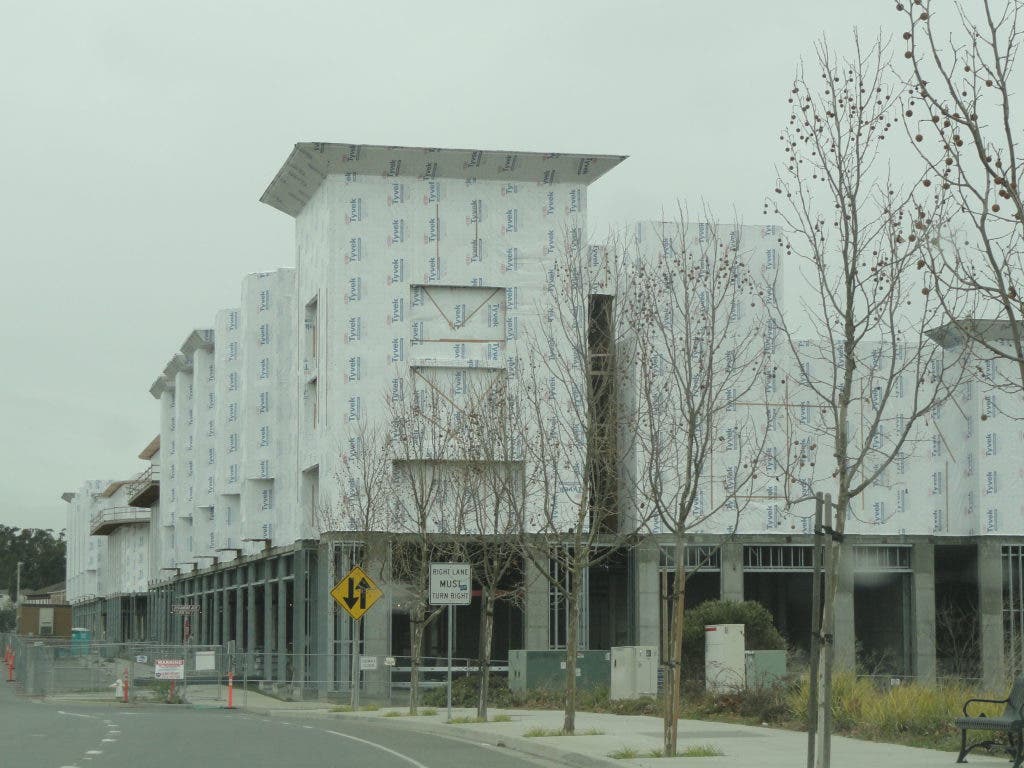
Hercules’ dilemma is the perfect storm of money and politics. It’s a classic example of the risks involved in robbing Peter to pay Paul, a practice sometimes utilized by cities in times of economic downturn and dwindling municipal revenues. For Hercules the situation is particularly devastating because of the approach to redevelopment taken by former city manager Nelson Oliva, who embarked on a borrowing binge to pay for implementing his own vision and interpretation of the community's original concept for an urbanist modern commuter Mecca. Today Oliva's scenario is an uncompleted shrink-wrapped structure towering over vacant downtown land.
But in 2005 when Hercules redevelopment began in earnest, borrowing money in the municipal bond market was easy. Property values were soaring and investors believed loans backed by tax collections were a good bet, especially redevelopment bonds, because new construction would generate increasing tax increment revenues to repay the debt.
When land is placed in a redevelopment zone, property taxes are frozen at a base level, and future additional tax revenues derived from new development -- the so-called “tax increment” – are used in part for repaying money borrowed to finance that development.
What then-city officials failed to recognize when they sold $142.7 million in housing and non-housing tax allocation bonds in 2007 were subtle, telltale signs of erosion in an overheated real estate market that ultimately collapsed a few months later and has yet to recover. Almost overnight millions in potential tax increment revenue evaporated leaving a new Hercules city administration to wrestle with a problem not of its making: How to repay the inherited tax allocation bond debt now totaling $227 million, including interest, over the next 30 years. Hercules tax increment receipts have fallen steadily, from a peak of $13.1 million in 2008 to $9.3 million this year.
Faced with the sudden loss of this anticipated windfall, Oliva began using inter-fund transfers and loans in an attempt to make ends meet – something akin to an individual taking a cash advance on one credit card to make the monthly payment on another. By the time he left office in early 2011, Oliva had maxed out the municipal credit line and the resulting downgrades in bond ratings will make it difficult, if not impossible, for the city to borrow more money.
According to the MSRB disclosure, shortfalls between available tax revenues and required debt service payments on the redevelopment bonds began in 2008 and have continued since then. To compensate for this shortage of tax increment money, Hercules began dipping into its Pooled Investment Fund, a piggy bank of cash containing 48 separate accounts, with 33 of those legally restricted to specific uses such Measure “C” street funds, the Retired Police Medical Fund and the Hercules Community Library Foundation Fund. The remaining 15 accounts, including the General Fund and various RDA funds, are unrestricted.
For the past four years, when semi-annual bond payments came due in February and August, if the city didn’t have enough RDA money available it would simply “borrow” from other accounts – whether they were legally restricted or not -- repaying the “loans” when he county distributed property tax collections every December and April. As long as the money moved back and forth during the same fiscal year Hercules’ books would always balance.
Confrontation Unavoidable
What set the stage for the Ambac confrontation was the city’s use of $4.1 million in December tax increment revenues to repay advances from its pooled investment funds to make payments last August. According to the MSRB disclosure, the diversion of these funds left the city with insufficient money to cover its full February obligations, forcing Ambac to make up the shortage. Ambac claims December tax receipts were illegally used for other expenses and part of the money should be handed over to the insurance company to reimburse its February payout.
Further exacerbating the city’s plight are circumstances impossible to have foreseen: State legislation (doc. 7) last year abolishing California’s 425 active and 15 inactive redevelopment agencies Feb. 1 -- and the December state Supreme Court decision (doc. 8) upholding the new law. Among other things, the law requires cities and counties operating RDAs to designate successor agencies to managing and repay existing long-term debt and other obligations. Further, it requires that future tax increment revenues be placed in trust funds administered by the county controller who will distribute the money solely for debt repayment.
The city has designated itself (doc. 9) as the successor agency, but will no longer control tax increment revenues, putting an end to the semi-annual shuffle of pooled investment funds.
In practical terms, the new law abruptly ends the flow of property tax dollars for funding redevelopment projects, delivering a potentially catastrophic blow to Hercules -- which has several downtown revitalization projects planned or underway and will no longer have money to complete them.
However, Hercules is still on the hook for the outstanding debts incurred by its RDA – something called “enforceable obligations” – that must be repaid according to a city-specific plan that must be reviewed by the state Department of Finance. An accounting of Hercules’ obligations (doc. 10) presented to the city council last August showed RDA debts, not including interest beyond this year, totaled $328.2 million.
“There won’t be any more cash flow,” said Duran. “There will be no more projects.”
Get more local news delivered straight to your inbox. Sign up for free Patch newsletters and alerts.