
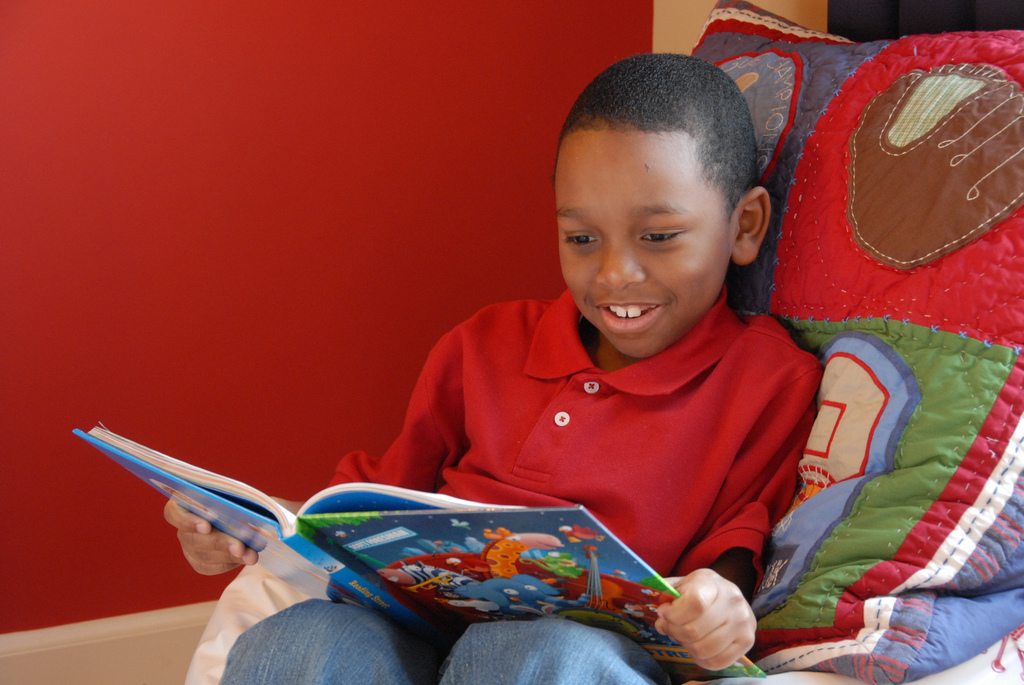
As summer begins, I am reminded of my grandfather. He loved to read. I remember sitting with him in his backyard as he took a sunbath, reading and smoking his pipe. He would pause and talk about something he read and sometimes he would laugh out loud and share what tickled him. The joy that reading gave him made an impression on me. Because of him, I have always seen reading as a pleasurable indulgence.
As an educator, this leads me to wonder how we transfer passion for reading to our children and students. With the plethora of entertainment options available to our children, how do we encourage them to opt for reading? Do children today approach reading like a curmudgeon or with childlike wonder?
Following the example of someone you love and trust is the best way to learn. As parents and teachers, we have the opportunity to encourage the joy of reading. Do you share with your children the wondrous lives of characters you have known in your favorite books? Talking about great books and how you were able to imagine living in that time and empathize with the character is a fun way to pass the time while driving or during a meal. I also relish seeing movies about books I have read and discussing how scenes were omitted, added or changed. I always have a mental picture of the characters and I delight in comparing the character in my minds-eye with the character on the screen.
Find out what's happening in Pinole-Herculesfor free with the latest updates from Patch.
Children and adults need to read what they want to read. A great way to tap into a child’s interest is with non-fiction books. What hobbies, activities or careers are exciting to your child? I was a huge sports fan in elementary school. My parents recognized this and bought lots of books about baseball and football players. I read some of them several times and enjoyed memorizing statistics. As I think back on these sports books, they were more than just list of facts to download. They included ideas about achieving success despite hardships and challenges. I would wrestle with these challenges along with the athletes and ultimately form opinions and attitudes. What remains of that reading today is not a mind loaded with statistics, but rather opinions with facts to support them, a work ethic as described by successful athletes, and a positive mental attitude that has elements of the ideas I read about as a youngster.
As I reflect on why I read habitually, I find that it is partially because reading is entertaining, and also because it is a great way to find facts and statistics to memorize. As an educator, I need to read to keep current on education trends and management practices. However, in my experience, reading is ultimately not about entertainment or memorizing facts. It is about understanding the ideas, arguments and actions of others. It is about thinking about what I read and weighing the soundness of what is written and its veracity. Ultimately, I love reading because reading is about thinking.
Find out what's happening in Pinole-Herculesfor free with the latest updates from Patch.
To help spread the joy of reading, Connections Academy has compiled suggestions* on great books for different grade levels:
K-2
- Brown Bear, Brown Bear, What Do You See? – Bill Martin, Jr.
- The Giving Tree – Shel Silverstein
- Alexander and the Terrible, Horrible, No Good, Very Bad Day – Judith Viorst
- Chrysanthemum – Kevin Henkes
- Hello, Baby Beluga- Darrin Lunde
- Lou Gehrig: The Luckiest Man – David Adler
- Goodnight Moon – Margaret Wise Brown
- Chicka-Chicka-Boom-Boom – Bill Martin, Jr.
- The Littles (series) – John Peterson
- The Ugly Duckling – Hans Christian Anderson and Jerry Pinkney
- Patrick in a Teddy Bear's Picnic and Other Stories – Geoffrey Hayes
3-5
- Maniac Magee – Jerry Spinelli
- The Great Gilly Hopkins – Katherine Paterson
- The Secret Garden – Frances Hodgson Burnett
- Old Yeller – Fred Gipson
- The Nancy Drew Series – Carolyn G. Keene
- Charlie and the Chocolate Factory – Roald Dahl
- The Indian in the Cupboard – Lynne Reid Banks
- The BFG – Roald Dahl
- The Wind in the Willows – Kenneth Grahame
- The Lion, the Witch and the Wardrobe – C.S. Lewis
- Charlotte’s Web – E.B. White
- Just So Stories – Rudyard Kipling
- Boxcar Children – Gertrude Chandler Warner
- Space Garbage – Isaac Asimov
- The Dog That Pitched A No Hitter – Matt Christopher
- The Truth About Great White Sharks – Mary M. Cerullo
- The Story of Baseball – Lawrence Ritter
6-8
- Little Women – Louise May Alcott
- The Little Prince – Antoine De Saint-Exupery
- The Cat Ate My Gymsuit – Paula Danziger
- The True Confessions of Charlotte Doyle – Avi
- The Adventures of Sherlock Holmes – Arthur Conan Doyle
- The Chocolate War – Robert Cormier
- The Princess Bride – William Goldman
- Holes – Louis Sachar
- Hatchet – Gary Paulsen
- Bridge to Terabithia – Katherine Paterson
- Dandelion Wine – Ray Bradbury
- The Hobbit – J.R.R. Tolkien
- Tuck Everlasting – Natalie Babbitt
- The Secret of NIMH – Robert C. O’Brien
- The Witch of Blackbird Pond – Elizabeth George Speare
- The Midwife’s Apprentice – Karen Cushman
- A Boy Called Slow: The True Story of Sitting Bull – Joseph Bruchac
9-12
- Emma – Jane Austen
- For Whom the Bell Tolls – Ernest Hemingway
- Of Mice and Men – John Steinbeck
- Life of Pi – Yann Martel
- Moby Dick –Herman Melville
- Gulliver’s Travels – Jonathan Swift
- Wuthering Heights – Emily Bronte
- The Adventures of Tom Sawyer – Mark Twain
- The Jungle – Upton Sinclair
- Flowers for Algernon – Daniel Keyes
- A Prayer for Owen Meany – John Irving
- The Alchemist – Paulo Cohelo
- Don Quixote – Miguel de Cervantes
- The Three Musketeers – Alexandre Dumas
- A Tale of Two Cities – Charles Dickens
- Les Miserables – Victor Hugo
For a more complete list of suggested summer reading for grades K-12, visit Connections Academy’s blog. Do you have any other great books to recommend? Please share with us in the comments below.
*Compiled from several sources including the American Library Association, the International Reading Association, and state reading lists, when available. The books on this list are not required reading nor is this intended to be an all-inclusive list. As always, parents and teachers are encouraged to review the selections to ensure the appropriateness for individual students.