Neighbor News
May is Lyme Disease Awareness Month--What your Vector Control District doing to Help
Lyme disease is the most reported vector-borne disease in the United States.

Alameda County Vector Control Services District is a countywide service area within Department of Environmental Health. One of our responsibilities is to conduct vector surveillance and prevent the spread of the vector-borne diseases in Alameda County.
Since 2009, our tick-surveillance program at ACVCSD has teamed up with UC Berkeley’s, renowned Professor Emeritus, Robert Lane’s research team in the Department of Environmental Science, Policy & Management to study ticks and the pathogens they carry in Alameda County. This collaborative effort resulted in the remarkable discovery within highly populated and ecologically diverse Alameda County, of seven different Borrelia spirochetes (spiral-shaped bacteria) among ticks surveyed from 71 sites and an 8th Borrelia species in a roof rat.
Most of us are familiar with ticks and the most reported vector-borne disease in the United States—Lyme disease. In 2013, there were 30,552 Lyme disease cases reported nationwide to the Centers for Disease Control (CDC) and in California, the Department of Public Health confirmed 97 Lyme disease cases. According to the CDC, from 1992 to 2011, there were 2,082 confirmed Lyme disease cases reported from California, and 67 of those were from Alameda County.
Find out what's happening in Pleasantonfor free with the latest updates from Patch.
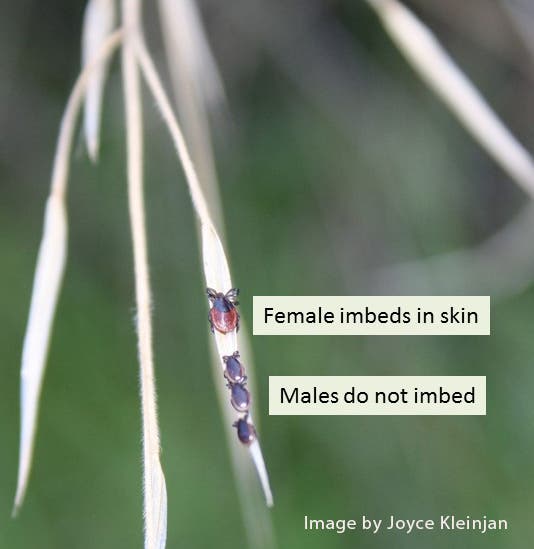
The carrier (vector) of Lyme disease in California is the notorious Western Black-legged tick (WBLT), a vicious human-biter present in virtually every county. The bacterium causing Lyme disease is Borrelia burgdorferi. Adult WBLT’s were collected from 89% of the 71 sites surveyed throughout Alameda County, whereas the poppy seed-sized and more infective nymphal stage ticks were collected from 61% of the sites.
In total, nearly 6,000 ticks were collected and tested between 2009 and 2012—a very large sample size that far exceeds the numbers tested in most other tick studies. In addition, tissue samples were taken from 101 small animals. The infection rates with Borrelia spirochetes averaging 0.9% for the adult ticks and 6.5% for the more infective nymphs. However, in a few “hot spots”, the nymphal ticks’ infection rate of Lyme bacteria exceeded 20%.
Find out what's happening in Pleasantonfor free with the latest updates from Patch.
Eight different Lyme disease-like spirochete species were identified in ecologically diverse Alameda County; two of them are novel to science and related to European group of spirochetes. Among the eight species, Borrelia burgdorferi, Borrelia bessettii, and Borrelia miyamotoi (a relapsing group spirochete), are known to cause clinical illness in humans within the United States and California. What this means in terms of public health risk and medical treatments for Lyme disease patients, remains undetermined.
Another interesting finding of this research is the ecology surrounding the different Borrelia infected ticks. On the western side of the foothills (moister side), significantly more nymphal ticks found in the California Bay and Live Oak wooded areas, were infected with B. bissettii than B. burgdorferi. In the drier inland areas, significantly more of the nymphal ticks were infected with B. burgdorferi, than B. bissettii. It appears that the ecological conditions of the western side of our foothills favors B. bissettii and the eastern slopes of our foothills favor B. burgdorferi. Borrelia miyamotoi spirochetes are found throughout the county with low infection in ticks (less than 1%).
While recreating or working in Alameda County parks or open spaces, residents should use personal protective measures to avoid tick bites since WBLT’s are present, and the tick infection rates with Lyme disease spirochetes were 1-3% for the adult ticks and 1-24% for the poppy seed-sized and more infective juvenile nymphs.
Keeping the information from this study in mind and using personal protective measures against ticks for your family and pets, will help in prevent the dreaded bite from ticks.
The best protection is awareness and checking yourself, family members, and pets periodically for ticks while outdoors in tick habitat, as well as wearing light-colored clothing so ticks standout. Use repellents containing at least 20-30% DEET for skin application or permethrin-based (0.5%) products for application on clothing, and staying on well-marked trails and avoiding brushy and woodland areas carpeted with leaf litter, branches, and logs. Be sure to follow commercial product label instructions carefully while applying repellents to skin, or tick-toxicants for clothing, to avoid undesirable side effects, such as skin irritation.
“Remarkable diversity of tick or mammalian-associated Borreliae in the metropolitan San Francisco Bay Area, California” was published in the journal of “Ticks and Tick-borne Diseases” and available online at Science Direct:
http://www.sciencedirect.com/science/article/pii/S1877959X14001605