Business & Tech
Ramona Valley AVA Was a Long Time Coming
But local wine growers consider the American Viticultural Area designation worth the effort.
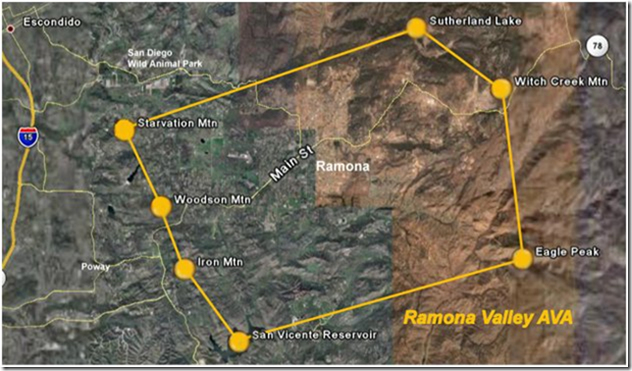
So what does it take for an American wine-growing region to get an "appellation," and how can you make it sound as good as it does in French?
You can't, especially when you use the official designation, which is American Viticultural Area, or AVA for short. AVA isn't quite as dull sounding, but to me it sounds more like a hobby club for movie projectionists. Do they still have movie projectionists?
Sorry, wrong column.
Find out what's happening in Ramonafor free with the latest updates from Patch.
Anyway, AVAs were first created under federal law in 1980. What constitutes an AVA is decided by the United States Treasury Department's Alcohol and Tobacco Tax and Trade Bureau, or TTB for short.
The Ramona Valley AVA was declared in January 2006. The announcement was a long time coming. A group of vineyard owners had petitioned the TTB four years earlier.
Find out what's happening in Ramonafor free with the latest updates from Patch.
"Around 2002 or 2003, a bunch of us decided 'Let's see what it takes to get our own designation,' " said Carolyn Harris. She has been a Ramona resident since the mid-1990s and a practicing attorney since 1988. Harris began growing grapes in the Ramona Valley with her husband in 2000. Their operation, Chuparosa Vineyards, had its first commercial harvest in 2006.
Joining Harris in petitioning TTB were other growers in various stages of what's been called the renaissance of winemaking in the Ramona Valley: Bill Schweitzer of Paccielo Vineyard, Beth and Victor Edwards of Edwards Winery & Cellars, John Schwaesdall of Schwaesdall Winery and Richard Carrico of Rockhill Vineyard.
When I first talked to Harris about the AVA, she offered a refreshingly simple justification for getting the status for winegrowing in the valley. She said wine isn't being grown in Ramona Valley just because people want "to play house."
"It's because this is a good place for growing it."
There's a soundbite that would sell a jury! Harris and her colleagues had plenty of solid evidence to back up their case.
"A lot goes into the designation," said Harris, noting that the process involves establishing "geographic distinction," as well as distinction for climate, soils and historical significance.
They had a lot of historical facts on their side.
"Before Prohibition, there was more premium wine being grown in San Diego County than in Napa or Sonoma," said Harris. She learned that from Richard Carrico. Carrico teaches at San Diego State University and has degrees in both history and archaeology. He contributed a study of the history of winemaking in San Diego County as part of the AVA application process.
The petitioners obviously did their homework. The TTB ruling, published in the December 2005 Federal Register, fills three pages, three columns to a page, and that was just a summary of the supporting documentation the feds had received. Those documents laid out the origin of the valley's name, grape-growing history, boundaries, geography, climate and soils.
Why go through this process? As the TTB itself stated in its ruling, "We designate viticultural areas to allow vintners to better describe the origin of their wines and to allow consumers to better identify wines they may purchase."
When the designation was announced in 2006, Bill Schweitzer told the San Diego Reader that having an AVA, "gives you the ability to make the connection between quality and the place where the grapes come from."
Harris said she and her husband started out in 2000 knowing they wanted to work the land in some way.
She told me it's a similar story for the other wine growers. "The lots here are four-acre minimums," Harris said, and "a lot of people found themselves with property and wanted to do something good with the land. We are all trying to be stewards of the land."