Schools
U.S. Secretary of Education Arne Duncan Visits San Diego, Talks NCLB
Arne Duncan holds a roundtable discussion at Shoal Creek Elementary in San Diego on Wednesday.


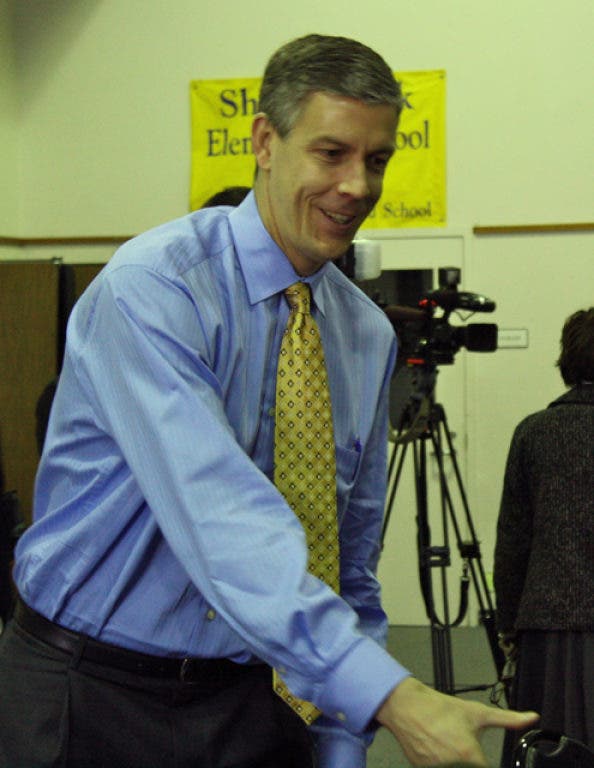

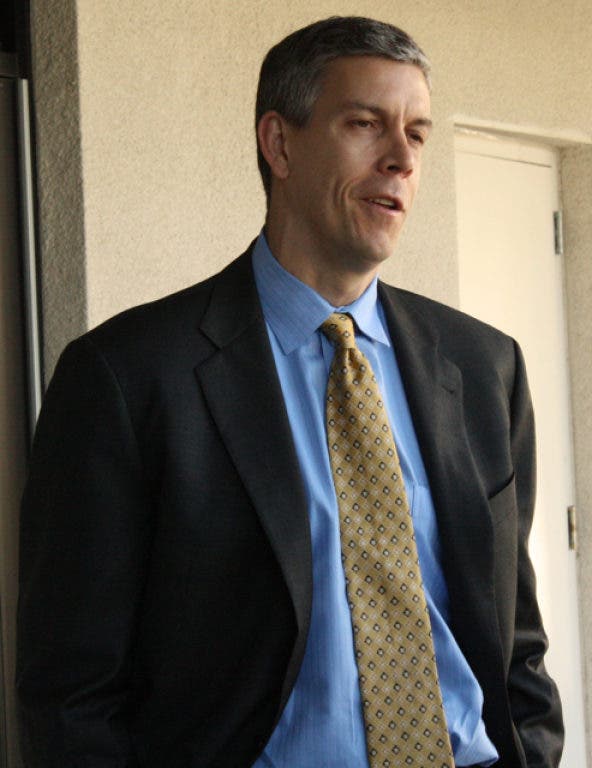
U.S. Secretary of Education Arne Duncan was in San Diego on Wednesday for a roundtable discussion about proposed changes to the No Child Left Behind Act, a controversial 2001 measure aimed at raising academic achievement.
Dozens of San Diego County education leaders were present for the discussion, including County Superintendent Randy Ward and superintendents from districts across the county. Rep. Duncan Hunter (R-Alpine), who is the chairman of the Early Childhood, Elementary and Secondary Education Subcommittee, sat alongside Duncan to help field questions about budget cuts and academic standards.
No Child Left Behind, the latest reauthorization of the Elementary and Secondary Education Act of 1965, sets annual achievement benchmarks for schools that some have criticized as incentives for teachers to “teach to the test.” President Barack Obama has proposed changes to the law to make it more flexible, especially its requirement that all students be proficient in reading and math by 2014.
Find out what's happening in Rancho Bernardo-4s Ranchfor free with the latest updates from Patch.
Duncan also discussed budget cuts, emphasizing that with all of the cuts being made, the government should give districts more flexibility in how they use the money they do have.
“Money's tight. The least we can do is offer flexibility,” Duncan said.
Find out what's happening in Rancho Bernardo-4s Ranchfor free with the latest updates from Patch.
He added, however, that California's budget crisis can't be solved at the federal level.
Below are some of the questions, paraphrased, asked during the discussion with Duncan.
Q: Some states have lowered standards so that they can meet the NCLB benchmarks. How can we make sure there is accountability for having consistent standards across the nation? — John Collins, superintendent of the Poway Unified School District
Arne Duncan: Forty-two states have adopted common standards due to courage from their governors, Duncan said. California adopted the Common Core State Standards for math and English-language arts in 2010. It should take two to four years for the standards to be implemented, then-State Superintendent of Public Instruction Jack O'Connell said last year.
Q: How can teachers—the ones who are working on the ground level with students—get their ideas to Washington so that they are part of education policy? How are you becoming aware of what ideas teachers have? — Candy Smiley, president of the Poway Federation of Teachers
Arne Duncan: “You don't learn by sitting in Washington,” Duncan said, adding that he tries to visit three or four schools each week and talks with teachers, students and staff. People are always welcome to email him their ideas at arne.duncan@ed.gov, he said.
Q: What can be done about schools losing their youngest and most energetic teachers through layoffs due to the “last hired-first fired” policy? Principals know which teachers are having success and should be able to have a say in who is let go. — Michael Dodson, principal of Bell Junior High School
Arne Duncan: “I can't agree with you more,” Duncan said. “Every sports team, all they think about is how you get the best players on the team.” If principals are going to be held accountable for academic performance at their schools, “you've got to be able to build your own team,” Duncan said.
Duncan also talked about the ineffectiveness of teacher evaluations and support systems that help the small segment of low-performing teachers but do nothing for those in the middle.
“If it's not working for any of the teachers, it's definitely not working for the children,” he said.
Seniority-based layoffs, however, are part of California Education Code, section 44955, and unions have not indicated support for a change:
Except as otherwise provided by statute, the services of no permanent employee may be terminated under the provisions of this section while any probationary employee, or any other employee with less seniority, is retained to render a service which said permanent employee is certificated and competent to render.
Get more local news delivered straight to your inbox. Sign up for free Patch newsletters and alerts.