

Added 12-4-15
I have just added 3 documents to this post- The Public Disclosure of Collective Bargaining Agreements for CUEA (Teachers) which show that average compensation for teachers has gone from $95,673 per year (2155 teachers) in 2012-13 to $105,340 in 2014-15 (2035 teachers) to its current $108,392 (2093 teachers). That is a substantial increase in compensation for a District that is claiming to be to poor to fund art and music.
--
Find out what's happening in Rancho Santa Margaritafor free with the latest updates from Patch.
During the great recession school districts were given flexibility to use categorical program money for general fund purposes. Many districts cut art and music programs in order to balance their budget. Parents were told that if they wanted their children to have art and music they would need to step up and pay for it. Parents did. Since 2010 fundraising has paid for CUSD’s Primary Music Program for grades 1-3, and Art for grades 1-5.
The average cost to fund Primary Music is about $87 per student.
Find out what's happening in Rancho Santa Margaritafor free with the latest updates from Patch.
The average cost to fund Art is $11 per student.
CUSD has 19,792 students enrolled in grades 1-5.
For just under $2 million per year every CUSD elementary school student would receive a full year of art and music.
The State has now recovered and is enjoying all time record high tax revenues, so why are parents still being asked to fundraise for art and music?
I have been asking that question and it seems that there is a “new normal” at CUSD.
“To be clear, CUSD isn’t “requesting” donations. CUSD cut these programs. Parents and the PTA responded. This created a new normal.
Reality Check to Parents and Taxpayers- CUSD has no intention of using District funds to ever fund Art or Music again. The new normal is the equivalent of a $2 million dollar local tax on parents in the district if we want our children to have art and music in public school.
This “new normal” raises some interesting legal issues for CUSD.
Fiscal Solvency-
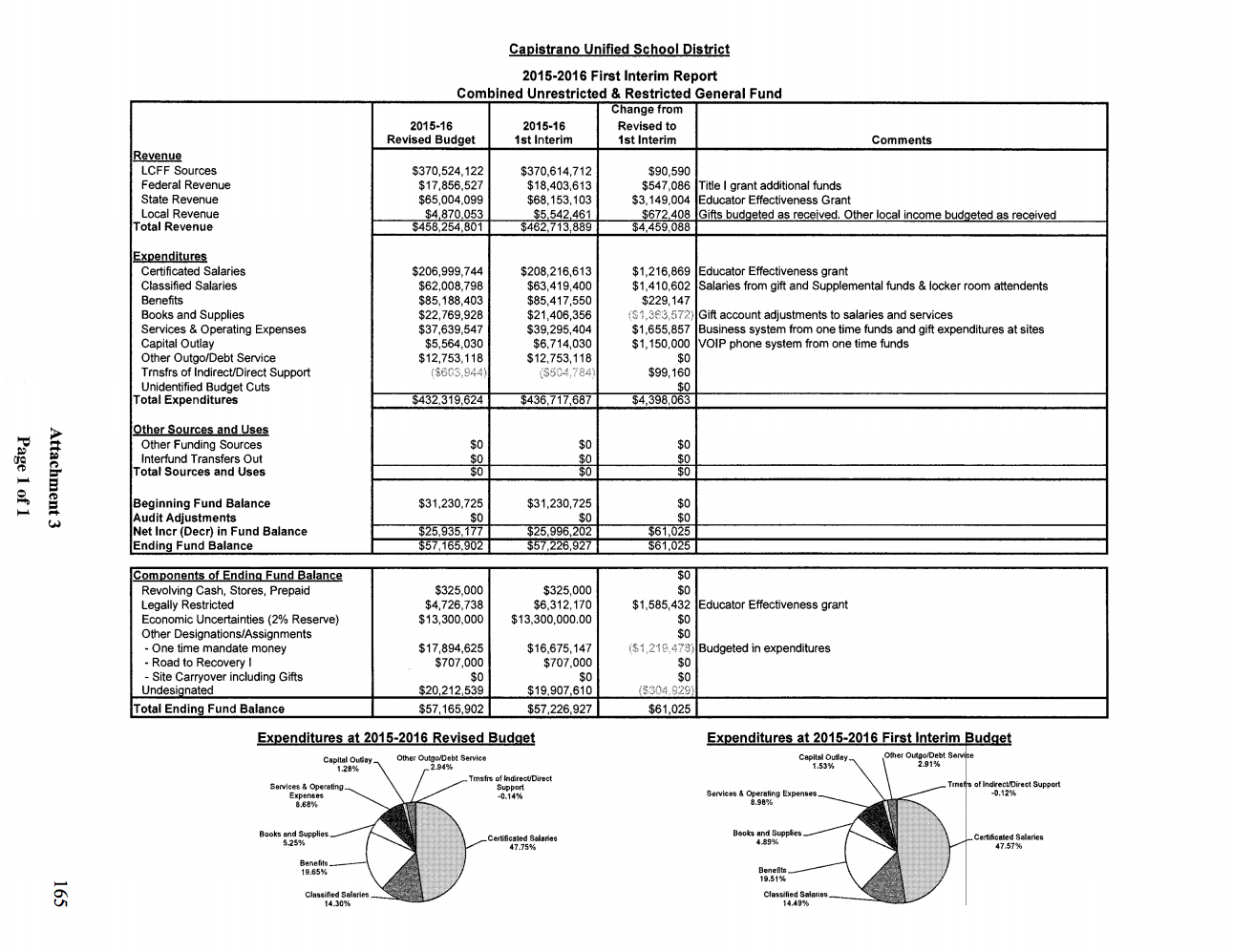
On December 9, 2015 the Board will be asked to approve the 2015-16 First Interim Report. The purpose of these reports is to satisfy State and County Office of Education officials as to whether or not the District will be able to meet its financial obligations for the remainder of this fiscal year.
CUSD is actually budgeting one time gift funds for on-going employee salaries! So the reality is that if parents can no longer raise donations of $100 per student to fund art and music - the district will not be able to meet it’s financial obligations. It will be short by $1.5 million dollars.
Employment and Tenure-
The reality is that parents are not able to raise sufficient funds to provide every student with a full year of art and music. Most schools are having to settle for 1/2 year of music, and some schools have no art and/or music at all. Relying on fundraising to pay for core educational programs creates inequities in educational opportunity across the District. The quality of education a student receives in CUSD is now dependent upon the relative wealth of an individual school. Wealth based inequities in public education violate the Equal Protection laws of both the State and the US Constitution.
Aside from Constitutional issues- forcing parents to fundraise for Core educational programs raises employment issues.
CUSD has 7 Primary music teachers on staff. From 2013-14 to 2014-15 these teachers received substantial compensation increases.
Jerome Healy went from $92,355 per year to $117,926.40 (a $25,751.40 increase)
Quin Thomburg went from $96,836 to $121,003 (a $24,165.40 increase)
Are parents responsible for such increases in compensation, or can we (since we are funding these programs) lay off expensive teachers and hire more teachers at a lower cost so that more students can have music and art? Why is the public obligated to fundraise for compensation increases?


Primary Music Teacher at Hope Elementary School in Carlsbad California from September 2004 - June 2015

2014-15 Transparent California
Carly Hancock


This represents a $25,571.40 compensation increase from 2013-14 to 2014 -15.
2014-15 - Transparent California

Kim Nason


This represents a $24,165.4 compensation increase from 2013-14 to 2014-15
2014-15 Transparent California

Reality Check for CUSD-
It is the responsibility of the District to provide Core Educational programs to every child for FREE. It is the Districts responsibility to find and budget $2 million dollars for art and music for every student in elementary school. That is the law.
1. Every student has a fundamental right to a quality education.
“Education is essential to the preservation of the rights and liberties of the people” - California Constitution Article 9, Section 1
CALIFORNIA CONSTITUTION ARTICLE 9 EDUCATION SECTION 1. A general diffusion of knowledge and intelligence being essential to the preservation of the rights and liberties of the people, the Legislature shall encourage by all suitable means the promotion of intellectual, scientific, moral, and agricultural improvement.
2. A “quality education” has been defined by the Courts to be:
“... opportunity to obtain high quality staff, program expansion and variety, beneficial teacher-pupil ratios and class sizes, modern equipment and materials, high-quality buildings.”
[SERRANO v. PRIEST II (1976) Cal. 3d 728]
Substantial disparities in expenditures per pupil among school districts cause and perpetuate substantial disparities in the quality and extent of availability of educational opportunities. For this reason the school financing system before the court fails to provide equality of treatment to all the pupils in the state. Although an equal expenditure level per pupil in every district is not educationally sound or desirable because of differing educational needs, equality of educational opportunity requires [18 Cal.3d 748] that all school districts possess an equal ability in terms of revenue to provide students with substantially equal opportunities for learning. The system before the court fails in this respect, for it gives high-wealth districts a substantial advantage in obtaining higher quality staff, program expansion and variety, beneficial teacher-pupil ratios and class sizes, modern equipment and materials, and high-quality buildings.
3. California Education Code Section 51210 defines the minimum mandated course offerings that Districts must provide to all students in grades 1-6:
51210. (a) The adopted course of study for grades 1 to 6, inclusive, shall include instruction, beginning in grade 1 and continuing through grade 6, in the following areas of study:
(1) English, including knowledge of, and appreciation for literature and the language, as well as the skills of speaking,reading, listening, spelling, handwriting, and composition.
(2) Mathematics, including concepts, operational skills, and problem solving.
(3) Social sciences, drawing upon the disciplines of anthropology, economics, geography, history, political science, psychology, and sociology, designed to fit the maturity of the pupils.Instruction shall provide a foundation for understanding the history, resources, development, and government of California and the United States of America; the development of the American economic system, including the role of the entrepreneur and labor; the relations of persons to their human and natural environment; eastern and western cultures and civilizations; contemporary issues; and the wise use of natural resources.
(4) Science, including the biological and physical aspects, with emphasis on the processes of experimental inquiry an on the place of humans in ecological systems.
(5) Visual and performing arts, including instruction in the subjects of dance, music, theatre, and visual arts, aimed at the development of aesthetic appreciation and the skills of creative expression.
(6) Health, including instruction in the principles and practices of individual, family, and community health.
(7) Physical education, with emphasis upon the physical activities for the pupils that may be conducive to health and vigor of body and mind, for a total period of time of not less than 200 minutes each 10 schooldays, exclusive of recess and the lunch period.
(8) Other studies that may be prescribed by the governing board.
4. In Do v. Albany [Doe v. Albany Unified School District 190 CalApp 4th (5)] the Appellate Court held that California Education Code Section 51210 imposed amandatory duty on school districts to include the adopted course of study as their minimum core educational requirements.
(5) “We conclude section 51210, subdivision (g) imposes a mandatory duty on school districts to included in an adopted course of study for grades one to six physical education for a total period of not less than 200 minutes each 10 schooldays. Although one might reasonably question the wisdom of the Legislature micromanaging the state’s education system by mandating that schools throughout the state, regardless of circumstances, provide a minimum physical education requirement, that is nevertheless precisely what the Legislature has done. It is not for this court to second-guess theLegislature in this regard.
5. As a matter of law; under Do v. Albany, Education Code Section 51210 imposes a mandatory duty on school districts to provide a visual and performing arts curriculum to all students in grades 1 - 6 and 51220 imposes a mandatory duty on districts to provide a visual and performing arts curriculum in grades 7-12.
learn more at: http://peopleforstudentrights.com/index.php/complaint/count-16