Politics & Government
Students Don't Matter ... But The California Air Resource Board Does
Withholding Educational Opportunity from Students to Pay For High Speed Rail and the California Air Resources Board

Withholding Educational Opportunity from Students to Pay For High Speed Rail and the California Air Resources BoardPriorities of a State are demonstrated by what the State CHOOSES to spend its money on.
If the State asked voters to raise taxes so that the State could increase spending on the California Air Resources Board by 225% what percentage of voters would think- now theres a great idea!
or
If the State asked voters to raise taxes so that the State could provide tax relief for certain people by 322% what percentage of voters would think- now theres another great idea!
... and what if the State told voters that in order to pay for increases in these programs, the State would not have any money to fund facilities maintenance for K- 12 education facilities maintenance- not now and not even in 2019-20.
That is what the State is doing - and it is in violation of the California Constitution.
But does anyone care anymore?
Prop 30 demonstrated how the State of California use the public education system to get tax increases and then chooses not to spend the money as represented- Prop 30 proved that- 80% of K-12 Prop 30 money went to employee salary pensions and benefits with almost no money going directly to schools to restore programs, reduce class sizes or maintain facilities. Source: http://trackprop30.ca.gov/K12State.aspx
It’s time for Tax payers and parents to stand up and say no more- here is the basis to do so:
The California Constitution gives education funding a unique priority above all other state funding obligations by requiring that “from all state revenues there shall first be set apart the monies to be applied by the State for support of the public school system...” Cal. Const. art. XVI, §8. (Emphasis added)
“First” means that the State is constitutionally mandated to provide school districts with adequate funding to provide every student with equal opportunities for learning before the State can fund any other program or entitlement.
More from San Juan Capistrano Patch
Find out what's happening in Rancho Santa Margaritafor free with the latest updates from Patch.
- Call For Artists: Pumpkin Fest’s Annual Logo Design Contest Is Here!
- Video: OC’s Pint-Sized Darth Vader Undergoes Heart Surgery
- Photos: San Juan Capistrano Students Get a Move On
- In the LocalStream Capistrano Dispatch
- In the LocalStream St. Margaret’s Episcopal School
Under California’s new education funding law, the State has enacted a funding system that intentionally underfunds all districts that have a low percentage of students who are English Language Learners, are receiving Free and Reduced Lunch and are in Foster Care. To bring funding levels up to a level mandated by the California Constitution, the State is providing local municipalities with the power to tax residents at a greater level. Allowing local districts to increase taxes to fund a more enriched educational program is acceptable under both Serrano and Rodriquez. However, intentionally underfunding certain districts by setting the Base Grant extremely low is placing the burden of meeting the State’s constitutional obligation to fund education down to local municipalities.
Defendants in Serrano II put forth the argument that local control allows local Counties, Cities and other local Districts to remedy the inequities created by the State’s funding law using local tax rate increases to make up the difference. The Court rejected Defendants contention stating that it is the State’s responsibility under the California Constitution to provide every student with equality of educational opportunity: “equality of educational opportunity requires [18 Cal. 3d 748] that all school districts possess an equal ability in terms of revenue to provide students with substantially equal opportunities for learning.”
Find out what's happening in Rancho Santa Margaritafor free with the latest updates from Patch.
Without increasing local taxes, students in districts with low percentages of English Language Learners, students receiving Free and Reduced Lunch and Foster Care will not have the same opportunity to obtain high quality staff, program expansion and variety, beneficial teacher-pupil ratios and class sizes, modern equipment and materials, and high-quality buildings. Placing the burden on local municipalities to fund education so that the State can then spend “excess” tax revenue to create new programs and entitlements not mandated by the Constitution violates Article XVI, §8 of the California Constitution.
If the State wants to change spending priorities it must first change the Constitution. Any state education funding law that intentionally underfunds districts so that tax money can be used to create and support other programs and entitlements is a violation of Article XVI, §8 of the California Constitution.
The manner in which a State chooses to spend its tax revenue is the best example of the State’s priorities. California’s new education funding system sets the Base Funding Grant at 2008 levels with the expectation that 2008 levels of funding will be reached by the year 2021. A comparison of 2008 spending vs 2015 spending illustrates the fact that the State is choosing not to uphold it’s constitutional obligation under Article XVI, §8 of the California Constitution by spending money on everything except education.

Source:http://www.dof.ca.gov/budgeting/budget_faqs/information/documents/CHART-C-1.pdf
The State’s 2015 Five-Year Infrastructure Plan is projecting to increase spending on
Transportation/High Speed Rail from it’s current level of $5,684 to 2019-20 levels of $52,802.
The State’s 2015 Five-Year Infrastructure Plan is projecting to increase spending on the California Air Resources Board from it’s current level of $5,995 to 2019-20 levels of $365,893.
The State’s 2015 Five-Year Infrastructure Plan is projecting to increase spending on Health and Human Services from it’s current level of $29,587 to 2019-20 levels of $179,674.
The plan calls for no increase in funding for K-12 infrastructure spending through 2019-20. The cost to maintain, improve or build new K-12 facilities is being passed down to local municipalities. Local municipalities will not be able to sustain these levels of taxation and the result will be that students will go without.
Source: http://www.ebudget.ca.gov/2015-Infrastructure-Plan.pdf
The Governor and the State Legislature have unilaterally made the decision to alter the state’s spending priorities without a vote of the people, and in doing so are depriving students of their constitutional right to equal opportunities for learning.
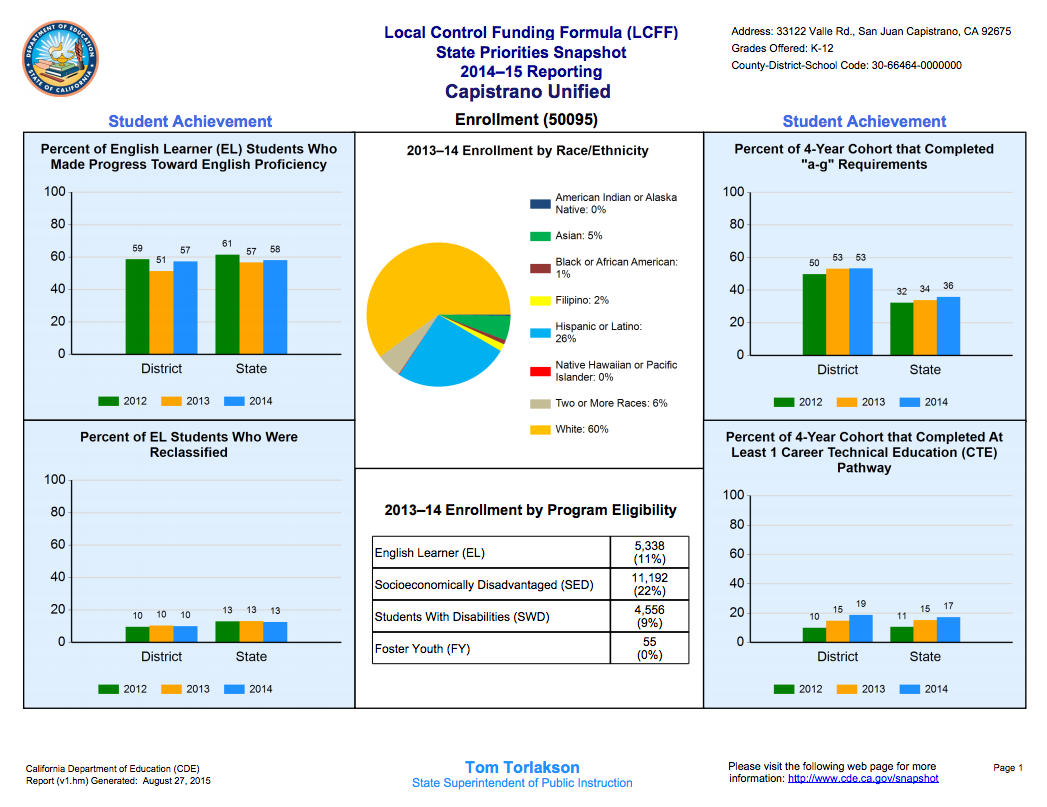
The continued Lack of Adequate funding resulting in notable declines in academic performance across all demographics.
See:
http://ias.cde.ca.gov/lcffreports/lcffreports.aspx?ID=yeomyMfYo9kxEYLoRgGZ3JHmO3gRd4KoPeuaK4bRYA5C8l+GmPyqgweGHSMVGqBo
For Capistrano Unified: