Schools
University of California
Admissions and Financial Decisions Have Disadvantaged California Resident Students
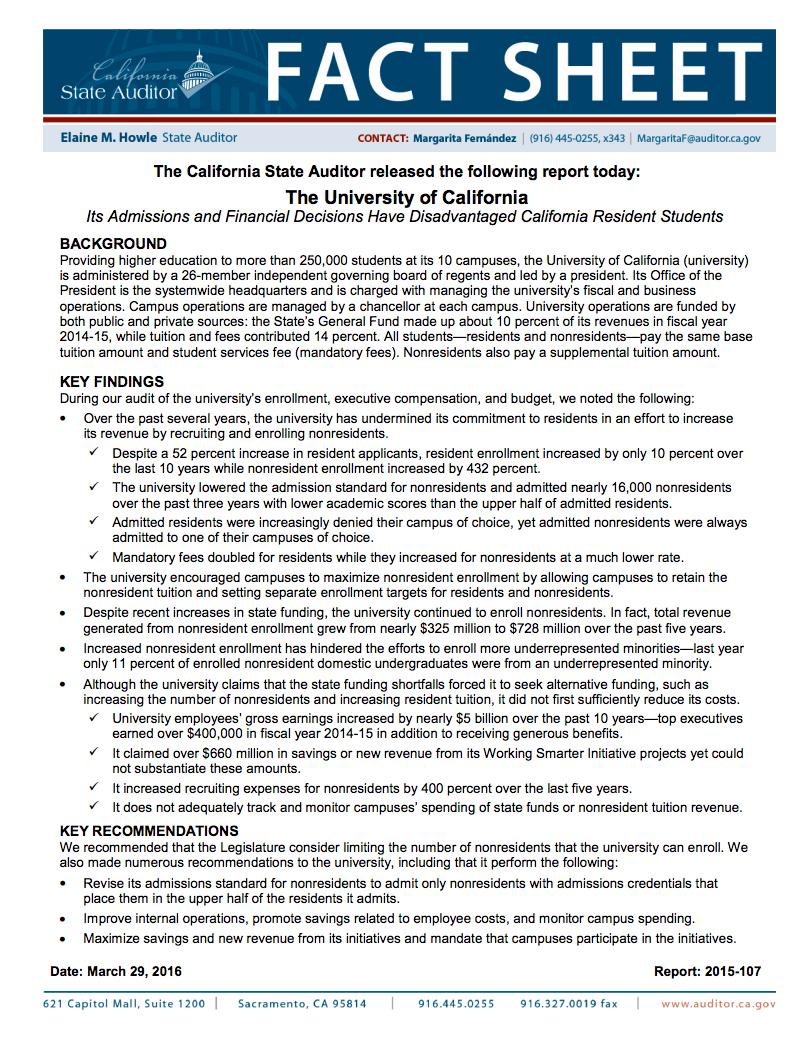
The full report can be read at: https://www.auditor.ca.gov/pdfs/reports/2015-107.pdf
The University of California:
Its Admissions and Financial Decisions Have Disadvantaged California Resident Students
HIGHLIGHTS
Find out what's happening in Rancho Santa Margaritafor free with the latest updates from Patch.
By subscribing, you agree to Patch's Privacy Policy and Terms of Use.
Our audit of the University of California's (university) enrollment, executive compensation, and budget revealed the following:
- Over the past several years, the university has failed to put the needs of residents first and has made substantial efforts to enroll nonresidents who pay significantly more annual tuition and fees.
- Total nonresident enrollment increased by 82 percent, while resident enrollment decreased by 1 percent.
- The university made it less appealing for the residents it did admit to attend the university by denying an increasingly large percentage of those students admission to the campus of their choice. In contrast, nonresidents, if admitted, are never denied admission to the campus of their choice.
- It modified its admission standard for nonresidents and, during a subsequent three-year period, admitted nearly 16,000 nonresidents with lower academic qualifications than the median for residents it admitted.
- From academic years 2005-06 through 2014-15, the university's campuses denied admission to nearly 4,300 residents whose academic scores met or exceeded all of the median scores for nonresidents whom the university admitted to the campus of their choice.
- In 2008 the university began encouraging campuses to maximize nonresident enrollment by allowing them to retain their nonresident tuition and establishing separate enrollment targets for residents and nonresidents.
- Admission decisions have hampered efforts for its student body to reflect the diversity of the State—only 11 percent of the increasing number of nonresident undergraduates were from underrepresented minorities in academic year 2014-15.
- The university had other options for generating savings and revenue without increasing tuition or nonresident enrollment.
- Assessing ways to streamline and reduce employee salary costs, which rose from nearly $8 billion to $13 billion over the past 10 fiscal years.
- Substantiating the claimed savings and new revenue of $664 million from the Working Smarter Initiative and directing these funds to its academic and research missions.
- Annually evaluating $337 million in state funds it allocates to 18 programs not directly related to instruction.
- The university's efforts to equalize per-student funding have not addressed historical concerns.
- The university excluded $886 million of state funds in fiscal year 2014-15 from the amount it distributed to campuses for per-student funding.
- Not including nonresident revenue in per-student funding exacerbates inequities, especially for underrepresented students.
Find out what's happening in Rancho Santa Margaritafor free with the latest updates from Patch.
By subscribing, you agree to Patch's Privacy Policy and Terms of Use.