Politics & Government
Was Prop 30 A Good Deal for Students?
Remind Taxpayers Why They Should Make Prop 30 Temporary Taxes Permanent?

Every parent in California was deluged with messages like the one below, advocating for the passage of Prop 30 ... to “Save Our Schools”!
Why Proposition 30 Matters
It’s no news that California schools are facing severe cuts in funding. No matter what the results of this November’s elections, schools will be facing an estimated cash flow reduction of 21.2% this year. Whether that reduction is a straight-out budget cut or a temporary monthly deferral of funds to next year depends entirely on the passage of The Local Schools and Public Safety Protection Act, or Proposition 30.
The Hard Truth: Proposition 30 is critical to the fiscal sustainability of California schools. If it does not pass, $5 billion in permanent cuts will go into effect. That is $460 per student! Take a moment to imagine the impact this would have on REACH.
Find out what's happening in Rancho Santa Margaritafor free with the latest updates from Patch.
What It Is: Proposition 30 raises taxes on upper income Californians, and temporarily raises sales tax by one-quarter cent for four years. These funds will go into a separate “Education Protection Account”. Funds will also go towards supporting local public safety, including police, fire, and health services.
Why It Matters: Proposition 30 helps restore essential funding for our schools. It guarantees that funding stays in place no matter what happens with the state budget, limits the use of stopgap measures like repeated funding deferrals, and guarantees that the funds go to classroom expenses, not administrative costs. To put it simply, we need Proposition 30 to pass.
There is another proposition on the ballot, Prop.38. While well-intentioned, its uncertain impact make it a less viable choice.
What You Can Do: Vote for Proposition 30! Educate yourself and encourage others to vote.
Source: This is just a sample of the type of message that was sent to parents from educational institutions all over the state. http://www.reach-program.com/webgraphics/10_12.pdf
Find out what's happening in Rancho Santa Margaritafor free with the latest updates from Patch.
2 Years Later... Was Proposition 30 A Good Deal For Students?
Proposition 30 was entitled “The Schools and Local Public Safety Protection Act of 2012.” The Proposition explicitly stated that all of the funding would go directly to schools. However in a letter from the Legislative Analyst Office to State Attorney General Kamala Harris dated March 16, 2012 the LAO noted that under the law as proposed- revenues could also be used to address the state’s budgetary problem by PAYING FOR OTHER SPENDING COMMITMENTS:
Summary of Fiscal Effect
This measure would have the following major fiscal effects:
- Increased state revenues over the next seven fiscal years. Estimates of the revenue increases vary—from $6.8 billion to $9 billion for 2012-13 and from $5.4 billion to $7.6 billion, on average, in the following five fiscal years, with lesser amounts in 2018-19.
- These revenues would be available to (1) pay for the state’s school and community college funding requirements, as increased by this measure, and (2) address the state’s budgetary problem by paying for other spending commitments.
- Limitation on the state’s ability to make changes to the programs and revenues shifted to local governments in 2011, resulting in a more stable fiscal situation for local governments.
“Other Spending Commitments” - the Elephant in the Room.

http://victoriarollison.com/category/general-musings/
How K-12 Prop 30 money was actually spent: 80% went to Employee Salaries and Benefits
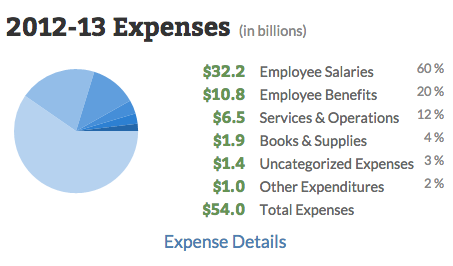
According to California Budget Fact Check:
“California’s public schools and universities will see an actual funding increase of closer to $3 billion compared to the $6.2 billion raised by Proposition 30. The remaining revenue is dedicated to other non-education spending priorities in the Governor’s budget proposal.”
Besides shoring up the California’s unfunded teachers retirement benefits; look at what else the State chose to spend our children’s education funding on:
Driver’s License’s for Illegal Immigrants:
AB 60 took effect January 1st, 2015, a law that specifically allows people who entered this country illegally to apply for licenses despite their lack of legal status.
The cost: $141 million has been budgeted this year, to open four new offices and hire 900 new Permanent State employees (along with their salaries, pensions and benefits). The State is expecting to grant 1.4 million new licenses.
Now California Taxpayers are expected to add to that, the cost of subsidized insurance to new immigrant drivers (a cost that is yet unknown).
This is but one example of hundreds of new entitlement programs that are being implemented that will not benefit a single legal resident.
“Californians bear an enormous fiscal burden as a result of an illegal alien population estimated at almost 3 million residents. The annual expenditure of state and local tax dollars on services for that population is $25.3 billion. That total amounts to a yearly burden of about $2,370 for a household headed by a U.S. citizen.”
Source: http://www.fairus.org/DocServer/research-pub/CaliforniaCostStudy_2014-v2...
At what point will taxpayers demand that revenue be used for the benefit of their own children?For a detailed look at the financial crisis facing school districts after Prop 30 s
see: http://disclosurecusd.blogspot.com/2014/11/re-research-brief-toward-grand-vision.html
The California Constitution
The California Constitution mandates that the State pay for two things:
- A “Free” and “Adequate” K-12 public education system, and
- A State Militia
No tax money should be spent for anything else until EVERY child receives adequate funding for a basic K- 12 public education.