Politics & Government
Investigators: Safety Lapses to Blame for Refinery Explosion, Spike in Gas Prices
Investigators gave ExxonMobil refinery critics fuel today, noting safety lapses led to the explosion that narrowly avoided a toxic disaster.


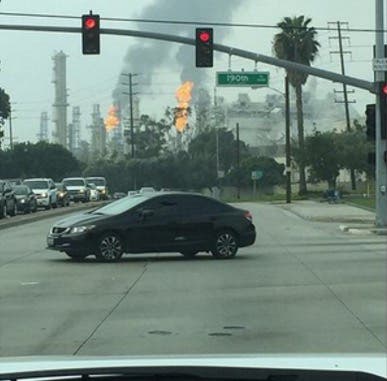
Breakdowns in safety procedures at the ExxonMobil refinery in Torrance contributed to an explosion that injured four workers and contributed to spiking Southland gas prices, officials with a federal agency investigating the blast announced today.
ExxonMobil officials insisted, however, that the company has “stringent” safety measures in place.
According to the U.S. Chemical Safety Board, a series of breakdowns leading to the Feb. 18, 2015, blast began six days earlier when a problem developed with a piece of equipment known as an expander, forcing the plant’s “fluid catalytic cracking” unit to be shut down.
Find out what's happening in Redondo Beachfor free with the latest updates from Patch.
That shutdown led to steam being forced into a reactor, and some was leaking from an open flange that was preventing plant employees from carrying out repair work, the board found. When a supervisor reduced the flow of steam, it caused hydrocarbons to flow into the plant’s electrostatic precipitator, where the hydrocarbons were ignited, causing the explosion.
According to the board, plant employees deviated from standard procedures while trying to repair the catalytic cracking unit, but they used an outdated “variance” that is required prior to moving ahead with the work. Investigators noted that a similar situation led to a 2012 fire at the Chevron refinery in Richmond.
Find out what's happening in Redondo Beachfor free with the latest updates from Patch.
Torrance plant officials also “performed inadequate process hazard analyses” which could have identified ways to control the flow of hydrocarbons, the board found.
“Although our investigation found two different process hazard analyses that considered a combustible mixture igniting in the electrostatic precipitator, no effective safeguards were implemented at the refinery to mitigate the threat,” said Mark Wingard, who is leading the investigation.
Board officials said ExxonMobil officials have repeatedly failed to cooperate with portions of the investigation, with the board receiving no or incomplete responses to about half of its subpoena requests.
ExxonMobil officials said the company has been complying with all of the probes being conducted into the blast, noting that it has provided the board with 136,000 pages of documents and taken part in 67 interviews. In a statement, the company insisted it has taken “corrective actions to prevent this incident from happening again.”
State regulators issued 19 citations against ExxonMobil and proposed penalties totaling $566,600 in response to the explosion. Cal/OSHA officials said a 2007 safety review found problems with flammable vapor in the plant’s electrostatic precipitator, but no corrective actions were taken. Regulators noted that the plant’s fluid catalytic cracker had not been working properly for as long as nine years prior to the blast.
A preliminary report by the South Coast Air Quality Management District determined the blast was caused by over-pressurization in the electrostatic precipitator -- an air-pollution-control system.
Chemical Safety Board chair Vanessa Sutherland revealed in September that according to the investigation, the blast sent a roughly 36-ton piece of equipment flying about 100 feet, narrowly missing a tank containing toxic hydrofluoric acid, which could have sent a dangerous chemical cloud through the Torrance area and surrounding communities.
As it was, the Feb. 18 blast rained a substance on nearby neighborhoods and residents were told they were in no danger from what was called a catalyst used in the refining process.
ExxonMobil officials denied there was any risk to the community from the hydroflouric acid alkylation unit.
“There was no damage to process equipment or loss of containment in the Alky Unit, and Alky Unit safety systems and procedures performed as designed,” according to ExxonMobil. “... ExxonMobil has stringent safety measures in place to prevent, detect and mitigate risks associated with modified hydroflouric acid alkylation and it is important and primary to our ability to provide clean-burning gasoline to Californians.”
The Chemical Safety Board will hold a public meeting in Torrance tonight to discuss the status of its investigation. Reps. Ted Lieu and Maxine Waters, both D-Los Angeles, are also expected to attend.
The refinery, which has been out of operation since the blast, leading to rising gasoline prices, was sold to New Jersey-based oil refining company PBF Energy in September. The $527.5 million deal expected to close in the second quarter of 2016.
The deal, subject to “customary closing conditions and regulatory approvals,” will also not be closed until the refinery is “restored to full working order,” according to PBF Energy.
The 750-acre refinery has a capacity of 155,000 barrels per day. With the purchase, PBF will increase its total capacity to about 900,000 barrels per day, according to the company.
City News Service
Get more local news delivered straight to your inbox. Sign up for free Patch newsletters and alerts.