Business & Tech
SpaceX Makes History with Barge Landing of Reusable Rocket
The rocket successfully launched a spaceship carrying 7,000 pounds of supplies for the International Space Station.
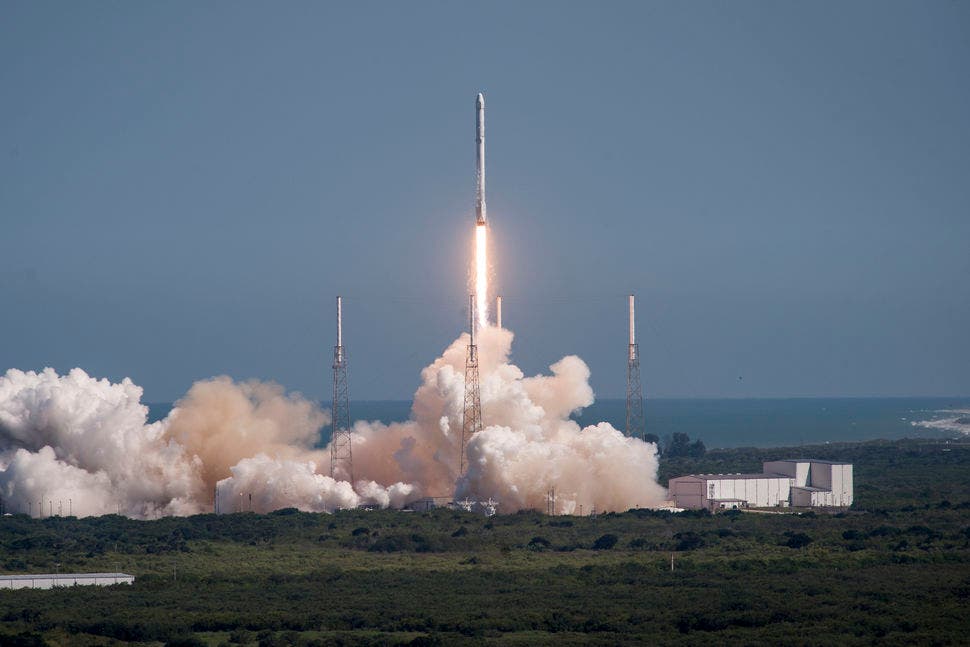
HAWTHORNE, CA - SpaceX's Falcon 9 rocket has successfully landed on a floating barge off the coast of Florida on Friday -- the first time the Hawthorne-based company has accomplished the feat in an effort to cut costs on future missions by recovering the expensive rockets.
The rocket successfully launched a spaceship carrying 7,000 pounds of supplies for the International Space Station, the first re-supply mission since one of SpaceX's rockets exploded shortly after takeoff last June.
The CRS-8 Dragon Resupply Mission was launched from Cape Canaveral, Florida, at 1:43 p.m. Pacific time.
Find out what's happening in Redondo Beachfor free with the latest updates from Patch.
Among the cargo the Dragon spacecraft was carrying is a 3,100-pound Bigelow Expandable Activity Module -- an experimental space habitat that attaches to the station in an effort to expand habitable space.
The cargo also included specimens of the fungus Aspergillus nidulans, which will be studied in the high-radiation, micro-gravity conditions aboard the space station.
Find out what's happening in Redondo Beachfor free with the latest updates from Patch.
Scientists from USC and NASA's Jet Propulsion Laboratory said the experiments represent the first time fungi are sent into space for the purpose of developing new medicine. Molecules from Aspergillus nidulans potentially may be useful in anti-cancer and Alzheimer's disease research, USC announced earlier.
The launch was SpaceX's first Dragon mission since June 28, 2015, when the Falcon 9 rocket propelling the spacecraft exploded 139 seconds after takeoff. The rocket and spacecraft -- along with its cargo -- were destroyed.
If today's launch is successful, the Dragon spacecraft is scheduled to arrive at the International Space Station in about two days.
After the launch, SpaceX plans another attempt to recover the Falcon 9 rocket by landing it on a barge -- known as "Of Course I Still Love You" -- floating in the Atlantic Ocean.
The company has made multiple attempts previously to land the rocket on a barge, but none have been successful.
SpaceX made history in December when it managed to return a rocket to Earth and set it down upright on land. That Dec. 21 launch, also from Cape Canaveral, delivered 11 ORBCOMM communications satellites into orbit. After delivering the vehicle carrying the satellites into orbit, the rocket was maneuvered back to Earth, and it successfully landed on a pad back at Cape Canaveral.
The landing was a major cost-saving step forward for space operations, proving that highly expensive rockets can be recovered and reused instead of merely being lost in the ocean.
Other cargo aboard the Dragon spacecraft are experiments relating to muscle atrophy and bone loss in space and the interactions of particle flows at the nanoscale level, according to NASA.
The Dragon spacecraft is scheduled to return to Earth May 11, splashing down in the Pacific Ocean off the coast of Baja California.
--City News Service, photo courtesy of SpaceX