Politics & Government
DID YOU KNOW That the California State Lands Commission Doesn't Have a Solution to Sea Level Rise?
Redwood City neighborhoods, Redwood Shores and Docktown, are impacted by overlap of Public Trust Doctrine and Sea Level rise concerns.


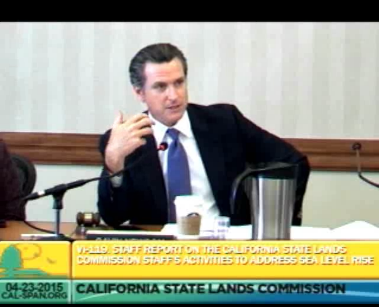
Last week the California State Lands Commission met and discussed sea level rise. As noted during the presentation three fourths of all California residents live near the coast so sea level rise will definitely impact the state. In addition, the state is also likely to suffer the effects of a “subduction zone earthquake” which will lower the land making the effect of sea level rise that much stronger. The California State Lands Commission is tasked with managing the development of 1100 miles of coastline and 4 million acres of land subject to the Public Trust doctrine. A doctrine that even according to Director Jennifer Lucchessi is not static and changes with public trust needs (http://cal-span.org/cgi-bin/archive.php?player=silverlight&owner=CSLC&date=2015-04-23 minute 50). Furthermore she noted the Public Trust doctrine is not easy to understand and in fact can be very nuanced and evolve according to the needs of the public. However the Commission’s current jurisdiction has an ambulatory boundary meaning it moves with the mean high tide line which of course with subduction events and sea level rise is moving more and more into what used to be upland owners private properties. In response upland owners have tried to protect their properties by building sea walls and other protective boundaries.
As Ms. Lucchessi noted the Commission will need to consider these changing conditions by properly revising and changing the lease terms for their various leaseholders. As the Commission’s current rules stand as the seas rise so does the commission’s jurisdiction. As I already wrote last year in an earlier post (http://patch.com/california/redwoodcity-woodside/did-you-know-that-homes-in-redwood-shores--could-soon-be-reclaimed-for-open-space-and-recreation) a federal-court ruling in United States v. Milner held that “the mean high tide line is measured in its unobstructed state as if shoreline protection did not exist. Milner cited as authority the seminal case of Leslie Salt Co. v. Froehlke, in which the Ninth Circuit held that navigable waters of the United States, as used in the River and Harbors Act, extend to all places covered by the ebb and flow of the tide to the mean high water mark in its unobstructed, natural state. Therefore, the mean high tide line under certain federal laws is measured in its natural and unobstructed state.”
“In Milner, littoral property owners erected shoreline protection on the dry sandy portion of their property that intersected the mean high tide line when the beach eroded. As trustees for the Lummi Nation, the federal government brought claims against the property owners for trespass and violations of the Rivers and Harbors Act and Clean Water Act. The court held that while littoral owners ―cannot be faulted for wanting to prevent their land from eroding away, we conclude that because both the upland and tideland owner have a vested right to gains from the ambulation of the boundary,‖ the littoral owners cannot permanently fix the property boundary. The court reasoned that, ―an owner of riparian or littoral property must accept that the property boundary is ambulatory, subject to gradual loss or gain depending on the whims of the sea. Consequently, the mean high tide line should be measured as if the shoreline protection did not exist for purposes of trespass and the Rivers and Harbors Act.”
Find out what's happening in Redwood City-Woodsidefor free with the latest updates from Patch.
What this means for Redwood City is that residents of neighborhoods such as Redwood Shores and Docktown are at the forefront of the discussion as to the overlap between the Public Trust Doctrine and Sea Level rise. In fact we have three council members that have a vested interest in how these discussions play out as they have direct or indirect property interests in Redwood Shores: Mayor Jeff Gee, Vice-Mayor Rosanne Foust and Council member John Seybert.
During the meeting, Commissioner Gavin Newsom asked if staff was exchanging ideas and in fact going with what today would be considered “best practices externally” be it in other states in the country including states like Florida and even countries around the world. For the fact is that places like Amsterdam and London are creating and expanding floating communities even though their legal systems also are based on the clearly evolving Public Trust Doctrine which must consider and include ever changing public needs.
Find out what's happening in Redwood City-Woodsidefor free with the latest updates from Patch.
As Ms. Lucchessi noted: “one size fits all is not going to work.” But even more importantly and she said it twice: “We don’t have the answers.”
What do you think? Should historically ambulatory borders become fixed? Should the Public Trust evolve to consider the effects of Sea level rise?