Politics & Government
DID YOU KNOW that San Francisco Just Made the Global List of Top Five Cities for Ultra High Net Worth Buyers?
As homes and rents rise ever higher this influx of non-residents into the pool of potential buyers will only further raise rents and prices.


Joining the exclusive clique of top cities like New York, London, Hong Kong and Los Angeles, San Francisco residents can now look forward to not only competing with other residents for homes but with the uber-wealthy jet setters that own on average as Sotheby’s points out 2.7 homes.
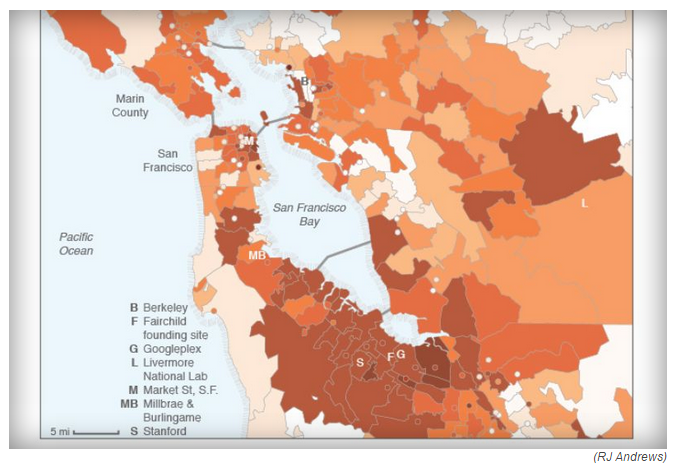
As homes and rents rise ever higher this influx of non-residents into the pool of potential buyers will only further raise rents and prices. For regardless of what the locals might think in the context of New York, London, Hong Kong and Los Angeles, the SF Bay Area is still a relative bargain. Note I say the SF Bay Area and not just San Francisco alone as the area is of interest for various reasons including the Silicon Valley which according to Google is defined as San Mateo to San Jose although according to the Verge is much bigger. (See photo above. http://www.theverge.com/2015/2/5/7984489/silicon-valley-startup-entrepreneur-concentration-map
Of course, ultra high net worth individuals come from all over the globe and the high tech melting pot of successful European, Israeli, Indian and Chinese individuals already in residence in this area make this area all that much more attractive to this high end socio-demographic.
Find out what's happening in Redwood City-Woodsidefor free with the latest updates from Patch.
The other side of this coin however means that the local residential market which is already sorely lacking in affordable housing will only get more so. In this type of an environment the reality is that affordable housing moves further and further away from the center which has led to local calls for rent stabilization and even rent control.
Unfortunately the reality of rent control is that in an environment of high demand like for example New York is that among others it has led to the development of a grey market in real estate. At best, New York’s experience with rent control has been mixed.
Find out what's happening in Redwood City-Woodsidefor free with the latest updates from Patch.
“Rent control first appeared (in New York) in the 1940s, when soldiers returned to the city seeking apartments for their new families, causing rents to rise drastically. Since then, countless housing programs have been created at local, state and federal levels, but the biggest housing intervention in New York today is rent stabilization: a slightly more flexible version of rent control, in which a city board of experts annually determines how much more landlords can charge their tenants.
The problem, though, is that these programs actually make the city much less affordable for those unlucky enough not to live in a rent-regulated apartment, (Christopher Mayer, a housing economist at Columbia Business School) says. The absurdity of New York City’s housing market has become a standard part of many Economics 101 courses, because it is such a clear example of public policy that achieves the near opposite of its goals. There are, effectively, two rental markets in Manhattan. Roughly half the apartments are under rent regulation, public housing or some other government program. That leaves everyone else to compete for the half with rents determined by the market. Mayer points out that most housing programs tie government support to an apartment unit, not a person. ’That is completely nuts,’ he says. It creates enormous incentive for people to stay in apartments that no longer fit their needs, because they have had kids or their kids have left or their job has moved farther away. This inertia is a key factor in New York’s housing shortage. One East Village real estate agent told me that only 20 to 30 units are available in the entire area any given month.”
http://www.nytimes.com/2013/07/28/magazine/the-perverse-effects-of-rent-regulation.html
Is this the example we want to emulate?
Photo credit: RJ Andrews,
http://www.theverge.com/2015/2/5/7984489/silicon-valley-startup-entrepreneur-concentration-map