Community Corner
Leopard Sharks found Dead in Redwood Shores Lagoon
Twelve others found this past week on shores of other Bay Area lagoons
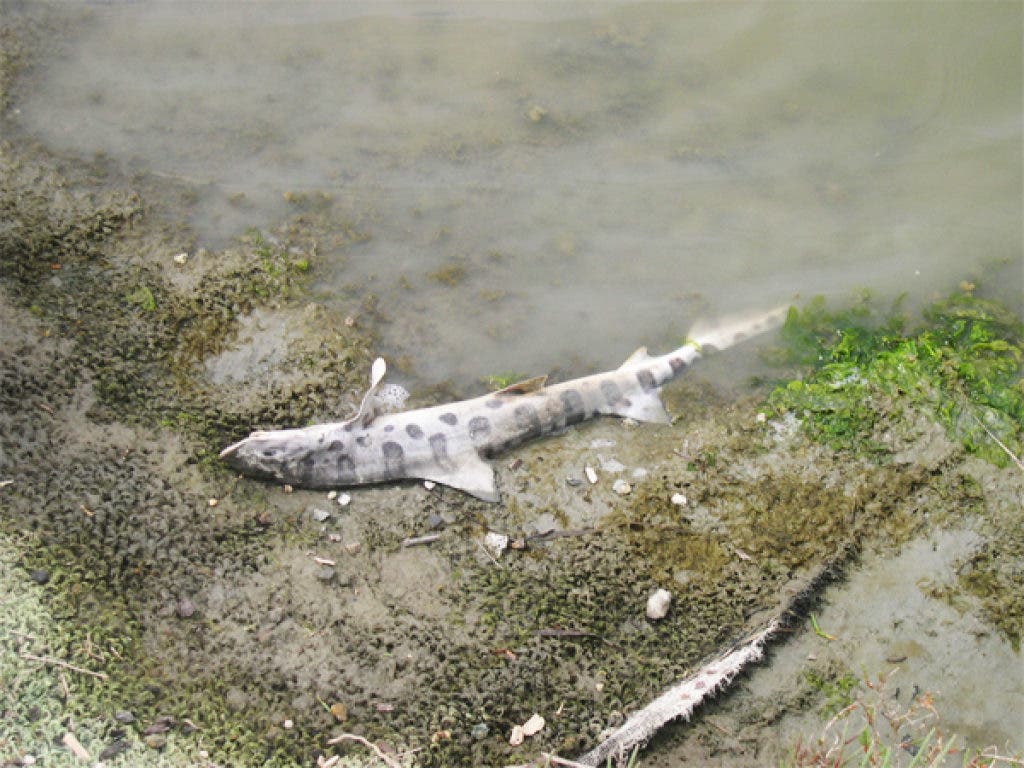


Volunteers rescued and removed about a dozen dead and dying leopard sharks in small waterways in Redwood City over the past few days in what is rapidly becoming a common occurrence, an expert said.
Redwood City resident Catherine Greer and her 13-year-old son, Lorenzo, were the first to discover the dying sharks at a lagoon near Redwood Shores off Radio Road earlier this week.
Greer, an avid fisher, said what she saw upset her. “It looked like they were trying to beach themselves,” she said.
Find out what's happening in Redwood City-Woodsidefor free with the latest updates from Patch.
Greer contacted local officials, who called in Sean Van Sommeran, executive director of the Pelagic Shark Research Foundation, a volunteer-led nonprofit organization.
While this latest stranding event is not the biggest the area has seen, it is the latest in a growing trend, Van Sommeran said.
Find out what's happening in Redwood City-Woodsidefor free with the latest updates from Patch.
The foundation has been addressing this issue for over a decade and has found that “it happens routinely and increasingly over the years,” he said.
Local resident Joe Caldwell and his family found sharks across from Seabrook Court in Redwood Shores. “We’ve seen dead fish out here before but not in a while. We’ve lived out here for 12 years and never seen two dead sharks in one week, so I am a little concerned.” Caldwell said.
“We’ve seen leopard sharks out here for a long time. One of them was 5 feet long. They are bottom feeders and harmless to humans. They feed on small fish, crabs and worms. Maybe they are coming in from the sump pumps that let water in and out of the lagoon from the bay.”
Van Sommeran said it is not unusual to find leopard sharks stranded in the Bay Area along with smoothhound sharks, bat rays, small fish and shore crabs.
There were much larger stranding incidents in 2006 and 2007, which were believed to be spill-related, Van Sommeran said.
Palo Alto resident and foundation volunteer Brandy Faulkner assisted in the 2006 strandings and saw hundreds of leopard sharks and bat rays beached on the coastline.
Faulkner has been helping to recover the stranded sharks in Redwood City and noted that, although fewer sharks have been found, she has seen some similarities that could indicate it was caused by toxicity in the water.
“It’s like they want to be out of the water,” she said. “They don’t have all of their faculties. You can walk right up and pick them up, and that’s not normal.”
The Redwood City-based Marine Science Institute has been taking samples from the lagoon looking for some type of infection or bacteria that have might have caused the shark deaths. The Institute stresses there is no specific factor identified as yet. One theory is that because of this year’s above average rainfall and snowmelt entering the bay, salinity levels are lower than usual.
Van Sommeran suspects this week’s incident may have been caused by a different type of human error. Strandings can be caused by a variety of factors including water temperature, unusually low tides, or poor water quality, he said. But Van Sommeran has found similarities unique to the Bay Area and believes that bay-front development may be a contributing factor.
In many instances marine life becomes trapped in man-made culverts, storm drains, and “nicely developed canals,” he said. Fortunately, this is something that can be rectified and averted in the future, according to Van Sommeran, who says he hopes new developers ”take heed of this example.”
The biggest hurdle Van Sommeran and his team face is a lack of man-power and the means necessary to respond to the increasing strandings.
Based out of Santa Cruz, with only two trucks and a core volunteer team consisting of six people, the foundation, Van Sommeran said, is increasingly looking to the community for help.
Van Sommeran said he hopes to enlist new volunteers who can be trained to handle and collect the sharks or just be on the lookout for sharks in distress.
To become a volunteer or to report stranded sharks, call (831) 459-9346.
-Bay City New contributed to this article