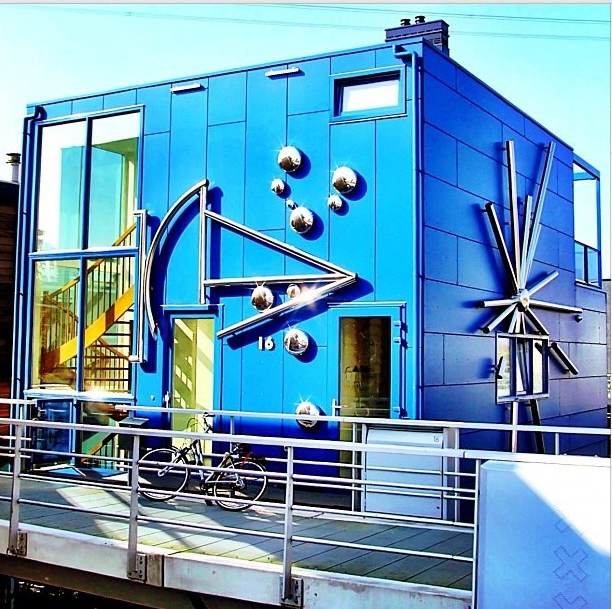
Carol Wong’s Walking Tour of Ijburg, a new section of Amsterdam built on the water was the first in a series of presentations on Great Waterfronts at a recent meeting of the task force that will determine the fate of Docktown, Redwood Creek and adjoining lands owned by the city, Granite Rock, and Rich Ferrari’s family.
Because most of their country is below sea level the Dutch have learned to adapt to water environments in ways that can benefit other cities threatened by rising sea levels, said Wong.
The floating and island based homes in her photographs rise with the water, and expand the footprint of the city beyond land-locked areas with European style clean architecture that is both stunning and diverse, using a wide range of materials from composites to metal and wood. Cars are de-emphasized in favor of bicycles and public transportation. She talked about one resident who spoke enthusiastically about the peaceful life he enjoys on the water only 20 minutes by tram ride from the buzz of city life in in downtown Amsterdam.
Find out what's happening in Redwood City-Woodsidefor free with the latest updates from Patch.
Wong’s recommendation to her fellow planners; Be bold. We don’t have to do the expected.
Jeff Birdwell from Bair Island Aquatic Center looked at three harbors, (and featured a lot more on a handout) including Granville Island in Vancouver where a deteriorating industrial area was reborn with an imaginative mix of markets, cultural activities, and factories with fresh, fun faces and stunning water views. According to Birdwell, Granville “shows great places can be created almost anywhere under any conditions with minimal expense."
Find out what's happening in Redwood City-Woodsidefor free with the latest updates from Patch.
Industrial revival was also front and center in his look at Monterrey’s Cannery Row, where a street of abandoned canneries were transformed into a welcoming waterfront with restaurants, boutiques, and nightlife that now attracts four million visitors each year.Birdwell’s final destination was Balboa Island at Newport Beach, another imaginative mixed use waterfront.
Birdwell stressed the importance of appropriate land-water interfaces, public access, and recreational activities; pointing to Redwood Creek as a critical people connector to downtown, and the importance of the Inner Harbor as the public gateway to to Redwood City’s scenic sloughs and bayfront.
Where the other presenters presented examples with green belts and low rise buildings close to the shore and taller buildings in the background, Attorney Mike Brown, representing the landowners, had a different message: Tall buildings next to the water can be attractive.
Brown showed pictures of a waterside development in Buffalo New York, Mill Valley, Vancouver, and New Jersey, and his own pictures of downtown Amsterdam, showing last century townhouses beside canals where houseboats were docked.
He made it clear he would prefer not to have floating homes and boats next to his new development when he said “If there is to be a floating community in inner harbor we should think about moving it downstream where the water is deeper.”
The 4th presenter was a staff member for the consulting firm that is managing the process: Rick Barrett, Urban Designer/Landscape Architect for MIG, Inc. also briefly revisited Granville Island in Vancouver where he showed dramatic before and after shots of the project before moving on to other waterfronts.
Portland’s South Waterfront is another dramatic re-use of industrial land, with tall buildings set back at a distance from the waterfront with a wide green belt in and some smaller buildings between and a public trail next to the water.
Jack London square in Oakland is a curious amalgamation of housing, and retail with an entertainment district and harbor notable for the visitors it attracts and respect for historical relics in spite of being separated from the rest of the city by a freeway, a problem also facing Redwood City.
Barrett also looked at revitalized waterfronts at Brooklyn Basin in Oakland, Chula VistaBayfront, Bellingham Washington, and in Napa and Petaluma, comparing scale, amenities and public access under different development models.
Like Birdwell he encouraged respect for historical features in the area, including its industrial base, and looked for ways to feature parks, recreation, open space, and public access in the Inner Harbor with development that is to scale and complements the waterfront.
Docktown residents who attended the meeting and spoke during public comments were encouraged by the mixed use vision presented, and the growing consensus that a floating community should be part of whatever evolves in the Inner Harbor. Adapting to rising sea levels was a common thread along with the attraction of an environment some compared to a mini-Sausalito.
Task member Rich Ferrari who did not make a formal presentation offered the possibility that the berm separating the large pond his family owns from the rest of the harbor could be removed, opening up a large lagoon that could incorporate floating structures of all kinds.
All the presentations are now now online at http://www.redwoodcity.org/phed/planning/innerharbor/index.html.
Still more task force members will present their own waterfront favorites tonite, Tuesday July 23 from 7-9:30 pm at the Seaport Conference Center, 459 Seaport Court.