Health & Fitness
About Zika Virus And Why Pregnant Women Should Be Concerned
If you're pregnant and thinking about traveling to an affected country, doctors are warning you to be cautious.


Health officials this week urged travelers to Latin America, the Caribbean and Puerto Rico– especially pregnant women– to take precautions to protect themselves from contracting a mosquito-borne virus that can cause birth defects.
The Zika virus outbreak is ongoing in 21 countries, including Mexico and Puerto Rico.
No transmission of the disease has been reported in the United States. However, there has been one confirmed case of the virus in Los Angeles County — in an adolescent girl who traveled to El Salvador in late November. Health officials said she has recovered.
Los Angeles County’s top health official advised travelers to use bug spray approved by the U.S. Environmental Protection Agency and wear long-sleeved shirts and long pants or clothing specially treated to avoid mosquito bites.
ZIKA AND PREGNANCY CONCERNS
“Pregnant women should avoid travel to the areas where the outbreak is ongoing, if possible,” said Dr. Jeffrey Gunzenhauser, the county’s interim health officer.
The disease has been linked to miscarriages and microcephaly — which can cause serious developmental delays and babies born with abnormally small heads — though the Centers for Disease Control and Prevention website notes that additional studies of such reports, initially out of Brazil, are needed.
The CDC further elaborates on the subject:
“Zika virus can be spread from a pregnant woman to her unborn baby. There have been reports of a serious birth defect of the brain called microcephaly and other poor pregnancy outcomes in babies of mothers who were infected with Zika virus while pregnant. Knowledge of the link between Zika and these outcomes is evolving, but until more is known, CDC recommends special precautions for the following groups:
Women who are pregnant (in any trimester):
* Consider postponing travel to any area where Zika virus transmission is ongoing.
* If you must travel to one of these areas, talk to your doctor first and strictly follow steps to prevent mosquito bites during your trip.Women who are trying to become pregnant:
* Before you travel, talk to your doctor about your plans to become pregnant and the risk of Zika virus infection.
* Strictly follow steps to prevent mosquito bites during your trip.”
As of Jan. 28, Zika-affected countries included Barbados, Bolivia, Brazil, Cape Verde, Colombia, Dominican Republic, Ecuador, El Salvador, French Guiana, Guadeloupe, Guatemala, Guyana, Haiti, Honduras, Martinique, Mexico, Panama, Paraguay, Samoa, Saint Martin, Suriname, U.S. Virgin Islands, Venezuela and Puerto Rico.
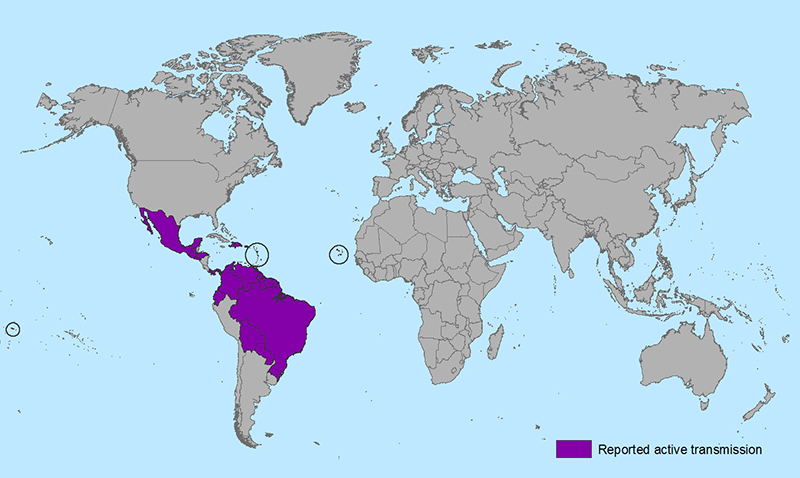
(Countries and territories with active Zika virus transmission. Courtesy: CDC)
“Because the Aedes species mosquitoes that spread Zika virus are found throughout the world, including the U.S., it is anticipated that outbreaks will spread to new countries,” the DPH statement says.
For those who are not pregnant, about one in five will get sick, according to the CDC. Symptoms, including fever, rash, joint pain and conjunctivitis, typically begin two to seven days after being bitten. Some people experience no symptoms. People can reduce the spread of the Aedes mosquito — and the risk of other mosquito-borne diseases such as chikungunya and dengue — by eliminating standing water around their homes where mosquitos may breed.
Updates of affected countries and traveler health notices are posted on the CDC website at www.cdc.gov and more information on the virus can be found at http://publichealth.lacounty.gov.
SEE ALSO:
— City News Service contributed to this report.
Get more local news delivered straight to your inbox. Sign up for free Patch newsletters and alerts.