Community Corner
FrogSong Co-Housing Celebrating 10 Years
Don't call it a co-op or a commune. FrogSong is an intentional community in downtown Cotati that's using smart design principles to reduce energy and foster connections between people.



Modern living can be an isolated affair.
Homeowners spend years living next to neighbors without getting to know them, cut off from contact once they drive into the garage and close the door.
Not so at FrogSong, a co-housing community in downtown Cotati, celebrating its 10th anniversary this year.
Find out what's happening in Rohnert Park-Cotatifor free with the latest updates from Patch.
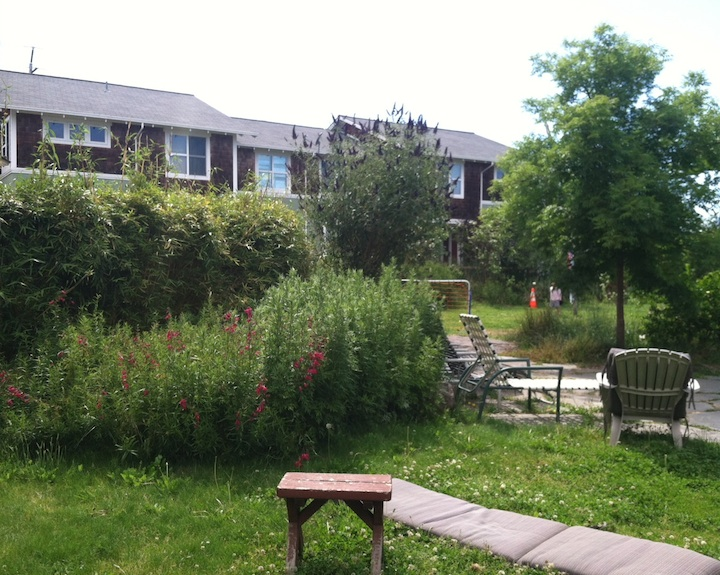
Here homes are clustered closely together and connected by winding pathways shaded by apricot, pear and persimmon trees. Backyards have no fences and open onto a small green space where children play and adults unwind with a glass of wine after work.
All cars are parked away from homes, forcing more interaction between neighbors. Kitchens have windows and face the walkway, making it easy to greet the neighbors and do dishes at the same time.
Find out what's happening in Rohnert Park-Cotatifor free with the latest updates from Patch.
Residents own their homes, which range from two to four bedrooms, but share a laundry room, a wood shop, a yoga/meditation room that doubles as a music practice room, and guest rooms for out of town visitors. A solar array provides most of the energy needed.
“We sometimes joke that when you move to co-housing you get a smaller house but a bigger home because everything is your home,” said Eris Weaver, one of the founding members of FrogSong.
FrogSong, so named because of the very vocal frogs in a nearby creek, was born from the ashes of a co-housing community in Santa Rosa that never really took off, according to Weaver.
That’s when several families came together to purchase an empty 2.5-acre lot on Old Redwood Highway with a dream of building a different kind of “development.” The parcel was not very attractive to developers because it required commercial in one portion, which FrogSong leases to Little New Yorker Pizza, Sharp Cuts and KEMA.
The community officially opened in 2003 and today has 75 residents living in 30 homes.
Three times a week residents, who include Sonoma State professors, therapists, teachers and retirees, share a meal in the Common House, positioned against Old Redwood Highway to absorb most of the street noise. All decisions— from what plants to purchase to neighbor disputes— are made by consensus.
“If you want to just do whatever you want to do at any time, you’ll probably be frustrated here. Consensus takes time,” Weaver says.
Weaver, a self-employed group meeting facilitator, was drawn to FrogSong after getting divorced and living alone in the late ‘90s.
“I wanted more community in my daily interaction,” she says.
Now Weaver knows all of her neighbors and says that living in the co-housing community has made her a better person.
“Living in cohousing has changed my life. I’ve had to learn how to get over myself, how to listen and get along with people who are different from me,” says Weaver, adding that her business as a group meeting facilitator grew out of the training she received at FrogSong.
“It’s made me a better person, better wife, mom.”
Do you have experience with intentional communities? If so, we want to hear from you. What was good and what was challenging? Let us know by posting below or emailing karina@patch.com
Get more local news delivered straight to your inbox. Sign up for free Patch newsletters and alerts.