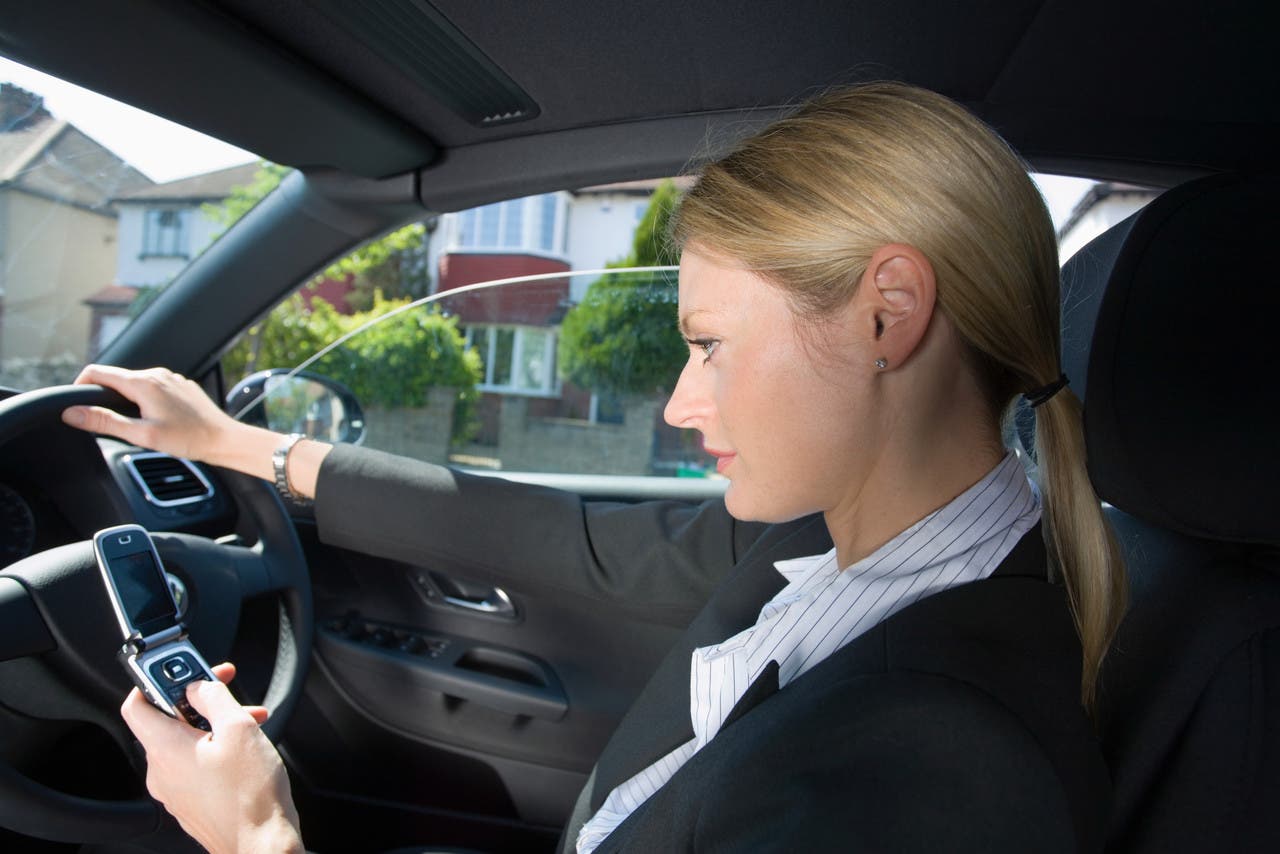
The next time you pick up your cell phone to call or text while driving, ask yourself whether it’s worth it. Talking and texting while driving, which many of us around here have come to take for granted, are responsible for 1.3 million crashes, a half a million injuries and nearly 6,000 deaths each year. In California, cell phone use was responsible for nearly 500 deaths and over 10,000 injuries in 2009, according to the California Office of Traffic Safety.
When asked, nearly 100 percent of us believe that texting or e-mailing while driving is a serious threat to our personal safety, according to AAA. Yet nearly 70 percent of us admit to doing it. Why? And, more importantly, how can we stop?
I asked local and state traffic officials and behavior experts, including San Anselmo traffic officer Todd Milowe, who just before speaking with me had issued a distracted driving citation to a woman who was texting, "with both hands.”
Find out what's happening in San Anselmo-Fairfaxfor free with the latest updates from Patch.
Milowe says that while calling and texting are major culprits, he has witnessed injury accidents that resulted from a variety of distractions: “women putting on makeup, people reading the paper, eating, playing with the radio and rummaging around for dropped items …” He recalls a driver searching for a dropped CD, who ran through a San Anselmo crosswalk, hitting a pedestrian; or the driver so engrossed with tuning his radio that he plowed right into the car in front of him.
The Distracted Driving Brain
Find out what's happening in San Anselmo-Fairfaxfor free with the latest updates from Patch.
“Because cars are such a part of our way of life, people forget that it’s an incredibly complex task and that we are having to process and integrate and act upon an incredible amount of information that is going by very quickly,” says Mill Valley psychologist Alexandra Mathews, whose practice focuses on cognitive behavioral therapy. “And the stakes are very high.”
Although ‘multitasking’ is often worn like a badge of honor, the truth is that our brains are not designed to do it.
In actuality, the brain handles tasks sequentially, switching between one task and another (a process called ‘attention switching’) but performs only one task at a time. The brain is also constantly dealing with information it receives: selecting, processing, encoding, storing, retrieving and finally executing on it -- all of which demand different neural pathways and different areas of the brain.
Brain researchers have identified “reaction-time switching costs,” which is a measurable time when the brain is switching its attention and focus from one task to another. While driving a car, even small amounts of time spent switching can lead to significant risks from delayed reaction and braking time. For example, if a vehicle is traveling 40 mph, it goes 120 feet before stopping. This equals eight car lengths (an average car length is 15 feet). A fraction-of-a-second delay would make the car travel several additional car lengths. And while all distractions can endanger drivers’ safety, dialing and texting can take a driver’s eyes from the roadway for five to ten seconds, while most crashes have less than three seconds reaction time.
When it comes to cell phone use, the primary danger is in talking, regardless of whether you use a hands-free device says Cochran, who emphasizes that hands-free is not a solution -- whatever the law says. While hands-free devices help eliminate two obvious risks – visual, looking away from the road, and manual, removing your hands off of the steering wheel – a National Safety Council report warns of a third type of distraction that occurs when using cell phones while driving: cognitive, taking your mind off the road.
“Talking on the phone takes away nearly 40 percent of your brain’s functioning from the act of driving to the act of talking,” says Cochran.
Vision is the most important sense we use for safe driving and the source of most of our information. Yet, estimates indicate that drivers using cell phones look at but fail to actually see up to 50 percent of the information in their driving environment, a phenomenon known as inattention blindness. “Your eyes see the kid or stop sign but your brain does not,” says Cochran. “It’s not so much where your hands are, as where your brain is.”
How to Focus
When it comes to paying attention in the car, my personal mantra is a simple, “it’s not worth it.” The cell phone, the Lego figure my son wants to show me from the back seat, the sandwich in my bag all can wait.
Here are some more do's and don’ts to keep you focused on the task at hand:
Turn off your cell. Thinking that you won’t pick it up when the ‘ping’ sounds is useless, says Cochran, explaining that the mere sound of an incoming text sets of a dopamine response in brain that triggers an addictive desire to pick it up. “Turn it off before you even get in the car so you never hear the ping or ring,” he advises.
Put the phone out of reach in the tailgate or trunk so you won’t be able to pick it up even if you want to.
Model for your children. Kids will do as they see, not as you say. Show them what is right.
Never text or call your kids when you think they may be driving. “That may be the last phone call or text they will get,” says Cochran.
Inform frequent callers that you are not talking while driving. Smart phone apps will send a message when someone texts you so they understand that you are not being rude – just responsible. Let them know that you are doing the safe thing.
Don’t reach down to pick up something. This is one of the worst offenders, according to law enforcement, taking your hands off the wheel and your eyes off the road.
Don’t eat, read, put on makeup or fiddle with the radio.
Don’t let teens drive with other teens. Teens are distracted by all kinds of things, says Cochran, and particularly friends and peers in the car with. “For every teen passenger in the car with a teen driver the rate of crashes goes up: one passenger raises the rate 10 percent; two, 20 percent; three, 30 percent.
Listen to those who have lost children, parents and friends as a result of distracted driving. Hopefully, this will be all the motivation you will need.
San Rafael and other Marin County communities are adopting a zero tolerance police when it comes to distracted driving in all forms. Join their effort by pledging to yourself, your family and those sharing the road with you that you will not call or text while you drive. Print your pledge card here and ask others to do the same.
Resources:
National Safety Council – Info, studies, tips on distracted driving
Focus Driven – Advocates and families of distracted driving victims give you the facts, stories and tools you need.
Impact Teen Drivers – working to share with teens the dangers of reckless and distracted driving through their effective campaigns online and in schools.
Distracted.Gov – the US government’s official website on distracted driving.
No Phone Zone – Oprah Winfrey’s distracted driving website
NHTSA – the National Highway Traffic Safety Administration’s distracted driving website
AAA – Info, studies, tips on distracted driving