Community Corner
Study Session On PARKING - 5:00 P.M. May 8TH Before The Council
Are you interested in the parking conditions in San Bruno?



Article Source: City of San Bruno CA
AGENDA - SAN BRUNO CITY COUNCIL SPECIAL MEETING - May 8, 2018 - 5:30 p.m.
Meeting Location: San Bruno Senior Center, 1555 Crystal Springs Road, San Bruno, CA
Find out what's happening in San Brunofor free with the latest updates from Patch.
City Council meetings are conducted in accordance with Roberts Rules of Order Newly Revised and City Council Rules of Procedure, You may address any agenda item by standing at the microphone until recognized by the Council. All regular Council meetings are recorded and televised on CATV Channel I and replayed the following Thursday, at 2:00 pm, You may listen to recordings in the City Clerk's Office, purchase CD's, access our web site at www.sanbruno.ca,ciov or check out copies at the Library. We welcome your participation. In compliance with the Americans with Disabilities Act, individuals requiring reasonable accommodations or appropriate alternative formats for notices, agendas and records for this meeting should notify us 48 hours prior to meeting. Please call the City Clerk's Office 650-616-7058,
- CALL TO ORDER:
- ROLL CALL:
- PUBLIC COMMENT ON ITEMS NOT ON AGENDA: Individuals allowed three minutes, groups in attendance, five minutes. If you are unable to remain at the meeting, ask the City Clerk to request that the Council consider your comments earlier. It is the Council's policy to refer matters raised in this forum to staff for investigation and/or action where appropriate. The Brown Act prohibits the Council from discussing or acting upon any matter not agendized pursuant to State Law.
4, STUDY SESSION:
Find out what's happening in San Brunofor free with the latest updates from Patch.
Discuss Zoning Ordinance Update Related to Public Benefits Zoning and Parking Regulations within the Transit Corridors Plan Area.
5. ADJOURNMENT:
The next Regular City Council Meeting will be held on May 8, 2018 at 7:00 p.m. at the Senior Center, 1555 Crystal Springs Road, San Bruno.
City Council Study Session Staff Report
CITY OF SAN BRUNO
DATE May 8, 2018
TO Honorable Mayor and Members of the City Council
FROM David Woltering, Community Development Director
SUBJECT Discuss Zoning Ordinance Update Related to Public Benefits Zoning and Parking Regulations within the Transit Corridors Plan Area and Provide Direction to Staff
BACKGROUND
In support of the City Council's on-going efforts and interests in improving and revitalizing San Bruno's downtown area, this Study Session focuses on aspects of the Zoning Ordinance Update related to the Transit Corridors Pan (TCP) area. In particular, the discussion will focus on the concept of Public Benefit Districts and Downtown Parking Regulations.
The Transit Corridors Plan (TCP) was adopted in 2013 with the objective to provide a blueprint for the transformation of San Bruno's downtown and adjacent nearby commercial corridors into a walkable, mixed-use district capitalizing on proximity and access to transit. The TCP goals, polices, development standards and design guidelines are founded on a vision for the future articulated by the San Bruno community and stakeholders. This community vision aspires to an economically vital downtown which is an exciting destination for workers, residents and visitors; more dense mix of commercial and residential uses with high quality architecture to attract and sustain activities throughout the day and night; and a welcoming pedestrian oriented environment with new plazas and streetscape improvements.
Successful implementation of the TCP will require ongoing commitment to achieve the desired types of development, provide certainty to developers and ensure an effective planning approval process. The City has taken important steps to provide the tools necessary to implement the TCP, including the passage of Measure N and establishing the pre-application review process to ensure that projects have minimal impacts on surrounding residential neighborhoods. The proposed Public Benefits Zoning and TCP Parking Standards will provide additional and necessary tools to realize the TCP vision.
DISCUSSION
Public Benefit District
Public benefit districts, part of zoning actions, is based on the premise that land use changes and enhancement enacted by a public agency contribute to increased real estate values. In addition to the value created by the public benefit district, additional value is typically gained
from the landowner and dedicated to community benefits. This can be based on negotiations and discretionary approvals, and ministerial entitlement based on compliance determination.
Public Benefit Zoning/Public Benefit Plans can be used by local agencies and community organizations to help implement desired community development projects, including those providing commercial, office, mixed-use and employment centers, while also obtaining one or more community benefits. For San Bruno, this would occur by developer provision for certain public benefits for the community in exchange for use of incremental, modified or flexible development standards for private development projects.
Why should San Bruno consider establishinq a Public Benefit District?
Like a Development Agreement (DA), a Public Benefit Plan would create expanded opportunity for the City to gain desired improvements beyond what standard conditions of project approval might allow, while a developer could utilize modified development standards or other features in building their project - a key incentive for new, desirable development in the City. However, while a DA typically is associated with very large and complex projects that have extensive obligations and responsibilities on the part of the City and a developer, a Public Benefit Plan can also be applied on a smaller scale and tailored to a specific development project, with creation of benefits serving the project area or the entire San Bruno community.
The benefits to the City could include affordable housing units (more units, deeper affordability, dedication of land); senior housing; parks, plazas, open space, or public art; Walk 'n Bike Plan implementation; payment of fees; etc.
How would the Public Benefit Plan process work?
The Municipal Code currently does not contain provisions for use of a Public Benefit Zone/Plan, so a new chapter would be required for the Code to enact such regulations.
The process would typically involve Council review and approval of a Public Benefits Plan, including community input, as part of Plan formulation. Based on this process, a Public Benefit Zone/Plan would likely contain requirements to ensure it addresses key issues such as General Plan implementation, creation of affordable housing, contribution of funds for Walk 'n Bike Plan improvements, development of public spaces, and creation of jobs for San Bruno residents.
Key would be to ensure a balance between developer interests (concessions for reduced or modified development standards, and what that might equate to in terms of design, land use impacts, etc.) and that of City interests (benefits to be received through the Public Benefit Plan), and that the use of Public Benefit Plans not become commonplace (to be used as an assumed available alternative to having to meet development standards). The Plan should be required to demonstrate why it is necessary, even when providing public benefit. Where development standards are modified, the project should also be accompanied by exceptional project design elements, above and beyond ensuring compliance with any applicable City design guidelines.
Examples of Public Benefit Plans
Several communities in California have successfully used Public Benefit zoning (and related Community Benefit Plans), including the Cities of Palo Alto, Menlo Park, Berkeley, Oakland, San Francisco, San Jose and Los Angeles.
In Palo Alto, public benefits are built into the Planned Community (PC) zoning designation; in order to qualify for a PC, the Planning Commission and City Council must find that "development of the site under the provisions of the PC planned community district will result in public benefits not otherwise attainable." In Palo Alto, developers choose to pursue a PC zoning change if they want to build a project at a greater height, density or FAR, or with a different mix of uses than is allowed under the current zoning designation for a site. The zoning change application must go through review by the Planning Commission, Architectural Review Board, and the City Council.
In Menlo Park, the City makes use of an "X" or Conditional Development Combining District. This can be applied to a parcel of land in excess of one acre (or greater than or equal to 20,000 square feet, if certain Below Market Rate (BMR) Housing requirements are met), in most zoning districts. The X district permits adjustment of the underlying base-zoning district requirements in order to secure special benefits possible through comprehensive planning of larger developments.
In Berkeley, the City has adopted public benefit zoning amendments to implement a new Downtown Area Plan to achieve greenhouse gas reduction targets and create an environmentally healthy and sustainable downtown. One of the key components of the Plan is to require environmentally sustainable buildings that meet LEED Gold or equivalent; car sharing, on-site bike parking and transit passes; on-site open space or in-lieu fees; and "unbundling" parking rents from dwelling unit rents. As proposed in the Plan, which was also the subject of a voter-approved ballot measure, the implementing ordinance establishes a voluntary "Green Pathway" development review process that streamlines the permit process for buildings providing additional public benefits that exceed the requirements. Since the Green Pathway is voluntary, applicants waive certain rights and agree to certain obligations that the City could not otherwise impose in return for certain processing benefits. In particular, Green Pathway projects must provide affordable housing and pay prevailing wages.
At a broader scale, San Francisco applied the Community Benefit planning to development of a large residential neighborhood in the Hunters Point area, gaining affordable housing, job training, and local hiring of residents, while a similar range of Plan benefits were gained in an Oakland waterfront residential development. These extensive and detailed plans included partnerships with several local agencies and community organizations.
Parking Regulations
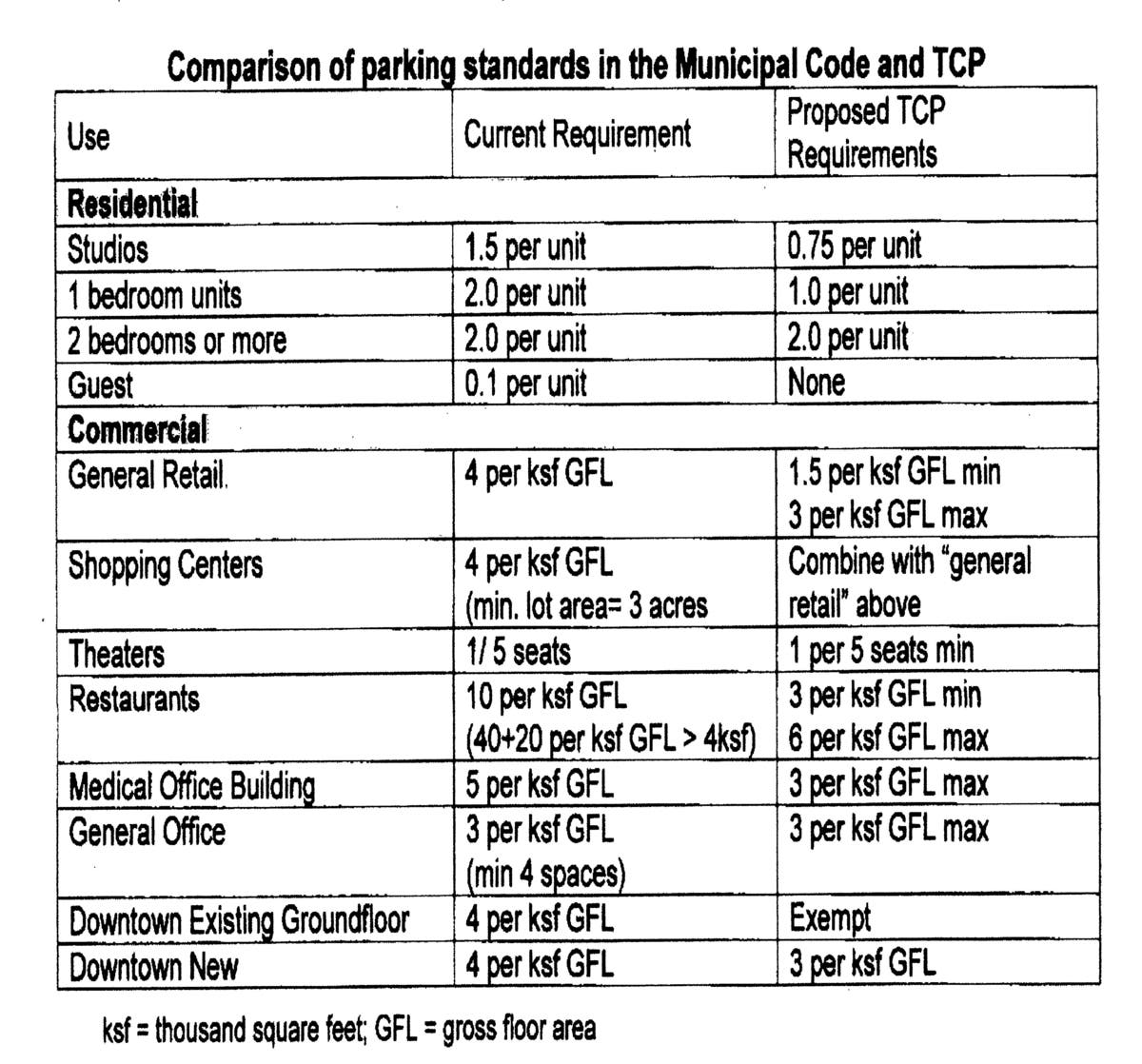
The current Municipal Code parking standards were established based on national guidelines that typically reflect suburban locations and do not take into consideration proximity and access to other modes of transportation.
The updated parking standards reflect the parking requirements of mixed use development in transit rich areas, and would apply only in the TCP area. The TCP emphasizes greater pedestrian activity associated with mixed use (including live/work/shop) zoning provisions. The TCP anticipates that the reduction in multiple-destination vehicle trips will reduce parking demand, which allow for reduced on-site parking regulations.
Below: Comparison of parking standards in the Municipal Code and TCP
The draft Zoning Ordinance also emphasizes the use of shared parking, trip reduction programs (expansion of transportation demand management requirements), mechanical parking systems and electric vehicle charging stations, access to transit, bicycle parking and other approaches that collectively would reduce parking demand and the area devoted to parking in the downtown. In addition, the City is preparing a comprehensive Parking Management Program with near, medium and long term strategies for addressing parking needs in the downtown area.
The TCP seeks to make efficient use of the parking supply through shared parking, which aims to pool all available parking spaces within the TCP area, including public and private spaces, and make those available for everyone to use. The goal is to provide the lowest number of parking spaces while maintaining the viability of the plan without impacting surrounding neighborhoods. The objective is to achieve a target of 85% occupancy rate in all area
Many cities in the Bay Area have undertaken similar transit oriented development (TOD) planning using similar development standards that emphasize higher density mixed-use zoning near public transit, including of South San Francisco, Millbrae, Redwood City and San Mateo. These also include designation of Priority Development Areas, supported by and consistent
with San Mateo County C/CAG policy for investment of infrastructure funding and future population growth. All of these plans include reduced parking requirements in their TOD areas.
Next Steps
With input and direction received from this study session, combined with any needed additional Council Study Sessions to be held, staff will complete its work on a public Draft Zoning Code. This will also include preparation of a CEQA (environmental review) document. The Draft Zoning Code will then be the subject of Planning Commission review at a noticed public hearing before being presented to the City Council at a public hearing, and anticipated adoption in 2018.
ATTACHMENTS
- Reasons to Update the Zoning Code
- Community Benefit Plan/Zoning Approach Outline
- Transit Corridors Plan Parking Section
- Existing Conditions Memo - Downtown Parking Management Plan
- Mills Park Parking Study
- Plaza Apartments Parking Analysis
- Parking Standards in other cities (South San Francisco, Millbrae, Menlo Park, Redwood City)
- Schedule of Zoning Code Update Actions To Date
- Proposed Schedule
====
FULL Council Agenda Packet WITH Staff Reports can be viewed and downloaded from:
https://sanbruno.ca.gov/gov/elected_officials/city_council_minutes_n_agendas.htm
This document should be available late Friday before the Tuesday Council Meeting
====
Robert Riechel
E=Mail: SanBrunoPatch.Robert@Yahoo.com
My Posts: http://patch.com/users/robert-riechel
Photo Credit: San Bruno CA Patch Archives
Source Credit: San Bruno CA City Council
Web Site: https://sanbruno.ca.gov