Sacramento City Unified School District - Role Model for Compliance with Healthy Youth Act - Comprehensive Sexual Health Education
VERY IMPORTANT - Sacramento City Unified School District DOES NOT MAKE HEALTH A STAND ALONE CLASS REQUIRED FOR GRADUATION.
Sacramento City Unified School District embeds the minimum curriculum into High School Biology and allows parents to "OPT OUT" of all or a portion of the curriculum.
Find out what's happening in San Juan Capistranofor free with the latest updates from Patch.
School Districts that CHOOSE to make Health a stand alone class that is required to graduate make it impossible for students to "OPT OUT".
Eliminate Health as a Graduation Requirement.
Sacramento City Unified School District is doing the right thing for parental choice.
Find out what's happening in San Juan Capistranofor free with the latest updates from Patch.
They are teaching the "Rights, Respect and Responsibility" not the "Teen Talk" curriculum.
California state law, the California Healthy Youth Act, requires that comprehensive sexual health education and HIV prevention education be provided to students at least once in middle school and once in high school, starting in 7th grade. Instruction must encourage students to communicate with parents, guardians or other trusted adults about human sexuality. Instruction must be medically accurate, age‐appropriate and inclusive of all students. It must include the following:
Information about HIV and other sexually transmitted infections (STIs), including transmission, FDA approved methods to prevent HIV and STIs, and treatment
Information that abstinence is the only certain way to prevent unintended pregnancy and HIV and other STIs, and information about value of delaying sexual activity
Discussion about social views of HIV and AIDS
Information about accessing resources for sexual and reproductive health care
Information about pregnancy, including FDA approved prevention methods, pregnancy outcomes, prenatal care, and the newborn safe surrender law
Information about sexual orientation and gender, including the harm of negative gender stereotypes
Information about healthy relationships and avoiding unhealthy behaviors and situations
How can I view the curriculum materials?
You can view written instructional materials and the CA Healthy Youth Act (California Education Code Sections 51930‐51939) at your child’s school in the main office.
You can also examine the curriculum digitally (including audiovisual resources) using the links listed below.
Who is responsible for teaching the curriculum?
Instruction will be usually provided by 7th grade life science teachers and high school biology teachers. Schools and teachers may partner with organizations like Planned Parenthood to deliver instruction. Please contact your child’s teacher for more information about instructional delivery.
Can I opt my child out of the curriculum?
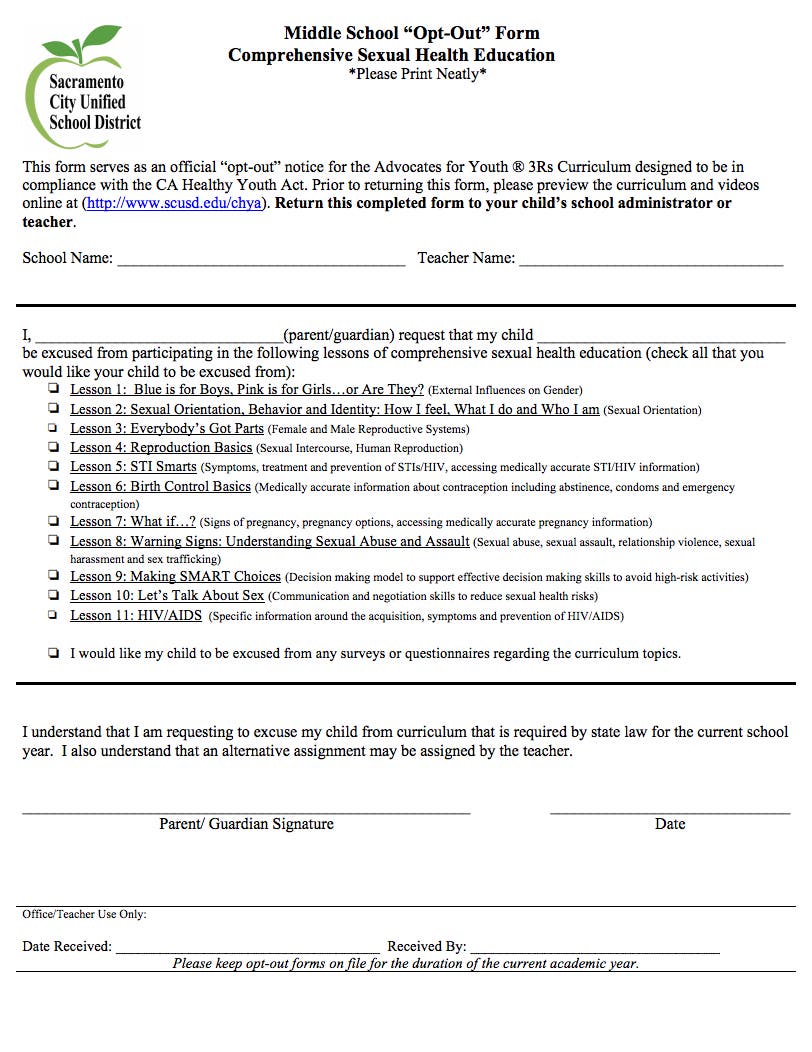
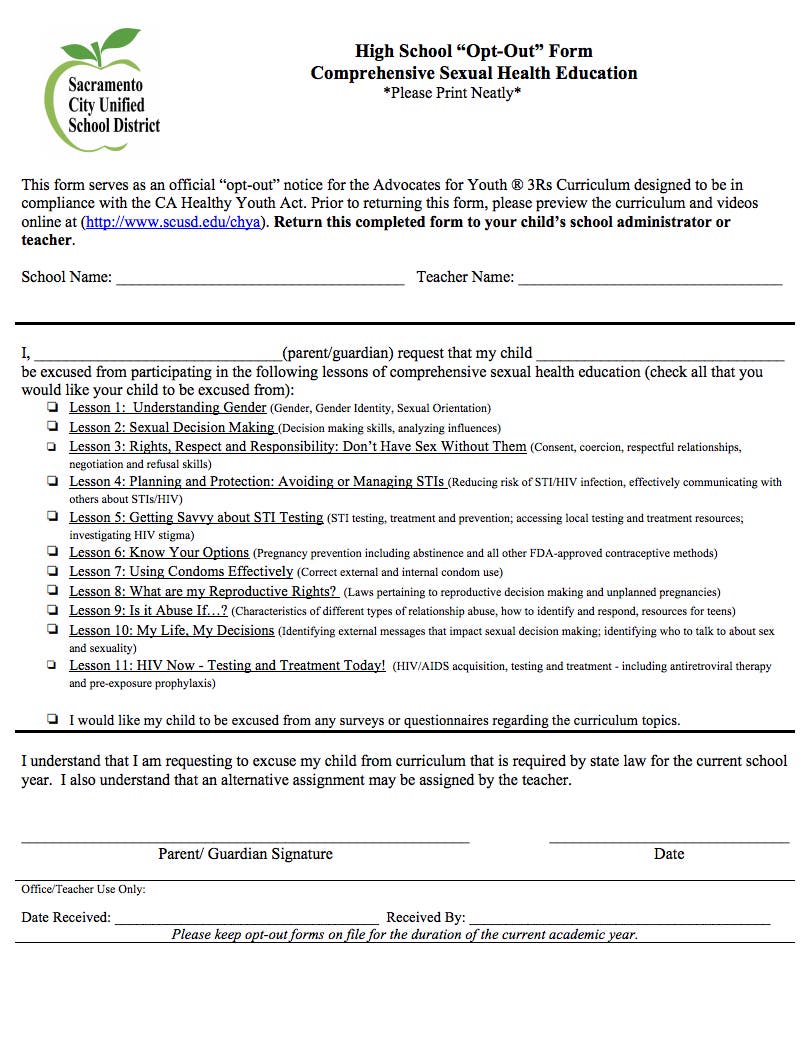
State law allows you to excuse your student from this instruction. If you do not want your student to participate in comprehensive sexual health or HIV prevention education, please fill out the an “Opt-Out” form (downloadable below) and provide it to your child’s 7th grade life science teacher, high school biology teacher or school’s principal.
This document provides a brief summary of each lesson that addresses the California Healthy Youth Act (AB 329) as required by state law. For the full lesson, please follow the attached hyperlink “MS Lesson…” Lessons will be primarily taught in 7th grade. For information on the curriculum used in addition to the lesson plans, please visit: http://advocatesforyouth.org/
This lesson engages students in a discussion surrounding gender stereotypes and their origin. In addition, students are engaged in connections around non-heterosexual orientations.
This lesson engages students in the structure and function of reproductive anatomy (male and female). Students will also have a basic understanding of the menstrual cycle, where sperm is made and how it leaves the body. Changes in bodies’ appearances and performance is a normal part of growing up.
This resource outlines the role of the male and female in sexual reproduction. This resource might be used to assist the teacher in implementing the lesson or actively with students during class time.
This video highlights and breaks down myths regarding sex and reproduction. This video might be viewed in class or viewed as a homework assignment.
This lesson engages students in hypothetical situations to distinguish between the different STIs (sexually transmitted infections) and understand how each is tested, treated and prevented (including abstinence). The resources in the folder include California’s Minor Consent Laws that are reviewed during the lesson.
In this lesson, students define HIV/ AIDS and engage in the myths and facts around HIV transmission and community impact. Students also discuss the local, national and international implications of HIV infection and the AIDS pandemic.
In this lesson, students get information relating to the various forms of birth control (including abstinence) and its effectiveness at preventing unintended pregnancy. Teachers may demonstrate how to correctly use an external (male condom). Please note that it is not permitted for teachers to provide condoms to students outside of demonstration purposes. All demonstration materials must be collected and accounted for at the end of instruction.
In this lesson, students are engaged in a definition of sexual assault and are taught to recognize signs of abuse. Students learn that abuse is not limited to physical means, but social and emotional means as well.
In this lesson, students develop their understanding of and model decision making to inform and communicate their stance on real-life decisions (including relationship decisions).
In this lesson, students learn about 3 communication tactics to prepare them to communicate their stance on sexual behaviors to others (including their decision to remain abstinent). In addition to strategies shared with students, this lesson supports student voice and autonomy in decision making.
Videos and additional resources used in lesson:
N/A
Comprehensive Sexual Health Education
High School Curriculum Overview and Video Links
Rights, Respect and Responsibility
This document provides a brief summary of each lesson that addresses the California Healthy Youth Act (AB 329) as required by state law. For the full lesson, please follow the attached hyperlink “Middle School Lesson…” Lessons will be primarily taught in High School Biology. For information on the curriculum used in addition to the lesson plans, please visit: http://advocatesforyouth.org/
This lesson focuses on the difference between gender, gender identity, biological sex and sexual orientation. In addition, students identify “gender scripts” prevalent in their culture and experiences.
This lesson engages students in developing skills to communicate sexual boundaries with a partner. Prior to this, students identify reasons to engage or not engage in sexual behaviors and their “readiness” to do so.
This lesson begins with an introductory discussion to the word “consent”. Students eventually engage in discussion and practice around scenarios where consent is clear and when it is not.
Videos and additional resources used in lesson:
This video highlights what is consent and what is not consent using a trivial example (borrowing someone’s phone).
This video is another opportunity for students to get clarity on what is or isn’t consent.
This is the trailer for “Pitch Perfect 2” Students only watch the last 30 seconds and have a discussion regarding the consent offered in the situation
This lesson explores the ways of avoiding or managing STIs (including abstinence as the only 100% effective way of preventing pregnancy and STIs). Students are exposed to local resources to get testing and treatment if needed.
Videos and Resources
This video explores myths associated with STIs (STDs). This is a part of a homework assignment but may be used during classroom instruction
In this lesson, students are engaged in the importance of STI testing and treatment and their rights regarding testing and treatment - including the nature of HIV, transmission, prevention and treatment. HIV stigma is also addressed to encourage students to get tested if they are sexually active.
Videos and additional resources used in lesson:
A comical commercial urging viewers to get tested for STIs if they are sexually active.
This video outlines the importance of talking about sexual health. The video additionally discusses strategies of “how” to talk about sexual health with medical professionals and trusted adults/ peers.
In this lesson, students define and differentiate between HIV and AIDS and begin to breakdown the stereotypes associated with them. They are then engaged in modes of transmission for HIV, medical advances made thus far including treatment (including pre-exposure prophylaxis, post-exposure prophylaxis and antiretroviral therapy).
Videos and additional resources used in lesson:
This video sponsored by UNICEF begins to break down HIV stigma and myths around who is impacted. It encourages students to “show their love” regardless of HIV status and encourages students to know their status and get tested.
In this lesson, students will build their knowledge of effective birth control methods as well as factors that have an an impact on birth control success. In addition, students engaged in reasons to use birth control outside of pregnancy prevention (i.e. - menstrual cycle management).
During instruction, students integrate their life circumstances and beliefs to determine which method of contraception is right for them using this website as a tool.
In this lesson, students are engaged in the correct steps to use an internal and external condom. Teachers may demonstrate how to correctly use an external (male condom). Please note that it is not permitted for teachers to provide condoms to students outside of demonstration purposes. All demonstration materials must be collected and accounted for at the end of instruction.
In this lesson, students engage in online computer research to respond to 4 scenarios regarding reproductive decision making. Student’s rights are clarified in regards to the California Minor Consent Law - cards are provided to students and are attached in the lesson plan.
Videos and additional resources used in lesson:
Each scenario has 3-4 websites for students to visit during their research to respond to the scenarios. To access the student handouts with these websites to preview them, please click here or visit the lesson folder.
In this lesson, students engage in the 5 different types of relationship abuse and students examine their own beliefs when it comes to abuse and dating violence. Students are provided resources to access if they or someone they know is in an abusive relationship.
Videos and additional resources used in lesson:
This student-made video highlights realities and awareness of teen dating violence
In this lesson, students reflect on the messages (and factors) they have received in their life regarding sexuality and the extent those messages have impacted their decision making.