
In my first post I offered readers information, as I learn it, about keeping chickens under San Marino's new chicken law. I'm happy to report that I have obtained my chicken keeping permit, which was probably the first one issued under the new law. I write that because I was told that the city was drafting the permit in response to my request to obtain one. As it turns out, obtaining a permit is a simple enough process. I took in a scaled copy of my plot plan to San Marino City Hall. I had the plan from some fairly recent remodeling plans. I had marked on the plot plan where I intend to put my chicken coop. For those who might not have the plot plan as part of a set of remodeling plans, I also took in a Google Map copy of the plot for my address. I had marked the proposed site of the coop on the Google map also. Because a city employee visited me, at my home, during the ordinance drafting process and I had already discussed and shown the employee exactly where the coop would be located and we knew the measurements from the house, that information was not required from me again but if you are approaching the city for the first time, you will need the measurement of side and back setbacks, and the measurements from your house. The city will verify that the site you have chosen is sufficient distance from neighbors. With a filled out and signed application, and payment of the $50 fee, any resident can obtain a permit to keep chickens in the backyard. I keep my chicken permit in a file should anyone want to see it in the future.
After obtaining the permit, my next order of business was to purchase chicks. I decided to purchase chicks rather than juveniles or adults for a couple of reasons. First, chicks are much less expensive than older birds. I also wanted the experience of raising chicks so that I can understand as much as possible about their needs and quirks. Having grown up in a blended family, I also understand that it is easier to develop relationships if you start them from a young age. Love between the hens may be too much to hope for with my chickens but I want my flock to get along. If they know each other from day one or day two, I think they'll stand a better chance of getting along. Chickens are supposed to be very sociable critters. I'm sure there will be squabling but I'm hoping that their longevity with each other will ameliorate much of it. Three chickens is the maximum number you can have under San Marino's law without a variance and it is also probably the minimum number you need for the coop society to perform well.
I decided that I would purchase my chicks from a reputable feed store so that I didn't have to make a minimum purchase of 25 or more. I called several feed stores that had been recommended to me over the past months. Each store sells chicks without a minimum purchase required and the chicks run between $2.50 and $3.50 each. I decided to make my purchase through the Desert Feed Store in Apple Valley (760.247.4591) for a couple of reasons. First, I can get one of each of the varieties of chicks I was looking for at that store. Not all stores sell all breeds so you have to know what you want and ask specifically about them. Second, the two sales people at Desert Feed, Travis and Mary, are very knowledgeable about chickens and gave me lots of help when I was picking out my girls. Third, Desert Feed Store gets its chicks from Ideal Hatchery, a hatchery with a good reputation, and the chicks are vaccinated by the hatchery before delivery. Finally, Desert Feed Store sells everything else you need to raise egg-laying hens. It sells organic feed, starter feed, shavings, feeders and watering devices. I love one stop shopping and like it when the million and one choices out there are cut down by knowledgeable people so that I stand a fighting chance of making a decent choice.
Find out what's happening in San Marinofor free with the latest updates from Patch.
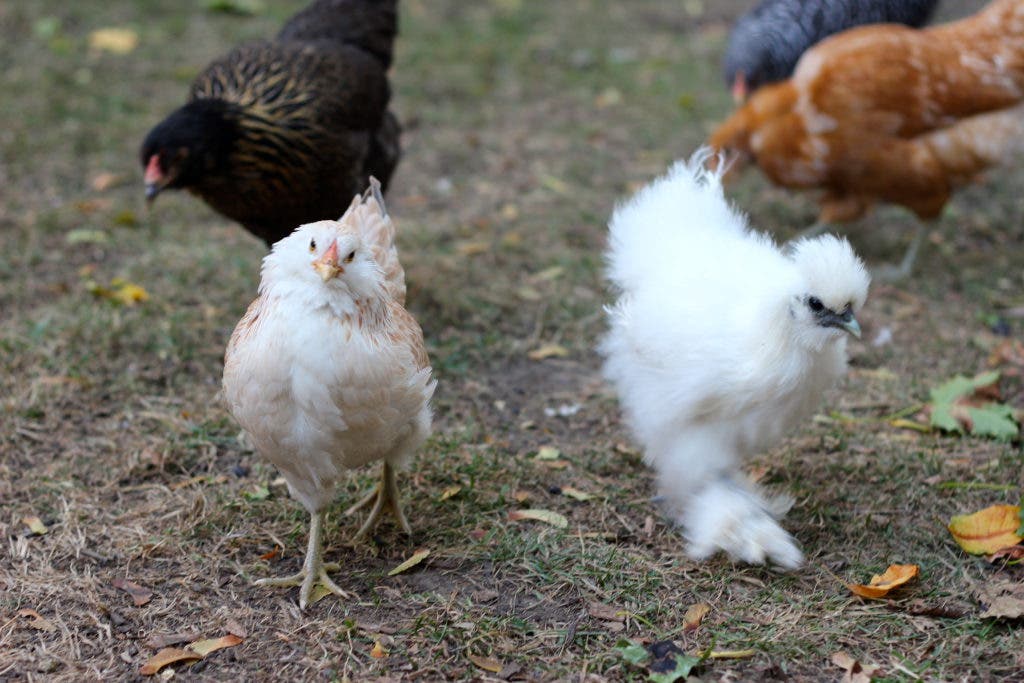
I ordered three different chick breeds. I ordered based on how the chicks behave in a flock, interesting characteristics, the dependability of egglaying, and beauty--attractiveness is always important. The white egg-layer is going to be a Blue Andalusian. This is actually a very beautiful chicken, if a chicken could ever be described as beautiful. Andalusians originally came from the Andalucia region of Spain. The color blue comes from a gene for black that dilutes over time. Only about 50% of Blue Andalusians hatch blue. The remaining hatch-lings will be 25% black and 25% a very light color, pale blue or white with some black and darker blue. That coloring might be seen in the wings and tail. Andalusians are good layers and produce a large white egg. Their color and upbeat nature make them good in a backyard flock. I also like the idea that they love to forage.
The brown egg-layer is the classic Rhode Island Red. Rhode Island Reds are the official Rhode Island state bird. These hens lay exceptionally well. If they are raised for their meat, they are a good breed to raise. San Marino is a no slaughter zone so meat is not the reason I'm getting one. They are extremely hardy in general and get along in a group.
Find out what's happening in San Marinofor free with the latest updates from Patch.
My green or blue egg-layer is going to be a pure breed, the Araucana. Arauncana chickens originated in or around Chile and are named for the Arauca Indians. They have an unusual feature on either side of their heads where feathers make up ear tufts, which slat backwards. The blue green egg is coloured throughout the shell. The inside of the shell is the same color as the outside. There is some notion that they only lay eggs during certain months though that is an inconsistent comment. Araucana chicks are strong and mature quickly which hopefully means they start laying eggs quickly. They do tend to be broody. They like being penned but will have to get out and forage with the other two hens. I'm cautiously optimistic that this breed will do well in Southern California with good girlfriends and a energetic keeper.
I'm expecting delivery of my chicks in or around April. I'll keep you up to date and would love to hear if there are other chicken keepers in the city.