Arts & Entertainment
Huntington Highlight: A Taste of Art
An art-meets-cooking class at The Huntington Saturday explored the rise of two avant-garde mid-19th century movements in England--the Pre-Raphaelites and vegetarianism.


If anyone had ever asked me, "When did vegetarianism, as a movement, begin?" I would probably have guessed the 1970s. Who knows why. But as it happens (all too frequently, I’m afraid), I’d have been wrong.
This past weekend I had the opportunity to correct my abysmal ignorance on the subject thanks to a class at called “A Taste of Art: The Avant-Garde in Nineteenth Century England,” taught by Maite Gomez-Rejón of ARTBITES. Gomez-Rejón has made a name for herself by combining her love of art with her talents as a chef. She has been teaching cooking classes at The Huntington for the past three years, tailoring each one to complement or enhance understanding of a current exhibit or of an artistic period represented in the collections.
The class on Saturday focused on the rise of vegetarianism in the mid-19th century (The Vegetarian Society was founded in 1847 in England, so I was only a little more than a hundred years off) alongside the birth of the Pre-Raphaelite movement.
Find out what's happening in San Marinofor free with the latest updates from Patch.
These classes, priced around $80 for members, $90 for non-members, routinely sell out, and fast. Now that I’ve taken one, I can see why.
Gomez-Rejón was an engaging speaker, and came prepared with a slide presentation covering a broad overview of vegetarianism’s long history as well as a printed booklet containing an introduction to the subject and the recipes we’d be making. The class included a tour of the.
Find out what's happening in San Marinofor free with the latest updates from Patch.
One interesting fact that I learned from the class that I hadn't known before was that until the mid-19th century, vegetarians weren’t even called vegetarians, but Pythagoreans, after the Greek mathematician and philosopher Pythagoras. All I ever knew before about Pythagoras was that he had a math theorem named after him, but I could never remember what it was (no doubt one of the many reasons for my awful grades in geometry back in high school).
But when he wasn’t busy immortalizing himself in the field of mathematics, Pythagoras was also writing about how people shouldn’t eat meat, based on his karmic beliefs in reincarnation. His teachings were later studied by Renaissance luminaries such as author and Venetian nobleman Luigi Cornaro--who took to a vegetarian diet in his 30s and lived to be 102--and artist-vegetarian Leonardo da Vinci. (Gomez-Rejón told us that the famed artist was known to buy chickens just to set them free.)
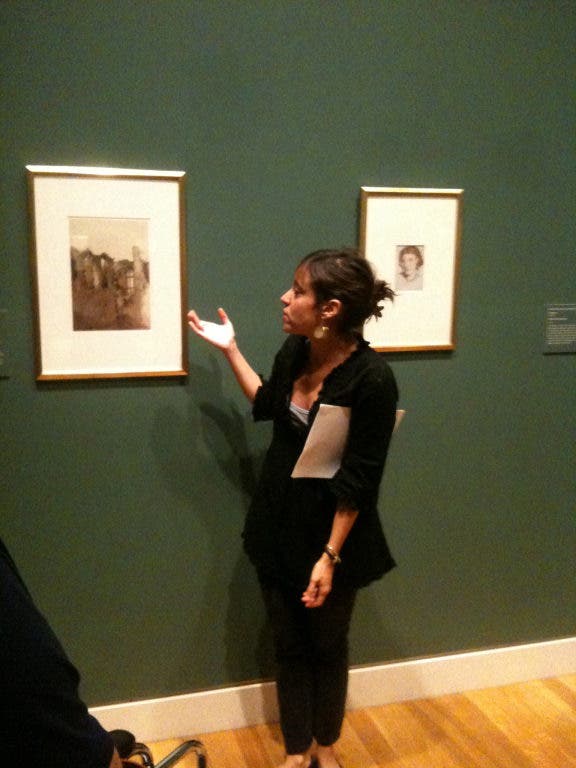
After Gomez-Rejón’s lecture, we headed over to the Scott Gallery to take a little tour of the Pre-Raphaelite exhibit. In addition to being an accomplished chef, Gomez-Rejón also has degrees in fine art, making her an informative tour guide of the pieces on display. She began with John Ruskin’s “Kenilworth” drawing, pointing out the mood evoked by his lines and his preoccupation with the past (the drawing features a ruin, with emphasis on a Gothic window). Continually looking for ways to tie the topics of art and food together, Gomez-Rejón let us know that the town of Kenilworth was the place where the first potato was planted in England.
Gomez-Rejón also highlighted some of the characteristics that define the Pre-Raphaelite style in Britain—attention to detail, scenes from the Middle Ages (“With everything that’s new, people start looking to the past for inspiration,” Gomez-Rejón said), and a new canon of female beauty (“not the 'ideal beauty' is what became beautiful.” )
Gomez-Rejón also showed us what she said was her favorite painting in the exhibit, “Isabella Boccaccio” (1920) by John Riley Wilmer. She explained that it depicted a scene from a story in Boccaccio’s Decameron, in which a woman named Isabella buries the head of her murdered lover in a pot of basil.
Then we went back to the kitchen and started making lunch (which, yes, included basil as an ingredient in two of the dishes—mmmm.)
The menu included an orange, cucumber and arugula salad, an olive tapenade, leek and feta cakes, roasted butternut squash with a tasty dijon sauce, spinach and mushroom pie and to finish it off, chocolate sponge cake with pomegranate whipped cream--proving once and for all for any doubters who might still be out there that "vegetarian" does not have to equal "bland" or "boring."
The kitchen had several stations, so people could work on different parts of the meal at the same time. Not being what you’d call “good in the kitchen” (unless you count being good at eating what’s in it, in which case call me awesome), I opted for the salad station. Everyone else found their niche and pretty soon we were hard at work, chopping, sauteeing, mixing and frying, eventually sitting down to a meal together that we'd all had the pleasure of helping to make.
That brings me to what was one of the most enjoyable aspects of the class for me--my fellow students.
I learned about the lives of some Pre-Raphaelite Brotherhood members from Stephanie Zill of West Hollywood, who helped me prep the salad and who once traveled all the way to Liverpool expressly to see an exhibit of Pre-Raphaelite works. Later, South Pasadena resident Linda Long, a Huntington member, shared stories with me of some of her recent travels, which included a tour of private gardens in Ireland. And Russ and Marilyn Saunders, who were visiting all the way from Martinez, CA, made me feel welcome from the moment I sat down next to them at the beginning of the lecture.
All of which is to say, if you haven’t yet taken an art-cooking class at The Huntington with Maite Gomez-Rejón, I highly recommend the experience. Aside from deepening your knowledge of both art and cooking, you’ll enjoy a well-earned and delicious meal in stimulating company. What better way to spend a Saturday morning?
Check back for Gomez-Rejon's recipe for leek and feta cake so you can have your own taste of art experience at home.