Arts & Entertainment
Huntington Highlight: Organic Edible Gardening
Experience the new Ranch site at The Huntington while learning how to grow your own food when you sign up for the Organic Edible Gardening class starting this weekend, and continuing over the next two Saturdays.


If you’re like me, the idea of growing your own vegetables and greens at home is tempting. You don’t have to worry about what kinds of chemicals were sprayed all over them, and it would save money in the long run—both very good things. However, if you’re like me, you don’t have a lot of yard space or time. So where do you start?
Maybe with the Organic Edible Gardening class at The Huntington Library Art Collections and Botanical Gardens.
This Saturday, March 12, is the first in a series of three 3-hour sessions designed to teach you how to grow your own organic vegetable garden, no matter what your living situation. Led by Erik Knutzen and Kelly Coyne, authors of The Urban Homestead and writers for the blog “Root Simple”, this class will provide an introduction to homegrown food.
Find out what's happening in San Marinofor free with the latest updates from Patch.
The first class will lay the foundation for the course by focusing on issues related to soil quality, such as composting and soil testing. The next session will include discussion about seeds and vegetable varieties, and the third will give participants a chance to get their hands dirty: “We prepare a bed and plant stuff. This one’s going to be totally hands-on,” said Kutzen.
Knutzen and Coyne taught the Organic Edible Gardening course last year as well, but this time around, it will be a little different. The class will have the benefit of using The Huntington’s new Ranch project, which just launched last November. San Marino Patch shot this back in December.
Find out what's happening in San Marinofor free with the latest updates from Patch.
“Rather than just telling people about things in the classroom, we can actually do [them],” said Knutzen.
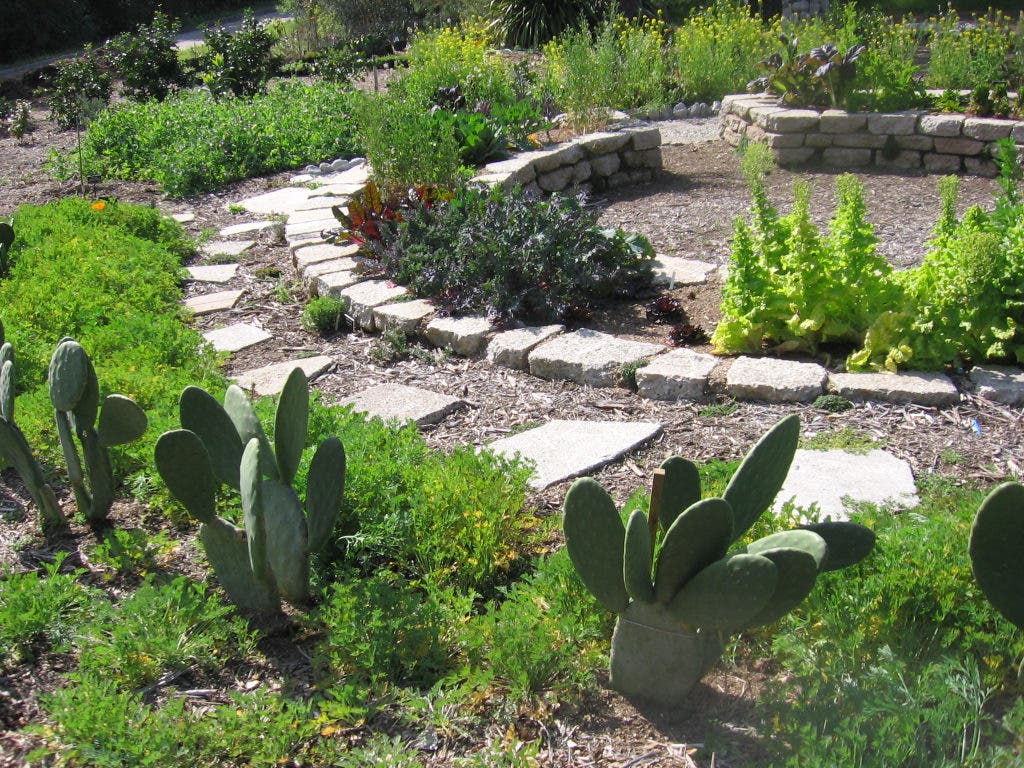
The Ranch is a forward-looking experiment in urban gardening as well as a tribute to The Huntington’s working-ranch roots. Located to the northwest of the Botanical Center, alongside what remains of the estate’s historic orange grove, the 15-acre site is not open to daily visitors. Instead, the Ranch will act as a functioning illustration of different growing techniques as it hosts programs and workshops for novice gardeners and enthusiasts alike.
“It’s a teaching space, mostly,” confirmed The Huntington’s Communications Coordinator, Lisa Blackburn. She gave me a little tour of the Ranch last Friday, and as we walked along dirt paths between beds of greens and vegetables, Blackburn pointed out various demonstrations. For example, we looked at a group of four peach trees planted in a single hole. Each tree was of a different variety and each variety gave fruit at different times of the year. The trees are pruned to stay small. These techniques combined mean more space in your garden, fresh fruit at multiple times of year and more manageable—and accessible—harvests.
I was also fascinated by an edible landscape garden where an attractive plant bed of recycled concrete abounded with fresh greens including Chirimen Hakarashi Mustard and colorful Osaka Purple Mustard. The plant bed could easily double as a space for outdoor entertaining, proving that you don’t have to sacrifice aesthetics for utility, or vice versa, when it comes to your back or frontyard landscape.
But what if you don’t have any kind of a yard? I talked about this to Knutzen, who responded, “One of the things in our book The Urban Homestead is that we show people how to use something called self-irrigating pots.” He explained that these containers are good for growing things on a balcony or a roof.
“As long as you have sun, you can grow some vegetables,” Knutzen said, adding, “It’s amazing how much you can grow in a small pot.” The Ranch has an area demonstrating the use of these types of containers.
Aside from saving money on groceries each week, homegrown food retains more of its flavor and nutritional value, according to Knutzen. After all, it doesn't have to travel far to get from your yard or balcony to your plate. You also don’t have to wonder whether or not pesticides were used; you know exactly where your food came from. It doesn’t get much more organic than that.
In a press release, the Ranch’s project manager, Scott Kleinrock, said, “One of our key objectives is to showcase ideas that anyone can do—even busy people with full-time jobs. We want to offer ideas that are relatively inexpensive, that utilize recycled materials whenever possible, that are not too time consuming to maintain, and that make harvesting as easy as possible.”
If any of this sounds interesting to you, the Organic Edible Gardening class is an opportunity to get some practical guidance, in a setting perfectly designed for it. The class will take place on Saturdays, March 12, 19 and 26, from 9:30 a.m. to 12:30 p.m. Advanced registration is required, so call (626) 405-2128 to sign up. (Members: $120. Non-Members: $135.)
For more information about the Ranch project, click here. Also, check out the Ranch blog.