Arts & Entertainment
Huntington Highlight: Significant New Acquisitions at The Huntington
At the annual Art Collectors' Council meeting, held this year on April 30, works by African-American artist Sargent Johnson and Ernest Lawson were highlights.
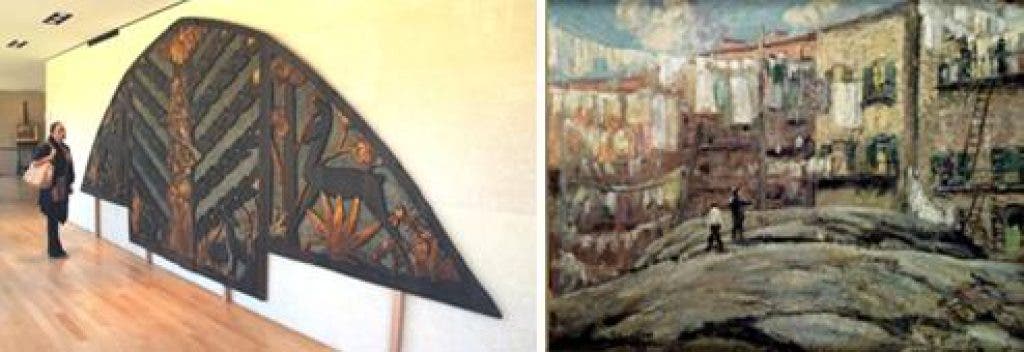


Following this year's meeting of 's Art Collectors' Council, two significant works by important 20th-century artists have been added to the institution's art collection—a remarkable pipe-organ screen carved by Sargent Johnson in 1937 and an early oil painting by Ernest Lawson titled Harlem Flats (Back Lot Laundry), made in 1907.
Both are on view in the Rothenberg Loggia of the Virginia Steele Scott Galleries for the next two weeks, after which the pipe-organ screen will be removed for conservation treatment and Harlem Flats will be incorporated into the permanent galleries.
“This is the first time we’ve had the Art Collectors’ Council pieces on display,” said Jessica Todd Smith, Virginia Steele Scott Chief Curator of American Art, who also expressed her delight at having these fine works become a part of The Huntington’s holdings.
Find out what's happening in San Marinofor free with the latest updates from Patch.
The pipe-organ screen is impressive for many reasons, not least its sheer size. The 22-foot-long, three-panel screen is made from beautiful California redwood and features charming iconography of woodland creatures, trees and musicians.
The piece was created for the organ at the California School for the Blind in Berkeley, CA, under the Federal Arts Project, the visual arts division of the Depression-era Works Progress Administration (WPA). Since such works are typically owned by the federal government and may form an integral part of a building structure (for example, a wall mural), the chance to purchase Johnson's screen presented an extraordinary opportunity for The Huntington to own, as Smith called it, "a monumental WPA sculpture."
Find out what's happening in San Marinofor free with the latest updates from Patch.
Aside from its aesthetic beauty, the screen is significant for being the first major work by an African-American artist to be acquired by The Huntington. And though it will need treatment before it is finally ready for permanent viewing (including replacing the non-original plywood backing), it is still in good shape, given its age and its removal from a building. “All kinds of bad things can happen,” said Smith. “The fact that it hasn’t been messed with too much is fabulous.”
Regarding the other acquisition, Harlem Flats, Smith said, “Lawson has been on our wish list for a long time.”
Lawson was a member of The Eight, a stylistically diverse group of artists that included George Luks, Arthur B. Davies, William Gackens, Maurice Prendergast and John Sloan (each represented in The Huntington’s collections). With Harlem Flats, The Huntington now owns works by seven of The Eight.
Smith said, “For me, it’s a great piece to represent Lawson because it shows his roots in the Ashcan school”—a realist art movement that focused on New York urban scenes. Yet, as Smith pointed out, this work--which depicts the back of a tenement building but still places emphasis on light and paint application--also demonstrates how Lawson kept one foot in the Impressionist camp.
“I really think it’s one of the best examples of his work I’ve seen,” said Smith.
Kelvin Davis of The Huntington’s Board of Overseers, and member of the Art Collectors’ Council, bought Harlem Flats for The Huntington at the outset of the council’s annual meeting, even before the council began to vote. Later that day, the council selected the pipe-organ screen by Johnson.
“It was clearly imperative that we add the striking Johnson relief, which will be a focal point of our American art installation,” said John Murdoch, Hannah and Russel Kully Director of Art Collections at The Huntington, in a press release. “But Lawson’s painting will add meaningful context to one of The Huntington’s greatest strengths—artists of the Ashcan school. We are delighted beyond words to be able to present both of these impressive works to our visitors.”
For more information about these new acquisitions, visit The Huntington's Web site.