Politics & Government
Legislators, Local Lawyers Push for More Asian and Pacific U.S. Citizenship
New census data show a growing Asian-Pacific Islander population that lawmakers and legal experts claim is politically under-represented.
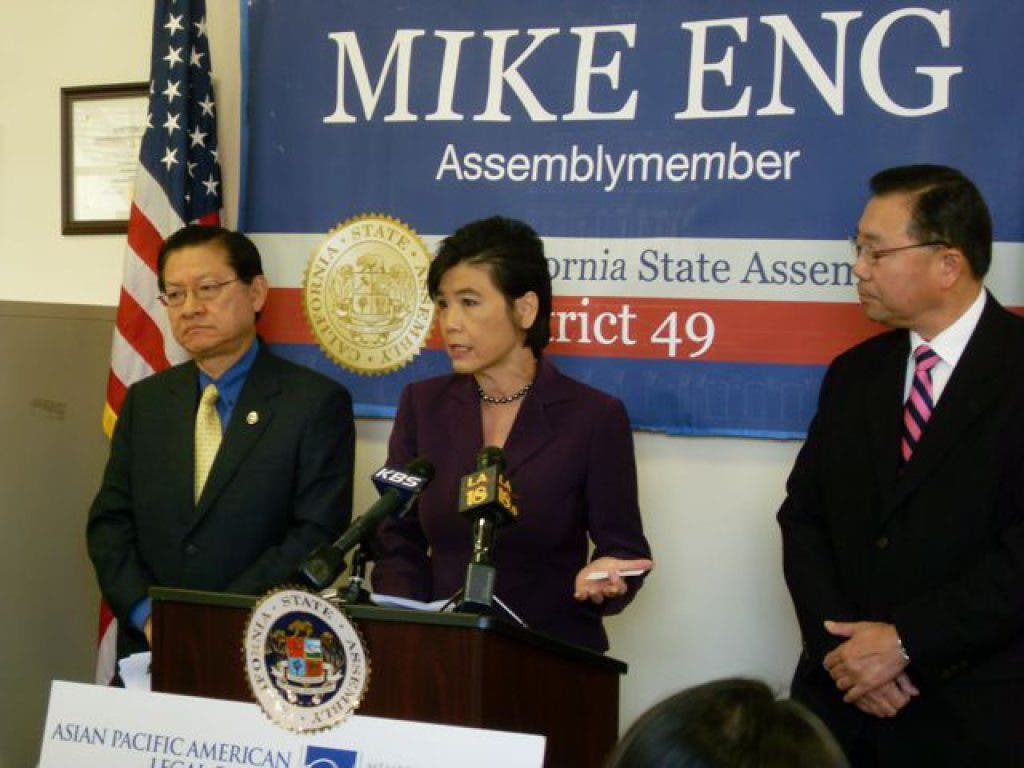


State , U.S. Rep. Judy Chu and a local legal organization gathered Friday in Alhambra to spread the word about an outreach program to increase citizenship among immigrants from Asia and the Pacific.
Eng—who just prior to the press conference at his district office attended an award ceremony at —promoted a March 26 workshop in Rosemead organized by the Asian Pacific American Legal Center.
"I noticed there were a lot of young people who could have parents that might be interested in this, and I think it's very important that residents of San Marino, which has a large immigrant population, take advantage of this opportunity," Eng said.
Find out what's happening in San Marinofor free with the latest updates from Patch.
The assemblyman and other speakers at the press conference referenced an increasing immigrant population with numbers that outpace the community's level of political representation.
Chu pointed out the benefits of citizenship, a key point in motivating immigrants to start the citizenship process.
Find out what's happening in San Marinofor free with the latest updates from Patch.
"There are so many ways that you can protect your children, that you protect yourself," said Chu, who represents the San Gabriel Valley in Congress. "We always talk about civic duty, but there are so many ways where your personal situation will be improved dramatically if you become a citizen, so it's well worth the effort. Once you become a citizen, nobody can take it away from you."
Eng, who is an immigration law expert, also highlighted several reasons for immigrants to become citizens.
Noting San Marino's family-oriented atmosphere, Eng said "for the immigrant population, what they may not realize is that when they become a citizen, they can increase the chances of having their relatives come and be with them."
He explained that "green card" holders can only sponsor the arrival of their immediate family, while a citizen "can sponsor your parents, your brothers and sisters, and your married children. That's very important to those families that want to build a new life here together and contribute to society."
Karin H. Wang, an APALC executive, pointed out that "the Asian American community is the fastest growing ethnic community in California. As we grow it's not just population that matters, it's actually who becomes citizens and who votes," she said.
"There's a misperception that just because we're a large presence in the state that somehow elected officials and policy-makers will pay attention to us," said Wang. "Maybe Mike and Judy will because they're Asian American, but the reality is if we don't become citizens and we don't vote, it doesn't matter if we're a large percentage of the state. We're still not a political voice."
APALC Director Stewart Kwoh said California's 800,000 eligible immigrants from the Asian-Pacific community haven't applied for citizenship. People of Asian descent make up 15.5 percent of the state's population.
"We thought this is a great time to have a citzenship campaign to encourage these eligible people to become U.S. citizens," said Kwoh. "The 800,000 people are longtime residents, and they are going to stay in the United States. They really should become a U.S. citizen because there's a lot of benefits, but just as importantly, a responsibility to get involved, to make shared decisions in communities."
Kwoh said the result is a stronger community in which "people feel more connected. We have a lot of challenges in our state. This is a time for people to pull together and make common decisions."
San Marino Vice-Mayor Richard Sun echoed the call for immigration-law workshops and noted the the educational value of the naturalization process.
"Learning the government structure of the United States, how the government was built 200-some years ago, would be good education especially for new immigrants," Sun added.
Part of the citizenship approval process requires applicants to pass a test on basic American history and civics.
"This is general information that is readily available, and I think it should be shared," said Vivian Chan, a San Marino resident who as a teenager emigrated with her family from Hong Kong. "There are a lot of immigration services but quite honestly you don't have to pay because it's all there."
Chan became a U.S. citizen and echoed the benefits mentioned by local officials.
Given the language and legal barriers that immigrants face, Chan was pleased to see a free community resource that will provide "the know-how of how to get the naturalization process started."
The March 26 workshop in Rosemead will take place at 3936 Muscatel Ave. from 10 a.m. to 4 p.m. More information can be obtained by calling the APALC at 213-977-7500.