Community Corner
Whales, Seabirds and Sharks: Exploring the Gulf of the Farallones
Wildlife viewing at the Farallon Islands is never what you expect.

Exploring the Gulf of the Farallones 28 miles offshore mostly invisible to the nearly one million residents of San Francisco lie the mysterious islands known as the Farallones. Discovered and named by explorer Juan Cabrillo in 1539, these rugged islands have experienced ship wrecks, shoot outs and destruction. Now part of our National Marine Sanctuary System, and protected by the Fish and Wildlife Service, the seabirds and marine life have a promising future for seabirds and marine life. Each time I cross the waters of the Gulf, I experience something different, learn something new and return as if I need my passport stamped. Recently we had an incredible visit to the Farallones with the local non profit The Christiansen Fund. This non profit funds important work protecting biodiversity and indigenous cultures across the globe and funding grassroots efforts to protect our fragile biodiversity, and indigenous cultures.
As usual, our wildlife experience started before we leave the dock. A California sea lion poked his snout above the marina waters as our guests boarded the Salty Lady- a classic fishing boat used for whale and wildlife watching. Typically, we exited under the Golden Gate in a light winds and marine overcast. Harbor porpoises furtively ducked in and out of the tidal shear in the deeper waters, as elegant terns dipped and screeched, plucking anchovies from the Bay. The sea was flat and oily calm as we encountered our first whale; a humpback feasting on anchovies among salmon fishermen and busy sea birds. Satiated sooty and pink footed shearwaters squat fat upon the water, too lazy to fly without the help of the wind beneath their feathered sails. Gulls and terns and common murres slurp up the silver fish as a whale surfaces and slides beneath them, oblivious of anything but the food.
After a half hour we headed west and exited the cover into a glittering sunny day. A light south breeze kept the kelp flies away as we entered Mirounga Bay at South East Farallon Island. The rocks are absent of the nesting murres but Brandt’s, double crested and pelagic cormorants peppered the salt colored stone. Gone from the rocks are the common murre nests that covered the crags earlier this year. Currently, the murre chicks swim alongside their fathers. Recently fledged and unable to fly, these penguin like birds pair up with Dad swimming and feeding until they are able to fly.
Among the cormorants a northern gannet has been reported and we spied the large “Booby”. Hailing from the east side of our continent, this is a rare sighting and equally strange, it is joined by a western gannet from the Hawaiian Islands.
The shark food- also known as elephant seals, California sea lions and Stellar’s sea lions toasted in the sun, but not a shark was seen. A disturbance near a patch of red raised hopes, but upon investigation we discovered a sea lion near a floating kelp paddy. The lack of sightings- a rare thing even when the sharks are most abundant- did not discourage our guests from learning about the behavior and biology of our great white sharks. Suddenly something broke the surface followed by several cries of excitement.
Find out what's happening in San Rafaelfor free with the latest updates from Patch.
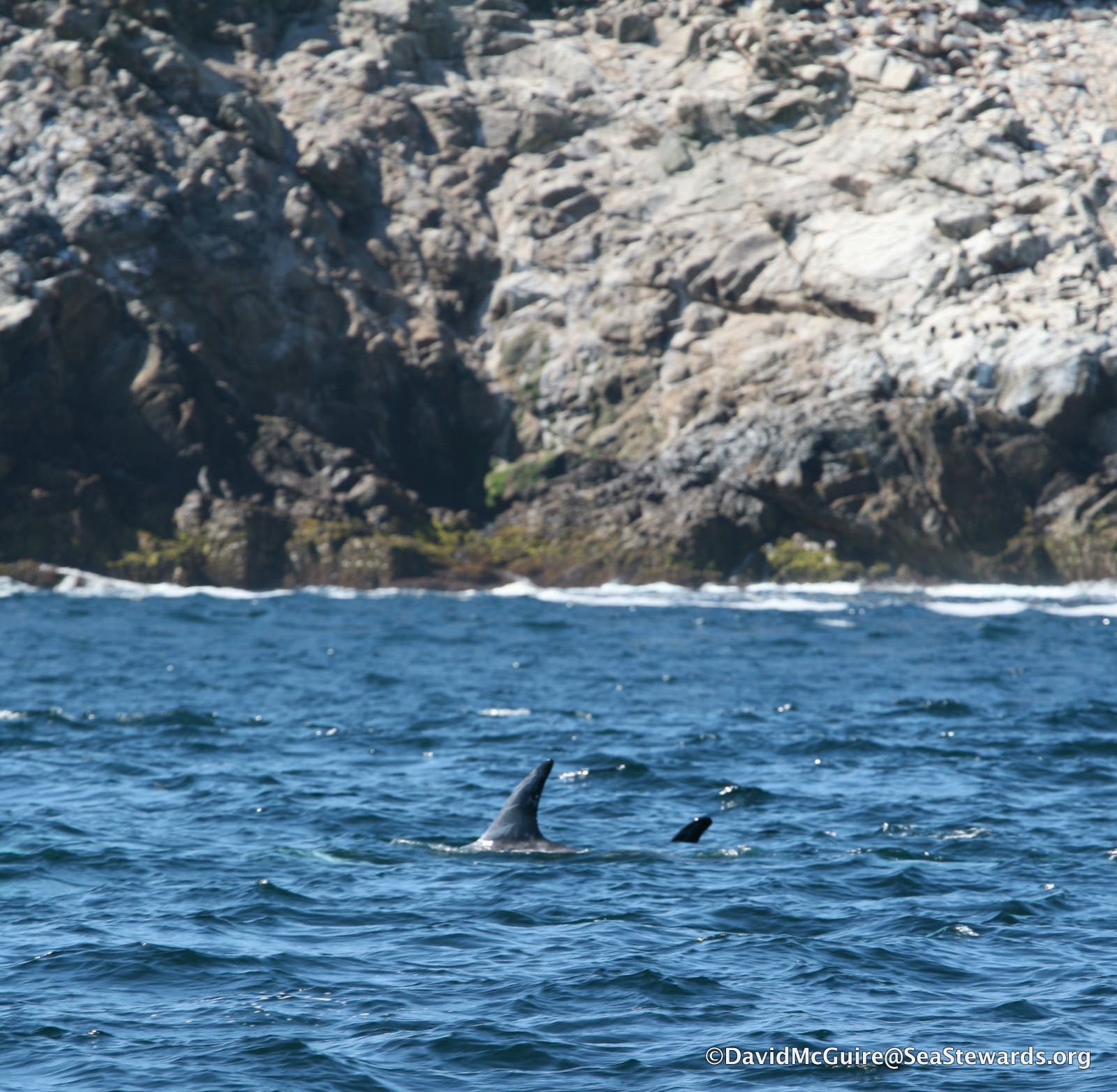
A large grey dorsal fin popped the surface, then another. “Look there!” White Shark?
No but almost as good to our crowd, as we watched a pod of 25 of Rizzos dolphins lolling along close to the island.
This is a strange year with sea water temperatures in the mid sixties. Most of the krill are absent and with the krill the large Blue Whales and the tiny Cassins auklets that feed on the small crustaceans, but the large numbers of anchovies are keeping the Humpbacks and seabirds happy.
Scores of brown sea nettles float beneath the surface- experienced first hand by my friend and marathon swimmer Joe Locke who swam the Gulf last July. These jellies are favorite food for leatherback sea turtles and Mola Mola, or ocean sunfish. Reaching over 14 feet and 3000 pounds, we spotted many juvenile sunfish lolling along at the surface.
We call the return of the sharks Sharktober, and instead of maligning the white sharks like Discovery Channel’s Shark Week, we are celebrating the shark with a series of education, talks and film events. We will be leading several marine education trips out into the Sanctuary, taking observations, collecting data and learning about sharks, as well as watching for whales and other marine life. You can join us on one of these unique Farallon Island Expeditions starting September 27 and in Octoberfor an unforgettable experience.
********************************************************************************
Shark Stewards is dedicated to conserving our ocean resources by saving sharks. Their work is recognized on the state, national and international policy levels around shark finning, the shark fin trade and creating shark sanctuaries. Each year Shark Stewards reaches over ten thousand students and public locally during talks and events, focusing on saving sharks. Shark Stewards is a non-profit project of the Earth Island Institute.
Please volunteer or consider donating so we can keep fighting for sharks.