Neighbor News
Santa Cruz County Governance Environmental protection and restoratio
Environmental protection and restoration
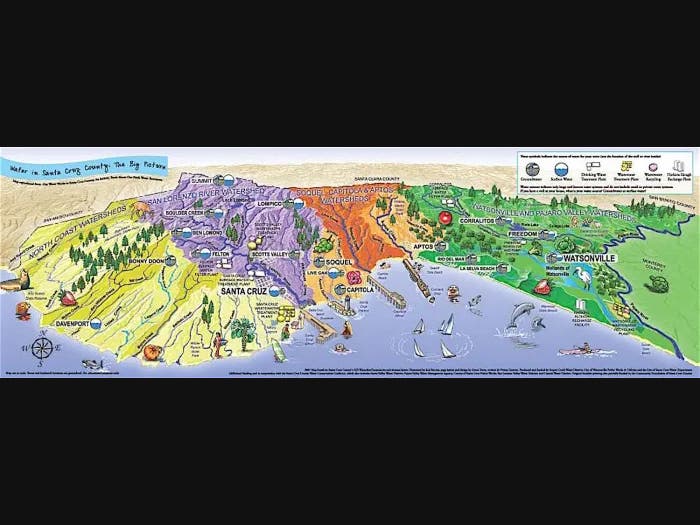
Santa Cruz County is the smallest county in California, with a population of some 270,000 residents living in a county of 670 square miles, 162 square miles of which is water. It contains four incorporated cities, Santa Cruz, Capitola, Scotts Valley and Watsonsville, surrounded by the unincorporated Santa Cruz County.
Local government consists of the County Board of Supervisors, four City Councils and a myriad of commissions, committees and advisory body, plus unelected staff in the various county and municipal governments.
- The County of Santa Cruz has 43 formal advisory bodies, listed and described HERE.
- The City of Santa Cruz has 14 formal advisory bodies, listed and described HERE.
- The City of Capitola has 7 formal advisory bodies, listed and described HERE.
- The City of Scotts Valley has 15 formal advisory bodies, listed and described HERE.
- The City of Watsonville has 4 formal advisory bodies, listed and described HERE.
The vast majority of county and municipal "environmental" activity is focused on climate change, Greenhouse gas emissions and climate adaptation. Environmental protection and restoration arises in response to development projects, especially those that require a CEQA Environmental Impact Report (EIR). Unfortunately, for the natural world, CEQA never prevents environmental impacts, it only regulates them. CEQA documents include a Findings of Facts and Statement of Overriding Considerations, which allow the lead agency for a project to present excuses for why the project should continue despite unavoidable and unmitigatable environmental impacts.
Find out what's happening in Santa Cruzfor free with the latest updates from Patch.
Since there is only a narrow single track pathway for environmental protection in county and municipal governments, local natural habitats and resources suffer impacts from government planned and funded growth and development policies and projects. County and city paid staff conceive of and plan development projects behind closed doors, revealing them to the public only when absolutely required, limiting the public to reacting to preordained project plans. Commissions and advisory bodies often meet semi-monthly or quarterly, making it impossible for the public to weigh in on proposed government activities in a timely manner.
Ironically, the County and municipalities have numerous ordinances, plans and policies for protection of the natural world, but no meaningful process for effective enforcement.
Find out what's happening in Santa Cruzfor free with the latest updates from Patch.
Click HERE for more details