Arts & Entertainment
Parkinson's artist
Local Johnny Huerta got hit with Parkinson's young. He has had to adapt to keep painting.

By Michael Ashcraft --
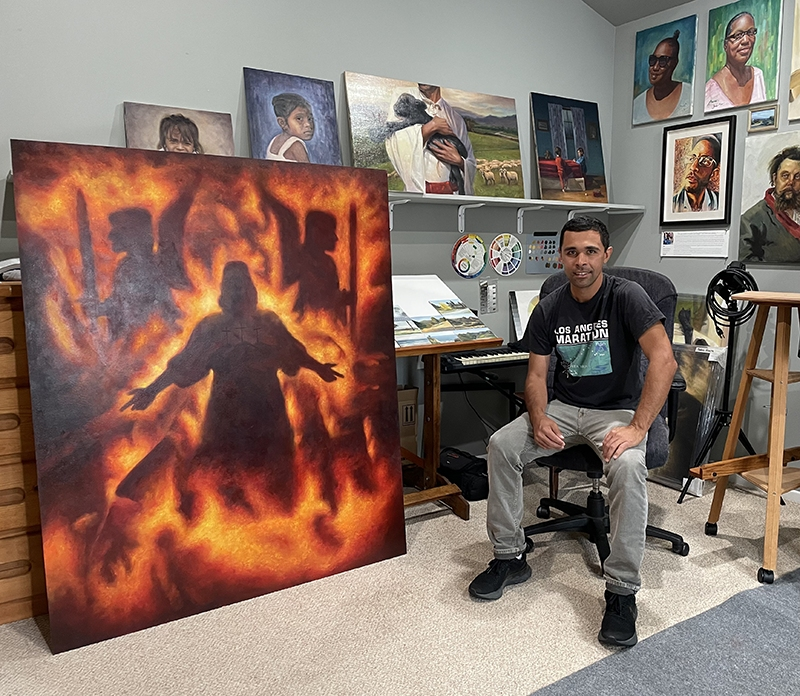
Johnny Huerta now paints with his left hand. Parkinson’s attacked his right.
“Parkinson’s affects different people in different ways,” says Johnny, an artist from Santa Monica. “Mine is rigidity more than anything.”
Find out what's happening in Santa Monicafor free with the latest updates from Patch.
A graduate from Los Angeles Academy of Figurative Art in Van Nuys, Johnny, 32, did a mural in Casa Blanca restaurant in Venice, but mostly he sells paintings online.
He’s a local who played baseball for Santa Monica High School’s winning 2007 team. He sometimes works as a waiter at his family-owned restaurant Gilbert’s El Indio Mexican restaurant.
Find out what's happening in Santa Monicafor free with the latest updates from Patch.
He’s right-handed. He noticed soreness three years ago but shrugged it off thinking it was just due to his heavy art workload while working on his bachelor’s degree in art.
Eventually, he realized it was more than simple soreness. “It was not like pain, it was a malfunction. It was scarier than a pain,” he says. “It wasn’t working the way it was supposed to.”
Parkinson’s is rare in younger people. But the brain scan showed dopamine deficiency, an early sign of Parkinson’s. Was his art career doomed?
Johnny didn’t waste time getting down about misfortune. He immediately started working on painting with his left hand. He’s semi-ambidextrous. He paints with his left now, sometimes guiding it with his right.
“You hear how you lose one sense and you gain another. It’s kind of like that. I’ve always done some things left-handed,” he says. “I batted left-handed and threw right-handed. I don’t know why. It was just natural.”
Johnny recently posted a time-lapsed video on Instagram @j_huerta310 of him painting a metaphor for his Parkinson’s. The painting served as a backdrop illustration for a speech he made in August to 500 youth at a church conference in Bakersfield. He told kids to not be held down by different difficulties and trials.
“We all go through fiery trials and tribulations, but they don’t have to define who we are,” Johnny says. “When something negative happens to us, we’re not rejected, we’re not a failure. I liked sports. In sports, there’s always a challenge, always something you have to persevere through. You have to adapt. It tests your faith and builds character.”
Johnny says the impairment won’t lessen the quality of his work.
“Maybe it’ll be less refined,” he says. “But there are beautiful pieces of art that are a lot more loose and there’s beautiful pieces of art that are a lot more refined. But yes, I probably have had to loosen my approach and brushwork, but that doesn’t mean the quality has go down.”
Johnny was so painfully shy in his childhood that teachers wondered if he was abused at home.
“I was always a quiet kid to the point in the elementary school teachers thought something was wrong with me. I was deathly afraid to say something stupid.”
In high school, drinking brought him out of his shell.
“As soon as I tried it, I immediately felt a release from the social struggle. I could be the person I thought I wanted to be. I received comments like, ‘you’re so much fun when you're drunk. That made me feel good,” he recalls. “But it also made me feel bad because it also says you're not good enough without alcohol.”
Alcohol dependence had another bad side. He started falling out of society. He skipped school and was ineligible to play baseball in his junior year of high school. He dropped out of college and drifted for about five years.
Then a friend invited him to church, and Johnny says he experienced God. He kicked the liquor and discovered a purpose to life, helping kids. He retook his passion for art and got an the degree.
Then Parkinson’s struck. Pretty much anybody would have seen it as a disaster: the very hand that produced masterpieces now became rigid, unable to manipulate the brush properly.
Johnny has maintained perspective. Parkinson’s has NOT introduced difficulty into the process, he says. It has simply shifted the difficulty already inherent.
“Painting is a struggle regardless,” he says. “As beautiful as a painting might seem and as effortless it might seem, there’s always a lot of work and a lot of frustration behind it. Sometimes its hard to tell if my frustration is because of my left hand or it’s because of a general frustration of making a painting.”
Michael Ashcraft teaches journalism at the Lighthouse Christian Academyin Santa Monica.