Community Corner
Savior of the Tongva springs retires from foundation
Angie Behrns fought developers, politicians, school officials and even homeless trespassers to preserve the Kuruvungna springs at Uni High.

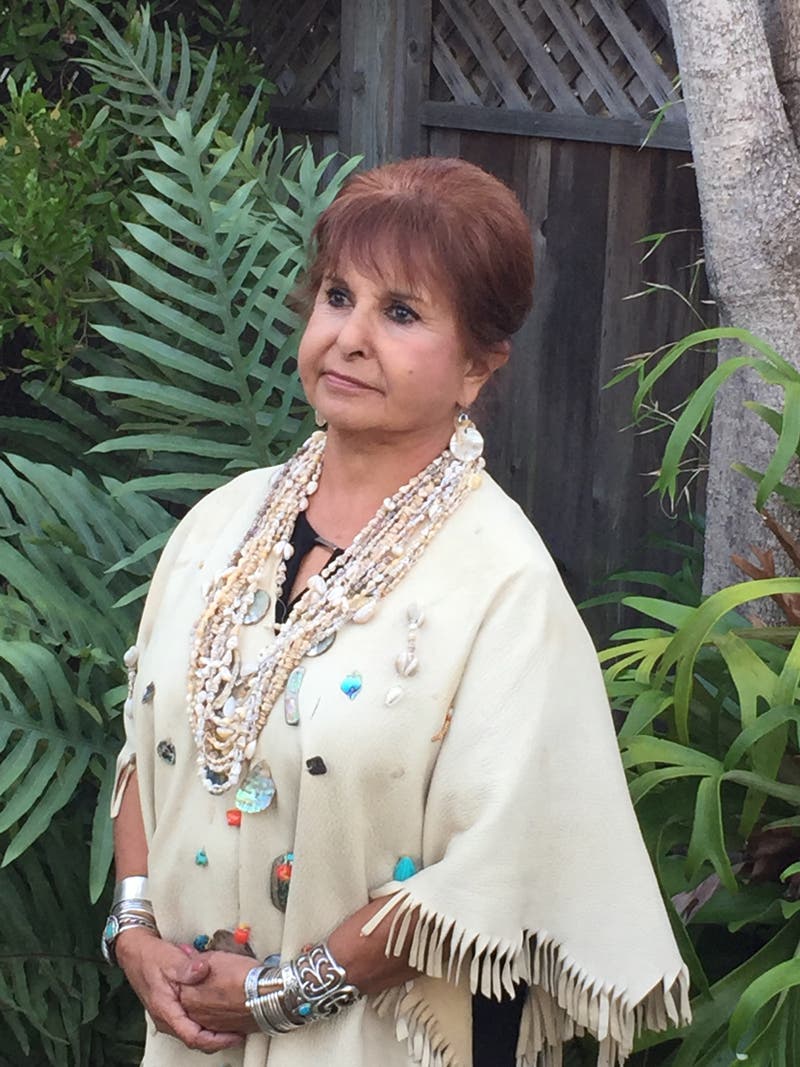
She fought to save the Tongva sacred springs at Uni High when a developer threatened to cut off the water supply. She fought to establish a museum with Native American artifacts on site. She fought to keep LAUSD from “mismanaging” grant funds to clean up the site that once was a village and burial grounds.
Now after 23 years of fighting, Angie Dorame Behrns, 78, a tribe elder, is quitting. The local Native American hero retired last month as president of the Gabrielino Tongva Springs Foundation, which helps administer the Southeast corner of Uni High where two springs bubble up the precious water that sustained the Tongvas before any white settlers came to the region.
“She’s been a one woman show,” said Ron Andrade, director of LA’s city-county American Indian Commission. “She has run that foundation. She did all the work to get that land set aside. She’s been a tremendous leader. I’m very pleased to see she is being kind to herself, but I’m very sad to see her go.”
Find out what's happening in Santa Monicafor free with the latest updates from Patch.
Thanks to Angie’s efforts, anyone can visit the springs – named the Kuruvungna Springs after the village that has been built over – every first Saturday of the month from 11:00 a.m. to 3:00 p.m free of charge.
“We’re going to miss her. She’s done a tremendous job,” said Tongva Chief Anthony Morales. “It’s kind of sad that she’s leaving. We thank her for keeping it going all this time.”
Find out what's happening in Santa Monicafor free with the latest updates from Patch.
The Spaniards called them Gabrielinos, but they called themselves Tongva. Their official name now is Gabrielino/Tongva band of Mission Indians of San Gabriel.
Angie always enjoyed the springs when she attended University High School in the 1960s. There were pine trees around them, and the students turned lunch time into a picnic around what was a natural wonder and beauty on campus.
Angie was reminiscing at a 1991 alumni reunion and wanted to show her husband, Don Behrns, the beauty of the springs. As they walked down the gentle slope towards the south side of campus, what she saw filled her with horror.
The lower springs were filled with garbage cans, school benches and trash. The site was completely overgrown. Tree trunks were defaced by graffiti.
“I felt like a knife had been plunged into my stomach,” Angie said. “I was totally sick at what I saw.”
For many years, the southeast corner, with the large “lower” springs -- had been used for horticulture classes. But years of disuse and neglect had destroyed the site that Tongvas considered sacred and is registered as a state historic site.
Wondering what to do, Angie called her brother Dan Dorame, and he told that the springs were destined to an even worse fate. The developer of the Barrington Plaza luxury highrise apartments on Wilshire Boulevard just north of the campus was planning a second phase to add three levels of underground parking that would block the flow of water to the springs, Angie said.
Angie resolved to fight. She joined forces with Uni teacher Loretta Ditlow who was part of an anti-growth group and began to attend neighborhood and city meetings.
“We brought every politician we could think of,” Angie recalled. “They were surprised because they didn’t even know the springs existed. I spoke with such passion before the groups. I told the Mexican-American city leaders, ‘This is your heritage too that you are neglecting!’”
In the meantime, Angie and her brother decided to clean up the springs themselves. On that first Saturday after seeing the site in a state of disaster, they climbed over the chain-link fence armed with garden tools. While Dan scraped the graffiti off the trees with a razor blade, Angie pulled out trash with a rake.
The next Saturday, they heard noises in a dilapidated greenhouse and happened upon three men, who apparently were living there. Dan ran for security, while Angie froze.
“I was scared,” Angie said.
School security officers escorted the subjects off campus. Inside the long-abandoned greenhouse, Angie found drug paraphernalia and apparently stolen radios and electric appliances, she said. This seemed to be their base for robbing the neighborhood, she said.
Warned to never return, the subjects stayed away. But to make sure, Angie broke the rest of the windows to deprive any form of shelter that homeless might find there.
After expelling the trespassers, Angie and Dan remembered they too were essentially trespassers who had “hopped the fence” to clean up. So for the next Saturday, Dan solicited and got permission from the principal to continue.
Eventually, Angie got her children and grandchildren all involved, and the family spent months and months cleaning up the springs site. Other Tongvas pitched in. Angie had to use her car and a rope to pull the heavy trash barrels out of the springs.
After months of drumming up support for the springs, Angie finally faced off with Los Angeles’ Planning and Land Use Management (PLUM) commission in 1992. Not intimidated by the politicians, Angie called each one out individually and demanded they vouchsafe heritage.
“I’m not intimidated by politicians,” she said. “I pay my taxes, so I pay their salaries. When I speak, I speak with passion.”
The PLUM commission voted against the variance for the parking structure, and the unique cultural and natural resource was saved. (Most of the springs site was built over in the 1920s when the school was constructed at a time when they lacked protocol for saving Native American bones and artifacts. A spring on the North side of campus gushes 250,000 gallons a day under a maintenance hole cover straight into the storm drain, she said.)
At the same time, the work of cleaning up the springs proved more than Angie’s family and fellow Native Americans could carry out alone. The Tongvas incorporated the Foundation in 1994 and lobbied politicians began for a grant, getting $250,000 with the help of then-State Senator Tom Hayden.
Angie contended with school officials, who oversaw disbursing funds, to make sure the funds weren’t squandered on frivolous expenditures, she said, adding that her success was only limited.
Angie won a lease for the local Tongva Indians to operate a museum and tours on the site. Many artifacts found are now stored on-site and exhibited. She herself gave innumerable tours to kids on field trips. Countless times she went to schools with artifacts and explained how the Native Americans lived.
When a faction arose in her tribe wanting reservation land to make a casino, she resisted them too.
There are meetings to attend all over Southern California. Recently, a meeting with Catholic leaders aimed to ask forgiveness for abuses during the colonial times. While some of the fellow Native Americans criticized the church harshly, Angie responded with largess.
“A lot of the Indians hate Christianity because their ancestors were beaten, torture and killed,” she said. “I forgave them for what they did in the past. We have to look to the future. I told them there was one God.”
Challenges remain ahead for the Foundation. A mid-campus spring that formed a beautiful 3-foot high waterfall has been diverted straight into the storm drain and fenced off because of concerns that dry-cleaning chemicals have seeped into the water in trace amounts and could endanger the students.
While safety concerns are critical, a well-designed construction could conserve the natural beauty of the waterfall and at the same time safeguard students, Angie said.
“I consider it destroyed,” Angie said.
University High School has pledged to restore the sacred waterfall but after almost two years nothing has been done. See related article.
But that is a battle for a future generation because she’s retiring. Voting will take place as early as this month.
“It’s a tremendous challenge for the Gabrielino Springs Foundation,” Andrade said. “She was very much embedded in the foundation.”