Arts & Entertainment
She wanted to dance ballet in L.A.
But since there was no professional company, Julie Whittaker joined forces with renowned dancers to form LA Ballet nine years ago.

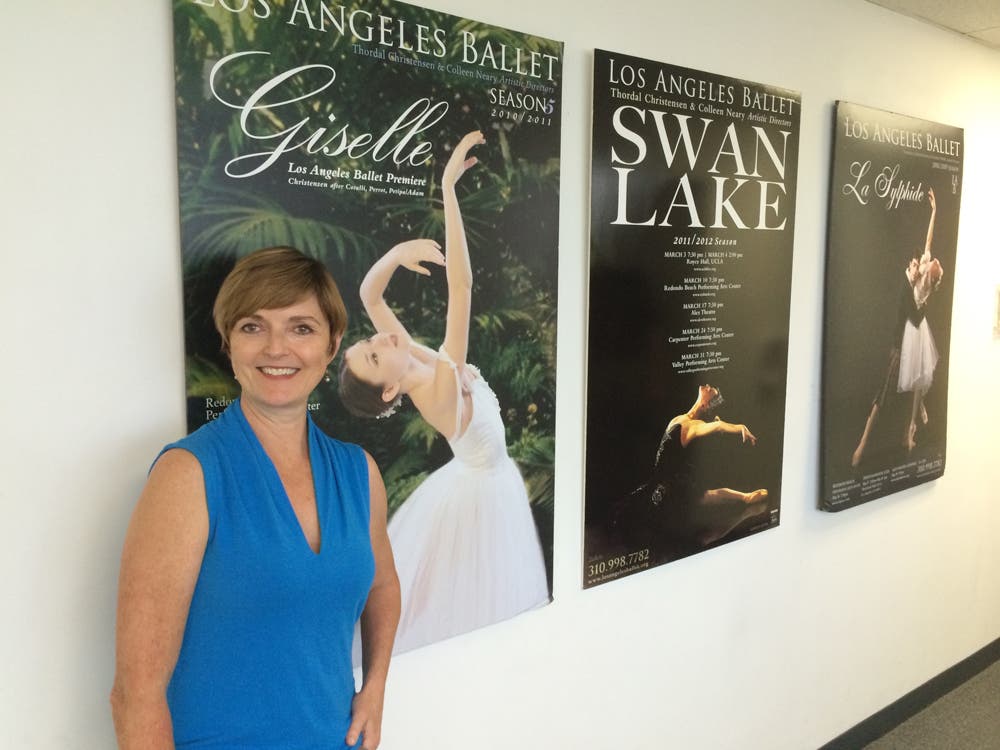
While touring with Canada’s Royal Winnipeg Ballet in Los Angeles, Julie Whittaker enjoyed the weather so much that she decided to sneak an audition in town when her bosses weren’t watching.
“I realized this was paradise, and I wanted to dance here,” she said. “So on my day off, I decided I would sneak off and audition for the local ballet company – only there wasn’t one.”
Today, Whittaker is filling that void. As executive director of the LA Ballet, she is the administrative workhorse who keeps the company – with its dazzling dancers and spectacular choreography – in business. The LAB just concluded its ninth season on Saturday at UCLA’s Royce Hall.
Find out what's happening in Santa Monicafor free with the latest updates from Patch.
“LA was the only major city in the world without a ballet company,” she said.
Eleven years ago, Whittaker joined forces with legends Thordal Christensen and Colleen Neary – with whom she taught at Santa Monica’s Westside Ballet School – to venture forming a professional company.
Find out what's happening in Santa Monicafor free with the latest updates from Patch.
With two significant previous failures in its history, LA was known as a graveyard for professional ballet companies.
The Joffrey Ballet tried to become a bi-coastal company with LA as its second venue for ten years until 1992. And John Clifford’s LA Ballet, which lost its rights to the same name, folded in 1985 after 11 years.
After two years of feasibility studies and planning and development, the LAB opened in 2007 with an annual budget of $900,000. It now sustains a company of 37 dancers with a $3.8 million budget – half of which comes from ticket sales and half from donations, Whittaker said.
“We’re going to continue with the model that has worked so far – slow and steady,” she said. “Hopefully we will grow every season – incremental, slow and steady is what I keep telling myself. From the beginning, we were not ever going to over-extend ourselves by being too ambitious too soon. That’s a mistake that I think was made in Orange County.”
After 45 years, Ballet Pacifica, to LA’s immediate south, closed. It’s relaunch effort floundered because organizers could never raise the projected $5 million needed for the first year, Whittaker said.
But if conservative budgeting has been the LAB’s blessing, it has also been its bane, as talent developed and honed here looks elsewhere for better paychecks. Saturday’s Directors’ Choice production witnessed the bittersweet departure of five talented dancers (some to retirement). Their replacements have already been contracted, Whittaker said.
With a shoe-string budget, the LAB maintains its headquarters and rehearsal studios in a converted old computer warehouse in West Los Angeles, with low-hanging ceiling pipes that have conked more than one high-jumping dancer. A skeletal administrative staff works more for the passion than the pay. Whittaker’s normal schedule is 15 hours a day, six days a week.
“We have a staff of 11,” she said. “We should have a staff of 50. I’m practically the CEO, the CFO and the COO.”
Meanwhile, Artistic Directors Christensen and his wife do all the rehearsals, all the choreography, all the auditions and recruiting and all the strategic planning for the artistic path ahead, Whittaker said.
“The artistic directors really know how to identify emerging talent,” Whittaker said. “Their eye is better than any artistic director I’ve seen in 47 years in the industry. They see potential in a recent graduate and develop her into principal dancer in five years.”
Whittaker started dancing at age 7 and retired at 30. She moved to LA in 1996 when her husband studied a Doctorate of Musical Arts at UCLA. She taught at the Westside Ballet School and got to talking with Christensen and Neary, who had moved to LA from the colder climes of the Royal Danish Ballet. Together, they devised an impossible dream to succeed where others had failed, establishing a professional company in LA.
The Music Center had hosted prestigious ballet companies on tour here for years, so “we knew there was an audience for dance here,” Whittaker said.
But the task seemed daunting considering the failure of previous attempts. Whittaker embarked on ambitious fund-raising campaigns.
“Whether you rise to that challenge or not is the crunch,” she said. “It’s everything whether you raise sufficient support in a city that houses the industry. Hollywood is not so much a competition (to ballet) as it is a distraction – as are the beaches and outdoor sports.”
The LAB hopes to tour the United States in a couple years.
“People used to say to me, ‘I didn’t know there was a ballet company in the city,’” Whittaker said. “We don’t get that any more. If they love ballet, they know we’re here.
“This city needs and deserves a professional ballet company,” Whittaker said. “You cannot be a cultural center unless you have all the components. We’ve had symphony music. We’ve had opera. Now we have ballet. LA is now a well-rounded and full-bodied cultural destination.”