Business & Tech
On the Job: For Him, All Signs Pointed Up
John Morley, a Santee signmaker and 2012 Chamber of Commerce president, never let polio get in his way.


admits he can be stubborn and a bit irascible at times.
As a signmaker by trade, he could probably hang up one of those “Don’t tread on me” banners and his family and friends would recognize the message.
“I have that stubborn streak today,” he says. “If you’re not going to help me, then get the hell out of my way and I’ll do it myself. I’m a firm believer in, ‘I’ll get it done.’ ”
Find out what's happening in Santeefor free with the latest updates from Patch.
But there’s a reason for it.
What do you do when you’re constantly told you can’t do something? How do you react when life throws you a curve at age 4? How do you adapt when the hurdles put in your path are higher than the ones in front of others?
Find out what's happening in Santeefor free with the latest updates from Patch.
For Morley, 61, the answer has always been to tune out the naysayers and clear the hurdles. Tell Morley he can’t do something, and that’s his green light to do it.
In 1954, Morley was stricken with polio. His life became a series of long hospital stays, surgeries, rehab sessions and learning to walk with braces and crutches.
Developing a stubborn streak allowed him to survive and thrive.
“I used to climb trees,” he recalls. “Didn’t have the use of my legs, but I would pull myself up with my arms. And I’d climb trees that way.
“My mom would say, ‘Well, he’s going to do whatever he wants to do.’ And that’s the way she was. If you don’t try it, you don’t know what you can do. You’ve got to try it. She always instilled that upon me: ‘Try it.’ So my stubbornness is, ‘I’m going to do it.’ ”
When told that his dad describes himself as stubborn, Corey Norman chuckles softly and says, “Yeah, I could see that.”
Norman and his father have worked together almost nine years in their Santee business, , since Norman was 15. Both father and son say it’s been an enjoyable partnership.
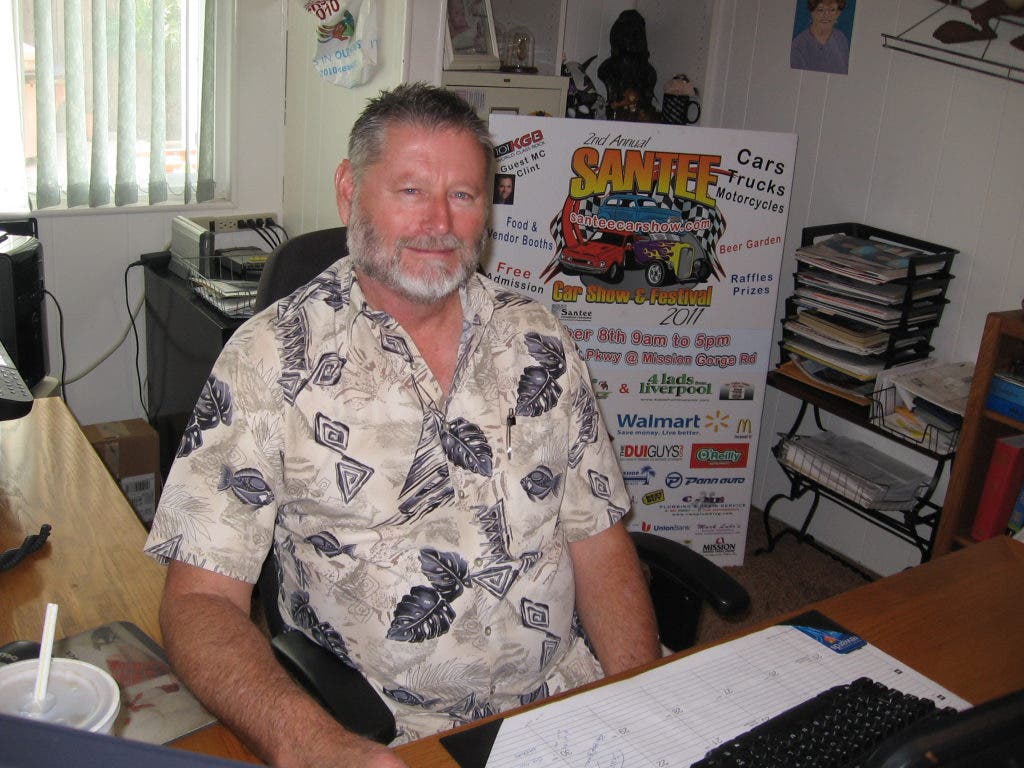
On a recent weekday morning, Morley sat at his desk in his home office, surrounded by family photos. His little sleeping dog, Pepper, was in a nearby chair.
Morley says his drive to succeed and his stubborn stance – often manifested in his perfectionism in his work -- don’t mean that he’s combative. Far from it, he says.
“I’m not a fighter, shall we say,” he says. “I believe in talking things out.”
But he remembers a lesson from his mother about sticking up for himself.
“I came home (from elementary school one day) and I told my mom that the kids would pull my crutches out and make me fall. That’s what the kids used to do.
“And she told me, ‘Next time a kid does it, just hit him over the head with your crutches. Hit him with your crutches. He won’t do it again.’
“Of course back then you could do those sorts of things. Today you’d be put in jail. So, I knocked the hell out of the kid with it, and I never had anybody pull the crutches out from me again.”
East County roots
Morley has deep roots in East County, aside from his business. He’s lived in Santee since 1999, but before that lived in Lakeside and El Cajon. In 2012, he’ll be the president of the . He’s involved in the and is chairman of the .
He became a sign maker in a roundabout way, following nearly 25 years making circuit boards for San Diego companies, and then managing storage units. Eventually he and his wife, Brenda, were looking for a more interesting venture, and bought a Pak Mail franchise in Santee in 2002.
Morley had to receive training in packing and shipping. He liked the business, but he jokes that his kids called it “The Store That Stole Christmas,” because of how much work was required in December.
However, the purchase of the Pak Mail franchise included a signmaking business.
“It was a lot more fun designing signs,” says Morley, so in 2005 the Pak Mail store was sold and Morley & Son became John and Corey’s primary business.
From the start, Morley says he liked the challenge of it.
They do window signs, marquees over stores, banners for special events, vehicle graphics, flags and brochures.
Morley does most of the design work, and consults with the customers about what they want. Norman does most of the hands-on installation.
“I like the challenge of trying to make it work, to see what they want, talking with the customer,” says Morley. “I’m a believer in meeting one-on-one. I’m old school like that.”
Because he’s been a business owner himself, Morley says he has good insight into what customers want in their signs. He wants to catch people’s eyes and present the pertinent information “but not be too busy.”
Once he gets ideas from the customer, he sits down at his computer and, using a program called FlexiSign, creates a variety of designs to offer the client, and uses logos, photos or graphics as needed.
That, he says, is where “the perfectionist in me comes out,” as the design process morphs into the actual installation.
“If I don’t like it, the customer won’t like it,” he says.
‘It doesn’t slow him down’
These days, you won’t find too many Americans who contracted polio. Because Jonas Salk came up with his vaccine less than a year after Morley was afflicted, the disease basically has been eradicated since the ’60s.
Morley has been asked to speak twice at local Rotary meetings about living and coping with polio, and he says he’s often the subject of curiosity by nurses and doctors who’ve never encountered a victim of polio.
When he was in the hospital a while back for something else, “15 to 20 nurses” asked if they could come see him and speak with him.
Otherwise, polio is just part of Morley’s life.
He walks with a limp, but does whatever he wants. As he said in one of his talks, “I have not let polio lead my life, I have led my life.”
Says his son: “It doesn’t slow him down. No one (in the family) treats it as anything special. We expect him to work.”
Morley, in fact, looks back fondly on his youth and his long stays at Shriners Hospital in Los Angeles, where he was accepted in 1958, three years after he was selected the Easter Seals poster child for polio victims. He had 14 operations in eight years at Shriners to correct lower-body paralysis and leg deformities.
And while there, he made wonderful friends with the other children, nurses and doctors. He recalls they often got in trouble for making too much noise on their floor, because the nurses lived right below them.
“Thank God for Shriners,” he says, noting that the psychological counseling the kids were given was as important as the medical attention. It was easy, he said, for he and others to ask, “Why me?” But they were advised to think “Why not me?” and make the best of what they had.
Today, that’s exactly what Morley has done.
Especially when he looks around his office and sees all the photos of his family – his adult sons and daughters and his grandchildren – he feels blessed.
In particular, he says, having his daughter, Amanda, and her daughter Kayla, 7, live with them while Amanda finishes nursing school, is a daily joy. Having Kayla around puts a smile on his face.
“She’s a big part of my life,” he says. “She says, ‘I’m the sign girl.’ ”