Community Corner
LaCanada Presbyterian Church Presents Samuel Beckett's "Waiting for Godot"
"Absurd" Play Continues Dec. 18 and 19; Offers provocative insight into "Meaningful Waiting"



Photos by: Tina Tong
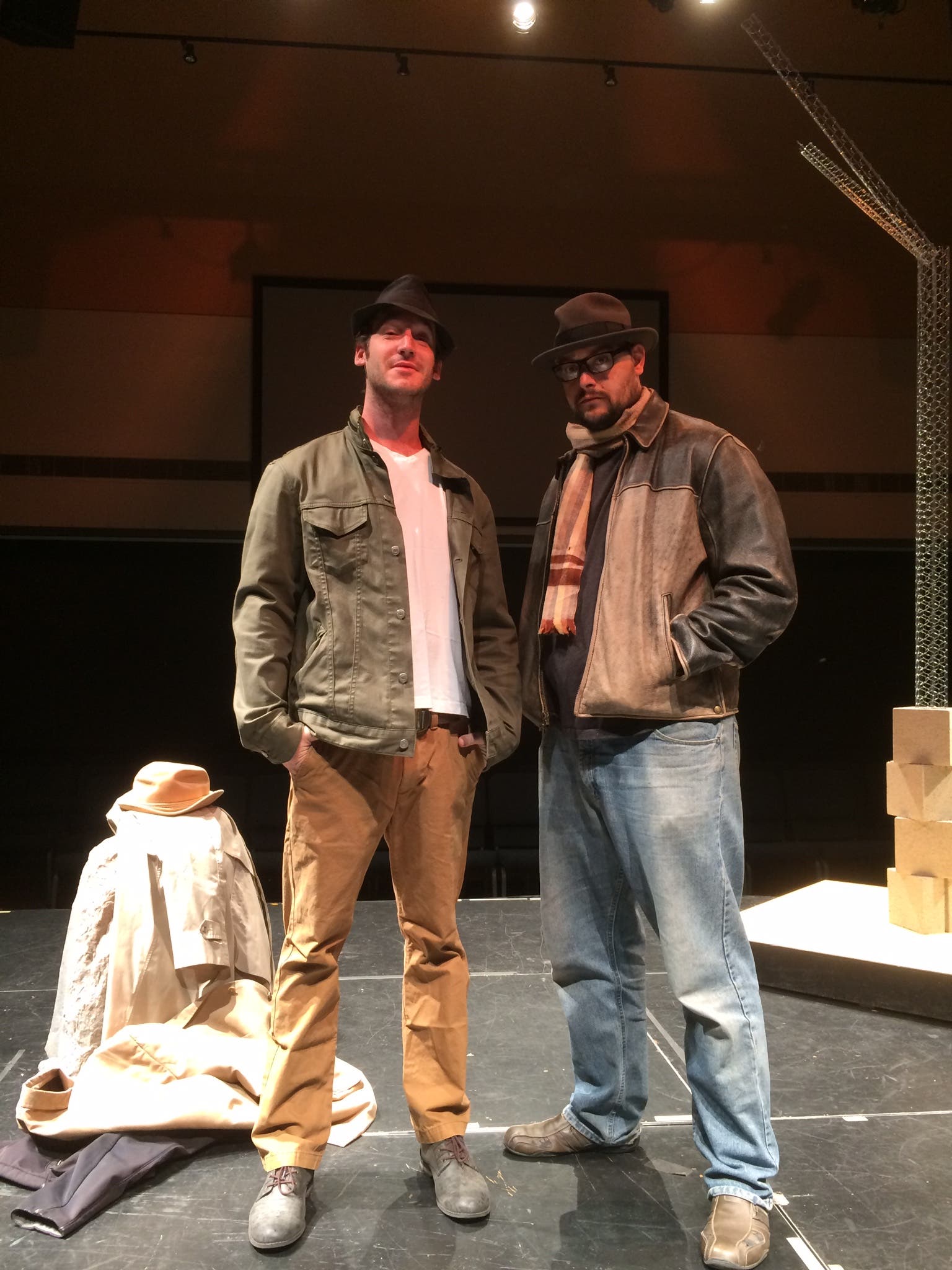
Left to right: (1) William Waters (Vladimir ‘DiDi’, Justin S. Fisher (Estragon ’GoGo); (2) Emma Waters (Lucky), Justin S. Fisher (Estragon ’GoGo’); (3) Susan Magee (Pozzo), Emma Waters (Lucky)
LCPC’s Waiting for Godot (Samuel Beckett)
Find out what's happening in South Pasadenafor free with the latest updates from Patch.
Review by J. Murphy Patterson
A beautifully adorned Christmas tree catches the eye at a lobby entrance of LaCanada Presbyterian Church’s current production of Samuel Beckett’s modern classic, “Waiting for Godot.” Overhearing comments, director Tina Tong welcomed audience members by offering friendly anecdotes to address questions about the décor.
Find out what's happening in South Pasadenafor free with the latest updates from Patch.
Already, overtures of the church’s play are introduced: “Why?” and “What is the meaning of this?”
In this season when many churches and theatres perform the traditional Dickens favorite, “A Christmas Carol,” LCPC’s Pastor Gareth, a fellow thespian, told his Drama Ministry team “Waiting for Godot” was his dream production. He felt the play’s title ‘Waiting for Godot’ as wordplay on “Waiting for God to” would make a compelling message theme.
In conjunction with Gareth’s Advent preaching series, “Meaningful Waiting,” through its main characters, Estragon “GoGo” (LCPC Drama Ministry Director Justin S. Fisher) and Vladimir “DiDi” (William Waters), the tragicomedy explores the definitive value of the passage of time; anticipation; boredom; friendship; loneliness; purpose of life and a variety of uniquely human characteristics.
When the original French-language piece, En Attendant Godot (Waiting for Godot) premiered in 1953 at the Theatre de Babylone in Paris, the literary world was shocked by the appearance of a drama so different and yet intriguing enough to generate the term “Theater of the Absurd” and inspire a movement of playwrights who identified with Beckett yet developed independently.
“Absurd” plays abandon all commonly accepted aspects of character, motivation, reaction, settings, language, and cause-and-effect relationships. Just as in life, it’s often impossible to make sense of things; the world is depicted as menacing and unknown. The dramatic situations make audiences uncomfortable and frightened but are simultaneously poetic and familiar.
Act I opens with bedraggled GoGo and DiDi hanging out together with nothing around them except a rock and bare tree. GoGo’s iPhone adds a modern element, but the two men don’t use it to entertain themselves while they anticipate the absent Godot, an unspecified person who has instructed them to meet him at the tree. It is their second day of waiting, and they clearly exhibit numerous signs of impatience and boredom. Yet they persevere, believing Godot will remain true to his word.
Suddenly there’s a loud cry and the arrogant Pozzo (Susan Magee) arrives with Lucky (Emma Walker), a young woman she refers to as “It.” With a rope wrapped around her neck and bearing the burden of a pack animal, Lucky doesn’t move or speak except at Pozzo’s command. GoGo and DiDi are intrigued, but make no efforts to free her, instead treating the troubled girl like the “pig” Pozzo calls her.
After Pozzo and Lucky have departed, a messenger (Ellie Boggs) arrives to tell GoGo and DiDi that Godot will not be coming to meet them that day, but will surely catch up with them “tomorrow.” Although they speak of going home and giving up, the two men remain in the same desolate place.
In Act II, GoGo and DiDi can’t seem to distinguish between fantasy and reality. They can’t remember if what has taken place so far actually happened or if they imagined it. The barren tree has come to life; director Tina Tong has designed its elements to parallel Christmas traditions.
Pozzo and Lucky come back to see them, but it’s a much shorter visit and Pozzo is has suffered some physical changes. The messenger also returns, again informing the men that Godot will not arrive that day, but “surely tomorrow” will be there as promised. Again, the men talk of going home yet continue to wait and pass their time in the same dull, unproductive way as before.
In spite of its unorthodox and bizarre elements, many relevant, current parallels can be drawn from “Waiting for Godot,” or viewers may choose to regard its purpose as complete nonsense. Either way, the outstanding cast entertains and educates its audiences through skilled portrayal of an intelligent, challenging work.
“Waiting for Godot” continues at LCPC, 626 Foothill Blvd, LaCanada, on Friday, Dec. 18 and Saturday, Dec. 19 at 8 p.m. For more information, visit www.lacanadapc.org or call (818) 790-6708.