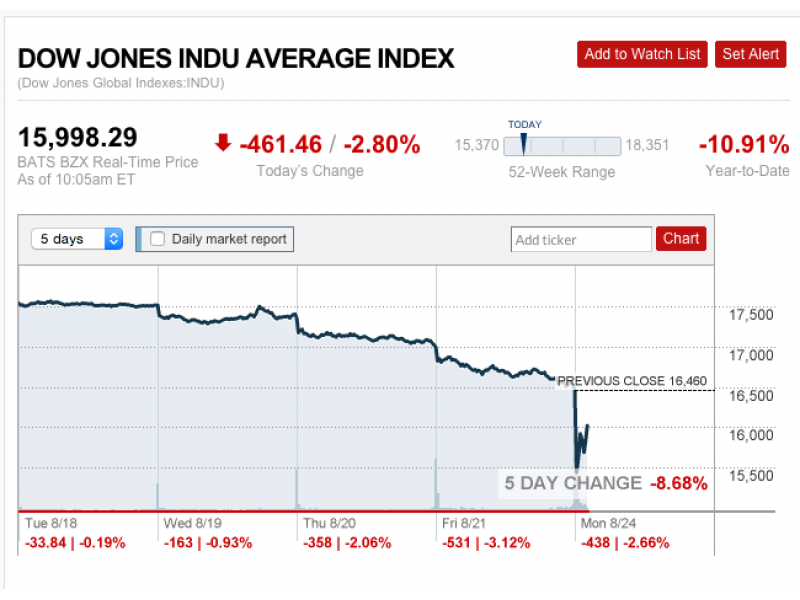
The Dow Jones plunged more than 1,000 points Monday morning, causing some not-quite-panic on Wall Street before rising again and going all yo-yo on nervous investors.
The downward trend continued Dow’s 530-point drop on Friday, its worst single-day decrease since 2011.
Find out what's happening in South San Franciscofor free with the latest updates from Patch.
So, what’s going on? And is there reason to panic?
Patch spoke with Daniel Johnedis, chief investment officer at Strategic Wealth Partners, to get his take.
Find out what's happening in South San Franciscofor free with the latest updates from Patch.
1.Don’t Panic
Your 401(k) and other retirement accounts should be fine over the long-term.
Monday’s plummet and last week’s decline were part of a trend expected by many financial analysts.
“We don’t believe there’s a global crisis going on,” Johnedis said. “We just believe it’s a natural correction.”
So, there’s no need for someone to freak out and sell off all of their long-term investments.
“What I would say more importantly is to hold on,” Johnedis said. “Your 401(k) is a long-term investment. These funds that you’re invested in are going to come back. By year-end, we very likely will see definitely a stronger market than what we’re seeing today.”
2. If I Shouldn’t Panic, Why’s This Happening?
These last few years have been a good stretch for the U.S. economy, with good housing numbers, low gas prices and a decreasing unemployment rate.
That creates confidence for consumers, who have more money to buy and invest, to the point where stock prices exceed a company’s true value, Johnedis said.
At some point, those prices have to fall.
“When the market goes up and up there’s always a period called correction,” Johnedis told Patch. “Just to get back to what we call equilibrium, where the value of the company, the value of the stock, is equal to the value it’s trading at.”
Major companies like Walmart, Lowe’s and Target didn’t meet Wall Street’s projections, which were based on those inflated stock prices.
“The other part of that is fear,” Johnedis said. “When people start seeing things trade down, there’s a snowball effect.”
3. No Sign Of A New Recession
Last week’s decline was in line with those predicted corrections. Analysts don’t believe that the recent trends are a sign of doom and gloom to come.
“That’s absolutely not our belief,” Johnedis said. “Our belief is that this is a correction, and a correction is a 10 percent change in the market, and we believe that was long overdue. “The global economy is still relatively strong.”
The natural corrections like this mostly affect short-term traders, according to Sean Williams, an investment writer. So the average Joe saving up money for retirement should just stay put.
“Another important point you should realize is that stock market corrections really aren’t an issue if you remain focused on the long-term with retirement as your goal,” Williams wrote in USA Today. “The only people who should be worried when corrections roll around are those who’ve geared their trading around the short-term.”
4. Continuing A Bad Week
Monday’s plummet was a sort of carryover from last week, when the U.S. correction began in full force.
Historically when there’s a decrease at the end of the day, as was the case Friday, “The very next day the market’s going to be sold off,” Johnedis said. “The momentum is still there.”
Investors had the whole weekend to worry about the bad week, and many put in orders to sell, which all hit at the same time when the market opened Monday.
“Fear will drive the market on Monday morning,” he said. “There’s all these outstanding orders in inventory waiting to be hit first thing Monday morning. I would say by the end of the day, it could even be positive or close to being flat.”
5. China Had A Role In This
China’s economy is going through a similar phase.
Over the last decade, China’s economy grew to “one third of industrial production in the world,” according to Johnedis.
“What happened lately is kind of the same thing,” he said. “China’s markets raised way too quickly.”
China recently devalued its Yuang currency, too, to help ease into that correction, which had a ripple effect into investors in the United States who had investments in China.
“They were losing money in exports because the value of the Chinese Yuan was so strong,” Johnedis said. “So when they devalued it, they did that so that they could increase their exports and decrease their pressure from foreign investors.”
Screenshot via CNN
Get more local news delivered straight to your inbox. Sign up for free Patch newsletters and alerts.