Schools
Daughter of Civil Rights Leader Tells Dad's Story
Karen Korematsu spoke to South San Francisco High School students about the legacy of her father, Fred Korematsu.

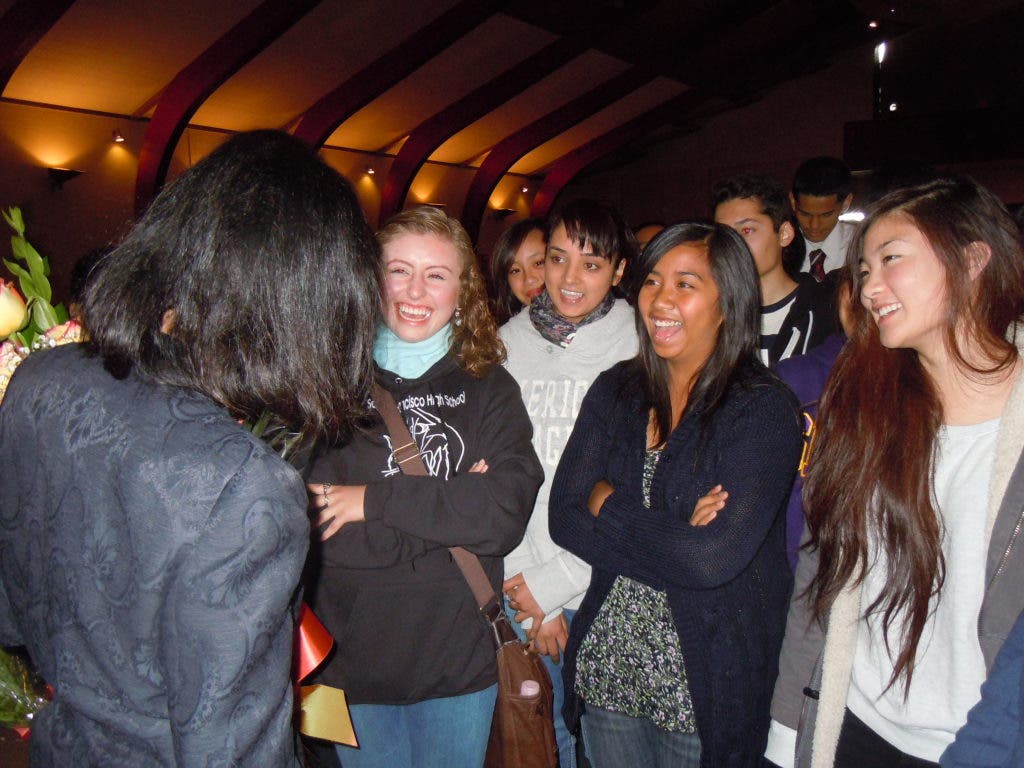
At a special Wednesday morning assembly, students got a unique look into the story a civil rights hero whose case went all the way to the Supreme Court but whose roots are just a few miles away.
Fred Korematsu was an Oakland native and Japanese-American who protested his forced internment during World War II. His daughter, Karen Korematsu, came to South City High School to share his story and explain how it affected his life and hers.
In 1942, President Franklin Roosevelt signed an executive order authorizing the military to remove people of Japanese descent from the West Coast and into internment camps, believing they were a threat to national security after the bombing of Pearl Harbor. Most, like Fred Korematsu, were American citizens who were forced to abandon their lives and homes.
Find out what's happening in South San Franciscofor free with the latest updates from Patch.
At the age of 23, Korematsu defied the order and was arrested on May 30, 1942. The ACLU took his case and fought it all the way to the Supreme Court. In Korematsu v. United States, the court upheld the internment program, and Korematsu spent the war in internment camps.
His first stop after being convicted was an ad hoc assembly center set up at the Tanforan Racetrack (now the mall in San Bruno), where conditions were primitive.
Find out what's happening in South San Franciscofor free with the latest updates from Patch.
“As my father indicated, prison was a lot better than the horse barracks,” Karen said.
Other Japanese-Americans at Tanforan discouraged him from continuing to pursue his case.
“No one wanted anything to do with him,” Karen said. “They thought some harm would come to them if they fought this. Everyone wanted to show they were good Americans.”
Karen said her father’s felony record followed him throughout his life, and like many other Japanese-Americans, he never talked about his experience during the war. Karen said she first learned of his place in American history while listening to a friend’s oral report at her high school in San Leandro.
“She went on talking about this famous Supreme Court case, Korematsu v. United States,” Karen said. She thought, “Korematsu, that’s my name. I knew it was uncommon.”
Karen’s mother confirmed the case was about her father; she said they hadn’t told her before because “It just never came up.”
When she asked her father about it, he wasn’t eager to speak.
“I could see the pain in his eyes, and I could see this wasn’t something he really wanted to talk about,” she said.
But later in his life, Fred Korematsu resumed a public role. He worked with attorneys to reopen his case in 1983.
“He said he felt like what the government did was wrong, it was unconstitutional,” Karen said.
After Korematsu’s attorneys showed that the government suppressed evidence that Japanese-Americans didn’t pose a threat, his case was overturned by the U.S. District Court of Northern California. In 1998, Bill Clinton awarded him the Presidential Medal of Freedom. Korematsu died in 2005.
Dozens of students stayed behind after the talk to speak to Karen Korematsu personally.
“It’s very inspirational because a lot of times when I hear about civil rights, I don’t hear about the Asian side of it,” said senior Oscar Ho, 18.
Andrea Gonzalez, 17, a senior, was emotional after the speech because it reminded her of her own dreams to fight for justice.
“My parents were deported because they’re not citizens,” she said. “Sometimes I hope I can fight for it and there will be immigration reform. It’s really important that there are people willing to fight.”
Karen Korematsu drew sharp lessons between her father’s case and civil rights issues today. Her father spoke up for the civil rights of Arab-Americans after Sept. 11, 2001, and both he and she have filed friend of the court briefs in defense of Guantanamo Bay detainees.
“Everyone should have their day in court,” Karen said. “Be involved in local politics and national politics, and vote, vote, vote.”
Get more local news delivered straight to your inbox. Sign up for free Patch newsletters and alerts.