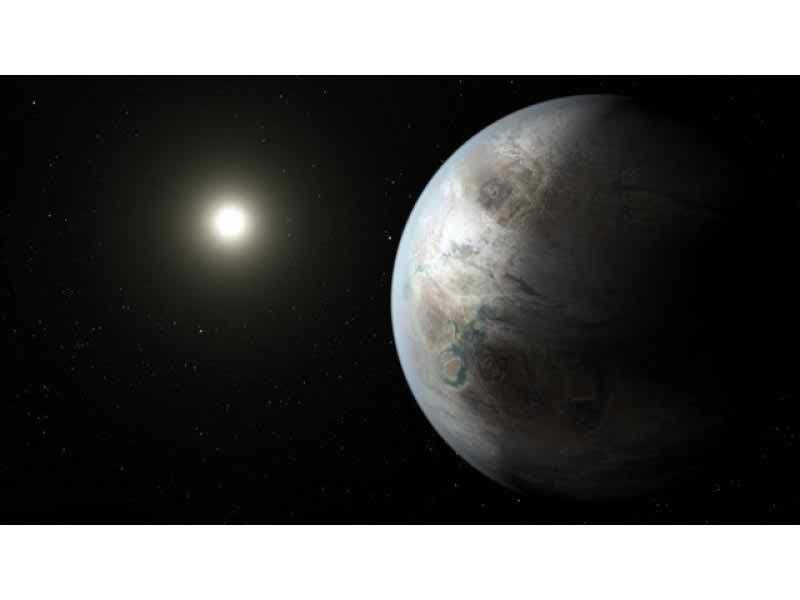
Photo courtesy of NASA
By City News Service
NASA’s Kepler orbiting telescope confirmed the existence of an “older, bigger cousin to Earth” 1,400 light years away — the first planet known to be in a habitable zone around a sun-like star, the Jet Propulsion Laboratory in Pasadena announced.
Find out what's happening in South San Franciscofor free with the latest updates from Patch.
Kepler-452b is larger than Earth and takes 385 days to orbit its parent star, according to NASA. Its orbit is distant enough from the star for liquid water to pool on its surface, and not so far away that the water would be in a frozen state year-round.
“We can think of Kepler-452b as an older, bigger cousin to Earth, providing an opportunity to understand and reflect upon Earth’s evolving environment,” said Jon Jenkins with NASA’s Ames Research Center, who led the team that discovered the planet.
Find out what's happening in South San Franciscofor free with the latest updates from Patch.
“It’s awe-inspiring to consider that this planet has spent 6 billion years in the habitable zone of its star, longer than Earth,” Jenkins continued. “That’s substantial opportunity for life to arise, should all the necessary ingredients and conditions for life exist on this planet.”
Scientists believe Kepler-452b is a rocky planet but the “ingredients and conditions” there are unknown.
The star — Kepler-452 — is 1.5 billion years older than the sun, is 20 percent brighter but has the same temperature, according to NASA. It is in the constellation Cygnus.
Since its launch in 2009, the Kepler spacecraft has spotted 4,696 exoplanet candidates, 1030 of which subsequently were confirmed to be planets, according to NASA.
JPL managed Kepler mission development, and the Ames Research Center in Moffett, Calif., manages the Kepler mission and its subsequent mission — dubbed K2.
Get more local news delivered straight to your inbox. Sign up for free Patch newsletters and alerts.