Politics & Government
Temecula Pushes Back Against Massive High-Voltage Transmission Lines Planned Through The City
Towers and lines would span over 100 miles, from San Onofre, southeast to Imperial County. The proposed route is directly through Temeucla.


TEMECULA, CA — Over 100 miles of overhead high-voltage power transmission lines — spanning three Southern California counties — are proposed to cut directly through Temecula, if approved.
On Tuesday, San Diego Gas & Electric, which owns the Golden Pacific Powerlink, held the first of its virtual open houses, as the project moves toward the environmental review and permitting process. Though no final route has yet been selected, the plan presented to residents in the Zoom session shows a route that would directly push through town. The Golden Pacific Powerlink remains in the early planning and environmental review phase and is subject to CPUC review and approval, said SDG&E spokesperson Alex Welling.
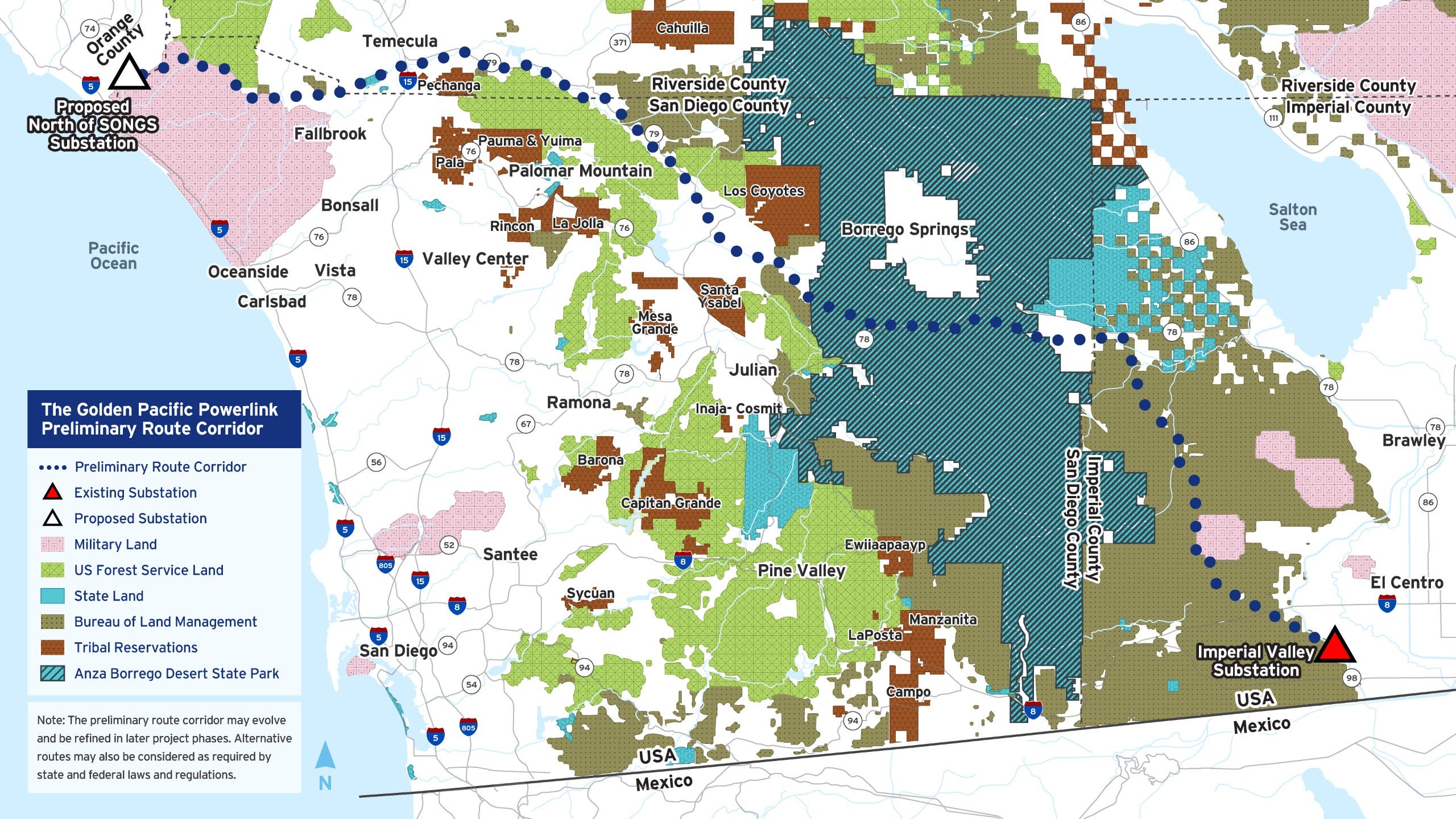
As planned, the project would consist of 500-kilovolt electric transmission lines carried on 120- to 190-foot-tall towers. The lines would run from the Imperial Valley Substation, through the Anza-Borrego Desert State Park where an existing 69-kV line runs, and across U.S. Forest Service land in San Diego County.
Find out what's happening in Temeculafor free with the latest updates from Patch.
The lines would then reach into Riverside County, slicing across state Route 79 South, passing Vail Lake and Galway Downs, then follow Temecula Parkway via Temecula Creek, before heading west across Interstate 15 toward the De Luz Heights area, and through Camp Pendleton to a proposed substation just north of San Onofre.
Locals have responded to the project with vocal and written dissent, as have both city and tribal officials, who say the route could threaten wildfire-prone land, property values, and culturally significant resources without directly serving Southwest Riverside County customers.
Find out what's happening in Temeculafor free with the latest updates from Patch.
Welling said the lines will add to California's much-needed power-grid infrastructure. Though it will not directly serve Temecula residents' power, as this is a transmission line, "this project is part of California's interconnected electric grid, designed to support reliability and meet growing demand across a broader system." The city's power supplier is Southern California Edison.
Temecula City Councilmember Brenden Kalfus opposes the project. He was the first councilmember to release a statement explaining his position.
"I do not support their plan to bring the Golden Pacific Powerlink project through the Temecula Valley," Kalfus said. "Temecula is not the right place for this type of infrastructure."
A firefighter-turned-city councilmember, Kalfus added that the proposed corridor is in a high-severity wildfire zone.
"This raises serious public safety concerns," he said. "In California, we know all about wildfires."
Over the weekend, a petition opposing the project was launched by Temecula resident Cristina Bracamonte. By Tuesday, over 1,200 residents had added their names, citing concerns about wildfire dangers and lowered property values.
"Temecula’s scenic hills, wine country, residential neighborhoods, and rural character should not be sacrificed for massive 500kV transmission towers," resident Claire Ireland commented. "These projects increase wildfire concerns, threaten property values, damage tourism and community aesthetics, and place industrial infrastructure near homes, schools, and open space. Temecula residents should not bear long-term environmental and economic impacts without meaningful local benefit."
A similar power link project was proposed in the same area more than a decade ago and was ultimately shot down.
Residents like Linda Ann McDonald-Cash remember fighting against it.
"I was here protesting the last time they tried to do this," McDonald-Cash said in a social media post. "This is different, though. I believe the main purpose of the line now is to have the energy to power the proposed AI data center they're trying to put in Imperial Valley, against the wishes of the working-class residents living there. I refuse to be a part of this money-making scheme for the rich and am ready to fight SDG&E again!"
During Tuesday's virtual open house, SDG&E spokesperson Erica Martin acknowledged concerns about the bygone battle.
"It is important to note that California's energy goals have changed, and CAISO's goals are to help the state meet the energy demand," Martin said. "Sunrise is at full capacity, and there is a need for additional electrical pathways through the region. Golden Pacific is one of the pieces of that puzzle."
CAISO, which stands for California Independent System Operator, is a nonprofit independent system operator serving the state. It oversees the operation of California's bulk electric power system, transmission lines, and the electricity market that is generated and transmitted by its member utilities.
SDG&E representatives said the proposed project is part of a broader effort to move energy across the region, for which they claim all of Californians benefit.
"Everybody uses the electrons that go across this line," Martin said. "The geography of where energy is created is changing. It doesn't directly serve any particular city. We are all members and customers of that energy."
But Southern California Edison spokesperson David Eisenhauer stated that the proposed transmission line was not providing power to Temecula or Southwest Riverside County customers. "Our understanding is that the project is intended to help bring more clean energy resources into Southern California, and that is consistent with California Independent System Operator's independent directives," Eisenhauer said.
Kalfus said Temecula is not the right route for this project.
"I understand that California needs energy infrastructure and I understand that we need to plan for the future," he said. "But not every project belongs in every community."
Many residents are looking to the Pechanga Band of Indians to lend a hand. More than a decade ago, the city and Pechanga joined forces to spare the area from the Liberty Quarry proposal from Granite Construction.
SDG&E said it will reach out to tribal governments.
"Since SDG&E obtained the rights to the project, we have been reaching out to tribal partners," Martin said. "That is a key part of our outreach. That will be part of the California Public Utilities Commission's compliance with the law there and elsewhere as we go through federal permitting. This will be later in the process during formal agency review."
Mark Macarro, tribal chairman of the Pechanga Band of Indians, said there are serious concerns about the power project's proposed route and potential impacts to Pechanga’s ancestral cultural resources and the Temecula community.
"We are closely monitoring the proposal and expect our tribal government to be meaningfully consulted," he said.
SDG&E's community virtual outreach remains underway through a series of Zoom meetings this week. There is still time to sign up. Visit: goldenpacificpowerlink.com.
This report has been updated.
Get more local news delivered straight to your inbox. Sign up for free Patch newsletters and alerts.