Politics & Government
Niles Canyon Widening Project Continues to Draw Criticism
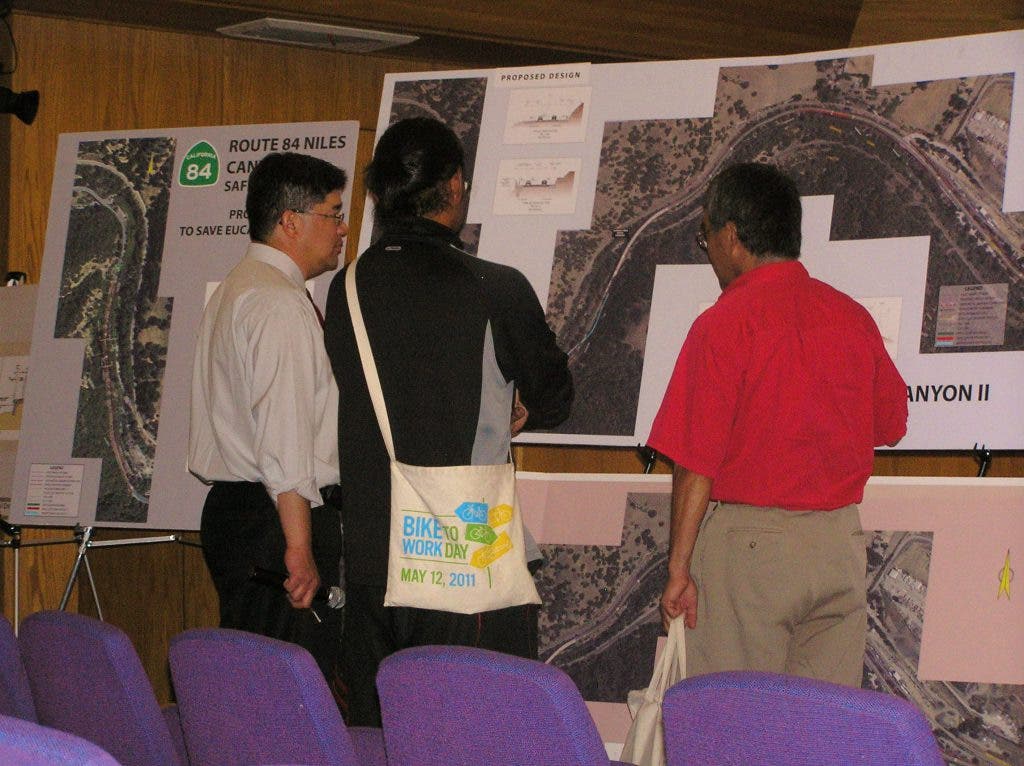
Caltrans hosts an interactive "map" meeting to give the community a preview of the work they will be doing.


For most people, Niles Canyon is simply a way of avoiding I-680, a connecter to I-580 or a scenic Sunday drive.
Most commuters traveling this stretch of State Route 84 are oblivious to the quiet community hiding behind the trees that line the road.
Calling the canyon home, these individuals have a vested interest in Caltrans’ latest local activity — a three-phase project involving major construction taking place practically in their own back yards that some residents say may do more harm than good.
Find out what's happening in Union Cityfor free with the latest updates from Patch.
The Route 84 Niles Canyon Phase II Safety Improvement Project, which would widen road shoulders from just east of Alameda Creek Bridge to Interstate 680, will soon enter its second phase. Caltrans hosted a public meeting Thursday night at the Union City Council Chambers with a map presentation and discussion session.
According to Caltrans officials, between 1999 and 2009 there were 455 accidents along SR-84 in Niles Canyon, with 10 resulting in fatalities and 237 causing injuries.
Find out what's happening in Union Cityfor free with the latest updates from Patch.
Widening the shoulder would allow law enforcement to safely patrol and pull over vehicles, increase visibility and provide more space for errant vehicles to correct course, according to officials.
However, the three-phase project has drawn to the area as hundreds of trees would be removed for the construction.
The Phase II project portion lies midpoint within the 7.1-mile scenic corridor near Niles Canyon Road and Paloma Way, in an unincorporated region of Alameda County considered to be rural, according to Caltrans project manager Ron Kiaaina.
Attendance at Thursday night’s meeting, however, proved that this rural area’s inhabitants demand to be factored into the safety improvement project’s equation.
Before commencing with the second phase of construction, scheduled to take place from 2013 through 2016, Caltrans has held several meetings to get the canyon community’s critiques and concerns regarding the project.
Caltrans reacted to residents' responses with a preliminary plan that they had hoped would appease all parties involved, officials said.
The Caltrans plan calls for the establishment of a standard eight-foot-wide shoulder area as well as the addition of centerline rumble strips, a concrete barrier, drainage capabilities, guard rails, retaining walls, shoulder rumble strips and state-of-the-art warning signs. The project will also require some utilities to be relocated and erosion controls to be implemented.
However, it isn’t so much what or how Caltrans is doing that is upsetting Niles residents, but trying to figure out the “why” behind the transportation agency’s decision to give the roadway an overhaul.
“Caltrans says it’s to improve safety, but ... 13 fatalities within a decade's span is not a lot in relation to other comparable roadways,” said Mike Dubinsky of environmental group Save Niles Canyon.
The next meeting on the topic will be held Tuesday, Aug. 2, at the Fremont Main Library, 2400 Stevenson Blvd., from 7 p.m. to 9 p.m.