Arts & Entertainment
Wild animals in circuses and other traveling shows denied "life worth living"
Expert review finds "all five of the 'freedoms'" compromised and supports ban on wild animal acts
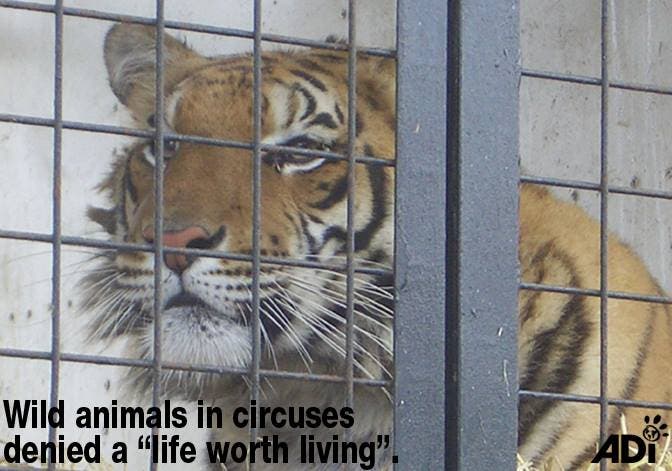
Animal Defenders International (ADI) calls for immediate action to end the suffering of wild animals in circuses in the US after a comprehensive and expert analysis of scientific evidence found “all five of the ‘freedoms’” are compromised in traveling animal shows. Experts said that circus life for animals is one not “worth living.”
Jan Creamer, President of Animal Defenders International, said: “This new report supports decades of reports and evidence that the welfare of wild animals is seriously compromised in circuses. Having time and again exposed the suffering and brutality of animals in circuses, Animal Defenders International calls for federal legislation to end wild animal acts.”
‘The Welfare of Wild Animals in Travelling Circuses’ report was commissioned by the Welsh government and undertaken by Professor Steven Harris, the 2nd Lord Dulverton Memorial Professor of Environmental Sciences at Bristol University, UK. The report summarizes: “The available scientific evidence indicates that captive wild animals in circuses and other travelling animal shows do not achieve their optimal welfare requirements, as set out under the Animal Welfare Act 2006, and the evidence would therefore support a ban on using wild animals in travelling circuses and mobile zoos on animal welfare grounds.”
The Harris team consulted 658 experts and organizations around the world, including 138 animal trainers/circuses; 206 lawyers and veterinarians with expertise in wild animal welfare; 107 people working for NGOs; 144 biologists, researchers, behavioral, and species experts; 58 zoo and wild animal sanctuary staff; and relevant government officials and wildlife experts.
The views of the animal trainers and circuses were “very different to the other groups of experts” on several issues. The group “did not believe that frequent training is stressful for animals,” that the “frequency and duration of transport should be minimised to avoid unnecessary stress,” and “disagreed that the portable enclosures required for regular travel cannot meet the preconditions for good welfare” – in contrast to all other expert groups.
Findings of the 178-page report include:
- “All five of the ‘freedoms’ are compromised in travelling circuses and mobile zoos”
- “Most if not all of the twelve ‘welfare criteria’ used in the [European] ‘Welfare Quality project are compromised”
- “Life for wild animals in travelling circuses and mobile zoos does not appear to constitute either a ‘good life’ or a ‘life worth living’”
- There is “No scientific evidence to suggest that some species of wild animals (vertebrates or invertebrates) are more suited to life in a travelling circus or mobile zoo”
- Most animal performances “focus on tricks that do not reflect natural behaviours”
- “Traditional animal training methods are coercive and based on force and aggression.” Circus trainers “have few or not recognised qualifications or formal training”
- “Minimum recommended enclosure sizes for animals in circuses are on average 26.3% of the recommended enclosure size for animals in zoos”
- There is “No scientific evidence that wild animals fully adapt to frequent transport”
The study included a review of 764 scientific reports and articles that had been peer-reviewed since 2007, following publication of a report by the UK Government on the subject. Harris’ report noted that there had since been “a substantial increase in the amount of information available.”
The continued use of wild animals in circuses is opposed by animal welfare experts, animal protection groups, politicians, and more than 2/3 of the American public. The Federation of Veterinarians of Europe has concluded “there is by no means the possibility that their [wild mammals in travelling circuses’] physiological, mental and social requirements can adequately be met.” A 2009 research paper co-authored by Professor Harris concluded “the species of non-domesticated animals commonly kept in circuses appear the least suited to a circus life.”
32 nations around the world have now banned either wild animals or all animals from traveling shows. It is time for the US to join this list.
Once a ban is in place, ADI has offered to assist with the relocation of circus animals should the need arise. ADI has just this year concluded an operation to enforce similar legislation in Peru, rescuing and relocating over 100 animals, with 33 lions airlifted to a sanctuary in South Africa.