Politics & Government
Obamacare: Hickenlooper, Kasich Call On Congress To Keep Individual Mandate
Kasich and Hickenlooper have teamed up to push for health care exchanges that would stabilize the market and assure affordability.

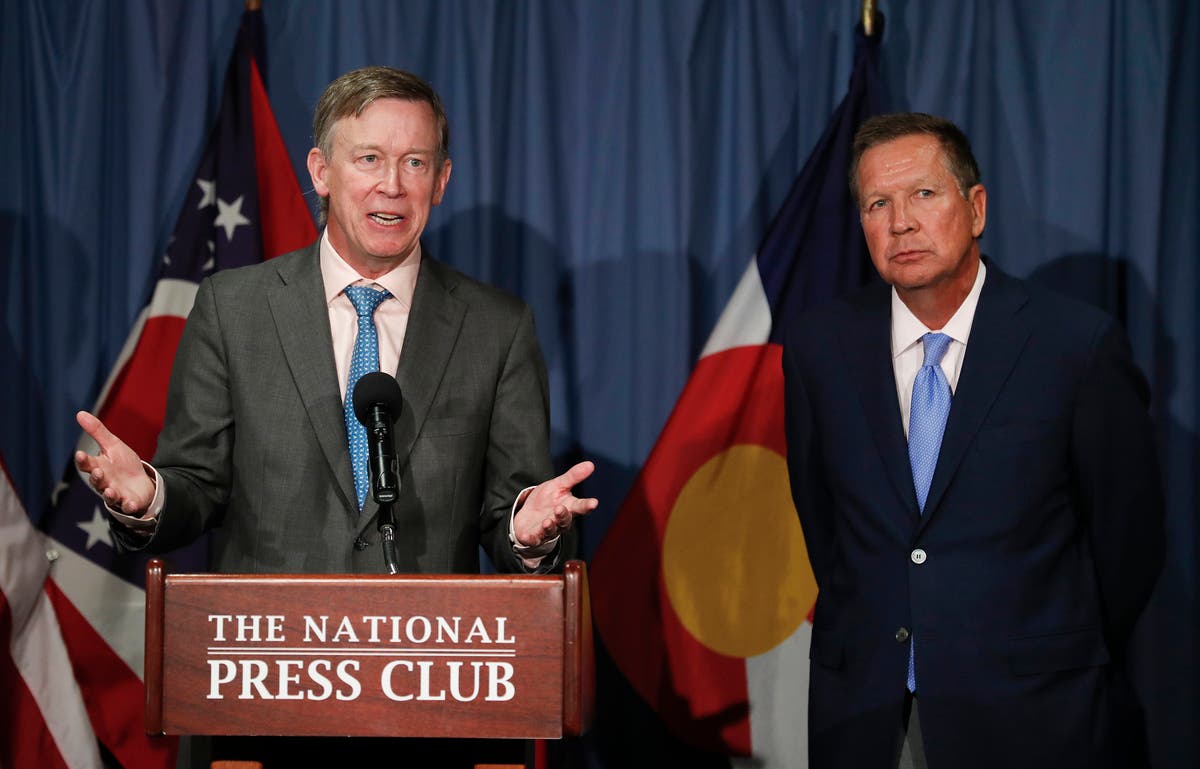
DENVER, CO — Congress should keep Obamacare's unpopular individual mandate and try to stabilize individual insurance markets as lawmakers work on a long-term replacement.
At least that's what Colorado Gov. John Hickenlooper, a Democrat, and Ohio Gov. John Kasich, a Republican, suggested in a letter to congressional leaders Thursday. Though the duo acknowledged that Congress — which has failed so far to pass a replacement health care bill — might not buy into the idea of keeping the health care law mandate.
"The current mandate is unpopular, but for the time being it is perhaps the most important incentive for healthy people to enroll in coverage," they wrote to House and Senate leaders of both parties. (For more information on Hickenlooper's health care law effort and other Denver stories, subscribe to Patch to receive daily newsletters and breaking news alerts. If you have an iPhone, click here to get the free Patch iPhone app.)
Find out what's happening in Denverfor free with the latest updates from Patch.
Experts agree that keeping younger, healthier people in the insurance pool prevents costs from skyrocketing out of control.
This nation made a lot of progress when Republicans and Democrats worked together. We can again. pic.twitter.com/WUEsMROADh
— John Kasich (@JohnKasich) August 31, 2017
The penalty and coverage requirement, or individual mandates, were meant to nudge healthy people into the insurance market. They have consistently polled negatively with Americans. In an Associated Press-NORC Center for Public Affairs Research poll conducted in July, 48 percent of those surveyed favored repealing the mandate, while 35 percent opposed repeal.
Find out what's happening in Denverfor free with the latest updates from Patch.
Last week, Axios reported that Kasich and Hickenlooper have discussed the idea of forming a unity ticket to run for the White House in 2020. Their letter was signed by Republican Gov. Brian Sandoval of Nevada; Democratic Govs. Tom Wolf of Pennsylvania, John Bel Edwards of Louisiana, Steve Bullock of Montana and Terry McAuliffe of Virginia; and Alaska Gov. Bill Walker, a one-time Republican no longer affiliated with a political party.
After Republicans' failure to pass a replacement of President Barack Obama's health care law, Kasich and Hickenlooper teamed up to push for health care exchanges that would stabilize the market and assure affordability. Both took pains to quash speculation that their collaboration and public appearances suggested a bipartisan presidential ticket was in the making for 2020.
Hickenlooper emphasized Thursday that steadying individual markets is a top — and time-driven — priority. Addressing Medicaid expansion costs and other health care elements can follow, he told reporters in Denver.
"Is this going to fix all that is broken with our health care system? No," he said. "If we can demonstrate success at stabilizing the individual markets, then we can move to the other parts of health care as well."
Kasich and Hickenlooper also recommended that President Donald Trump commit to cost-sharing reduction payments to insurers and that Congress fund those offsets at least through 2019. Those payments reimburse insurers for providing low-income people with legally required reductions on copays and deductibles. If Trump follows through on threats to pull the plug, premiums would jump about 20 percent.
Our bipartisan blueprint can bring positive change to health care reform. Congress must act now. pic.twitter.com/tmBC4DzUiL
— John Kasich (@JohnKasich) August 31, 2017
Kasich said the proposal satisfies the concerns of all parties studying the health care law.
"If you want to keep what you have, you can," the Ohio governor said Thursday. "We've stabilized everything up front, but then over time, we open up the doors to innovation and individual plans, within guardrails."
The governors support creating a temporary stability fund that states could tap to reduce premiums and limit losses; continuing to fund educational outreach and enrollment efforts under the Affordable Care Act; exempting insurers that agree to cover underserved counties from the federal health insurance tax; and supporting states' efforts to find creative solutions for covering the uninsured.
The governors said states can pursue lots of options without federal assistance, but in some cases they are "constrained by federal law and regulation from being truly innovative."
Kasich and Hickenlooper are expected to be in Washington next week to testify on their proposal. But congressional action on even a modest compromise is expected to be difficult following years of harsh partisan battling over the Republican drive to dismantle the health care law.
By JULIE CARR SMYTH and JAMES ANDERSON, Associated Press
Andrew Welsh-Huggins in Columbus, Ohio, contributed to this report.
Photo credit: Carolyn Kaster/Associated Press