Community Corner
African American Migration Westward And To Golden
After the Thirteenth Amendment was ratified in 1865, blacks were granted the freedom to expand anywhere in the nation.

October 8, 2020
This post is part of a series on the history of Golden and the Golden Cemetery. It’s based on a blog created by onetime (1950s) Golden City Manager Arthur Lowther. Each entry was written by a member of Debra Pearce’s AP history class of Golden High School in 2008.
Find out what's happening in Goldenfor free with the latest updates from Patch.
Lowther is the author of The History of Golden and its Golden City Cemetery. Read more about this project here.
By Alex Martinez, 2008 Golden High School student
After the Thirteenth Amendment was ratified in 1865, blacks were granted the freedom to expand anywhere in the nation. The South was in chaotic turmoil, and although the African Americans were freed, they continued to be harassed, persecuted, and segregated until the civil rights movement almost an entire century later. Realizing this, the post-Civil War era was the first major migration of African Americans westward. Though racism was by no means absent in the west, it was far more controlled and less blatant. Colorado, Oregon, Nevada, Utah, Idaho, Wyoming, and California stood as brilliant beacons that represented a new life filled with potential. From 1860 to 1950, the black population in western states grew from a petite 196,000, to 1,787,000! The movement of African Americans west began after the tragic Civil War in America, followed by another mass migration after the Allied victory in WWII. Excited Blacks arrived in Golden, Central City, and other mountainous cities in Colorado, pleasantly surprised by the wonderful economic opportunities the small, colorful mountain towns had to offer!
Find out what's happening in Goldenfor free with the latest updates from Patch.
The first major movement of African Americans west was after the Civil War, the bloodiest war in America’s history. The result was a Union victory, and the freedom of all African Americans in the United States, and the former slaves definitely played their role in the war. Approximately four million blacks fought for both the North and the South combined. After the war was over, however, the conditions that racist whites imposed were degrading, lonely, and often times dangerous. “But discrimination by White southerners and the former slaves’ own lack of education limited most of them to menial jobs.” Discrimination not only prohibited blacks from gaining work, but also threatened them into submission. The Ku Klux Klan, Black Codes, and Jim Crow Laws were all created to terrorize equal African Americans, and prevent them from rising to their full potentials in society. This harsh environment was the force that pushed large numbers of blacks west for the first time. This western migration from the cruel, offensive, and belligerently racist south brought blacks to Colorado, but many also moved further to California. Both States offered the chance of instant riches with their prospering mining industries. Blacks could also enlist in the army and protect pioneers from the threat of Indian assault. These regiments were often known as Buffalo Soldiers–the name derived from the Indians’ first encounter with African Americans, in which the tribes felt the thick black hair and correlated it with buffalo fur. Buffalo Soldiers were some of the bravest soldiers in the nation. Though they were segregated and chastised unfairly by their commanders, black regiments posted extremely low desertion rates, some of the lowest in the nation. The consistency of fair and acceptable work in Golden and throughout Colorado was a far better alternative than frying in the unbearable summer heat for measly wages in the rebuilding south.
Just as the post-Civil War era had spurred the first migration of blacks westward, the era following the great WWII produced the next significant mass immigration by African Americans. The dual-front war with Japan and Germany created an urgent need for not only regular war amenities, but an increase in naval construction. Factories were in dire need of employees, and blacks embraced the prospect. Although the south also increased its wartime production, the malignant racism white southerners expressed reduced greatly the number of available positions in factories for blacks. Agricultural positions in the southern states were excruciatingly difficult in the swelteringly humid climate, and the meager wages distributed for these tasks were absurd. The western front, on the contrary, offered a larger number of quality job opportunities for African Americans seeking stable, well paying jobs. Because large factories on the west coast were generally within large cities, the number of blacks within large west coast cities began to increase quickly. Though many historians view this sudden urbanization negatively, African American immigrants from the south actually displayed signs of more “acceptable” family lifestyles. Data from 1940 to 1970 shows more urban African American marriages without divorce, and a reduction in unmarried black women. In the so called “Great Migration,” a decade before the second one, Blacks primarily moved only straight north. Historians often only recognize the “Second Great Migration” as a continuation of the first, but in reality, it was a unique push from the south to both the north and west, that did not resemble any other. As they pushed west, African Americans began to trickle into Golden.
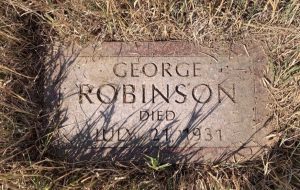
George Robinson worked at Foss General Store and Metropolitan Barber Shop in Golden, Colorado.
Initially, the only African American living in Golden was George Robinson, who migrated after his freedom was granted by Abraham Lincoln’s Emancipation Proclamation. Once he arrived, he quickly found work as a janitor at the popular Foss Drug Store, which was founded in 1913 by Henry J. Foss and his wife. Robinson also earned money as a shoe shiner at the Metropolitan Barber Shop in Golden. Robinson was liked by the whole town, and was the first successful black man in Golden. After his death in 1931, he was buried in the Golden Cemetery. The possibilities of black integration in the west did not exist in Golden alone, however. Clara Brown, often known as “Aunt Clara Brown,” arrived at Central City in 1859, and quickly began serving the miners. She washed laundry, prepared meals and cleaned, jobs that earned her a substantial amount of money. By the end of the Civil War, she had already saved 10,000 dollars!
The mines near Golden provided the most opportunity for African Americans looking for money, especially after the White Ash Coal Mine and Canyon Mine disasters occurred. Major strikes were organized by white mining groups who demanded safer conditions. These vacancies were then filled by African Americans hoping to get rich. Though not many blacks imagined making Golden their home before the mid 1900s, these mining booms attracted many that stayed from a couple of days to a couple of months. The famous gold rush in Denver in 1859 lured the most lucrative miners to the area, including the legendary black explorer and western pioneer, James P. Beckwourth. Beckwourth had a fascinating past. He had fought in the Seminole wars in Florida, and helped found the city of Pueblo. He had also spent many days filled with dangerous mountaineering expeditions in both Colorado and California, and brought these wild adventures with him to Denver during the boom. In terms of political opportunities in Colorado, Joseph H. Stuart was admitted to the Colorado Bar in 1891, and just two years later, he was elected to Colorado’s state legislature. While in the legislature, he was able to win approval and passage of his own civil rights act. These black individuals are strong examples of the wide variety of possibilities that Golden and Colorado offered African Americans looking to start their lives.
Although the first official black exodus to/in America is commonly recognized as the Atlantic slave trade that forcibly brought African Americans to the United States, the first voluntary migration began December 6, 1865, when ratification was complete for the Thirteenth Amendment. Civil War and WWII were brutal and bloody wars that resulted in many negative consequences and losses. They did however, accomplish positive impacts in the United States, one of the most important being the initiator of African American distribution. These wars lured the awe inspiring culture of African Americans to Golden, Colorado. Black influence changed the west, for better and for worse. They made white westerners realize how similar the two races really were. Once unique and interesting individuals like George Robinson and caring, compassionate people like Clara Brown introduced and expressed themselves to people in Golden and the rest of the west, they shattered the tense racial barrier. The notion of white superiority disappeared in many people’s hearts and minds, and Golden, once unfamiliar and untrusting of the African American presence, became a welcoming haven for blacks looking for opportunities!
This press release was produced by the Golden History Museum & Park. The views expressed are the author's own.