Community Corner
Golden History Museum & Park Shared Golden Gate Canyon
The time period of 1900-1930 had a booming mining growth and therefore the population jumped as well.

October 9, 2020
Golden Gate Canyon
This post is part of a series on the history of Golden and the Golden Cemetery. It’s based on a blog created by onetime (1950s) Golden City Manager Arthur Lowther. Each entry was written by a member of Debra Pearce’s AP history class of Golden High School in 2008.
Lowther is the author of The History of Golden and its Golden City Cemetery. Read more about this project here.
Find out what's happening in Goldenfor free with the latest updates from Patch.
By Austin Pottoff, 2008 Golden High School student
Golden Gate Canyon has had a rich western history. The time period of 1900-1930 had a booming mining growth and therefore the population jumped as well. The exciting history of the canyon involves people, natural resources, and the historic happenings throughout the area, and the cemetery that reflects the untold past of the canyon. This is all part of the many threads that weave the undiscovered tapestry of the canyon’s history.
The education of the children in the upper canyon was a hard and complicated process compared to what we have to go through today. The harsh and cold winters were incredibly enduring for the children. They did not have roads or cars to transfer them comfortably from home to school and so to cross the harsh frozen land to get to school the children relied on the donkeys to carry them to school. This was a very hard process because donkeys would not cross any frozen expanse of ground, so the children would often have to push the donkey across the pond or pull the reins of the donkey while others would push. One rare incident occurred when some of the Ramstetter children were returning home from school and their donkey collapsed and the children returned home crying to their father about how their donkey died. When the father returned he found the donkey grazing on some of the shrubs.
Find out what's happening in Goldenfor free with the latest updates from Patch.
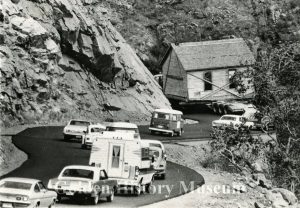
The Guy Hill Schoolhouse is transported on the back of a flatbed truck down Golden Gate Canyon Road in June 1975. The schoolhouse was being moved to downtown Golden to the original Mitchell Elementary School property, its first relocation. It’s now located inside Golden History Park.
Many groups of parents looking to make the transit from the school to their home shorter for their children physically moved the school closer to their houses. This aggravated the parents who were already close to the schoolhouse so they moved the school back to where it was. This happened a few more times but they eventually they gave up the struggle and the schoolhouse stayed where it was originally, but only for a short time. As the state government brought secure roads into the canyon many of the local inhabitants got cars themselves and their children started attending the local schools in Golden about 14 miles southeast of the canyon. The cars and easier transportation would lead to more families seeking refuge from bustling cities and urban claustrophobia. (This is why my own family immigrated into the canyon after living in Los Angeles.) But a group of sixth graders who had attended the school were determined not to have the school forgotten. So they moved the schoolhouse down into Clear Creek History Park [today’s Golden History Park], which is just across from the local library.
The job opportunities in the canyon were very scarce for men, and for women it was doubly so. But this was common among the nation as a whole and women every where were seeking suffrage in the late 1800s, and the western states were the first to grant women the right to vote. Men were far more open to the jobs in the canyon than the women were. Even so, the men mostly either went into the mining business or they became ranchers; there were few others who chose different jobs. Women were often teachers, as were a few men, but women were often forced to do what their husbands did. If the husband was a rancher, the wife was helping around the farm along with taking care of the house and the children. Miners’ wives would often take care of the children, deal with their drunken husbands, and try to pull in as much extra money as they could.
The job of mining was the backbone of Golden Gate Canyon’s economy. Although there was much mining in the canyon, gold or silver was never found, but there were large deposits of coal which proved very crucial for the economy of the canyon. To power the machines and other things in the mines, they required massive amounts of wood to burn, and in effect they almost completely destroyed the tree population in the canyon. But the biggest economical advantage for the canyon was that it was the central route into the booming mining cities of Blackhawk and Central City. Inns and taverns profited greatly from the volume of miners and others headed to Blackhawk and Central City because there was no other way of getting to the mining cities except for the route through Golden Gate Canyon. In 1932 US highway 32 was built, connecting Denver and Blackhawk and Central City; this later became US highway 6. Unfortunately the big mining cities lost their riches as they lost their gold and silver deposits.
The two cities needed to figure out a way to keep their wealthy cities from becoming ghost towns so they incorporated gambling. Over time, the big casinos started to move in and they kept the mining cities’ economies alive. Unfortunately for the innkeepers, Highway 6 cut off their supply and Golden Gate Canyon started to become the peaceful scenic area it is today. But still every once in a while when the highway is closed, we get a lost gambler or two who are eager to spend their money in need of direction.
The Golden Gate State Park that was built to protect the rare beasts that are still in the area was founded in 1965. But long before that there were many more powerful creatures roaming the land. Some of these include timber wolves, moose, grizzly bears, elk, mountain lion, and bobcat. Eventually humans would start to grow large crops of corn and other plants, replacing the grasses the elk herds were used to eating. They could not digest these new crops, seriously dwindling their numbers. The decline in elk led to a decline in the mountain lions who hunted them. And over a larger period of time big game hunters would eradicate not only the grizzly but also the moose. As if the humans hadn’t hurt the population enough, they started to fence off the area of their land reducing the roaming area of the elk even more, and when the mountain lions would kill their cattle they would find the puma and kill it. This created a strong fear of mountain lions and they stayed far away from the inhabitants of the canyon. The animals saved by the park are only a fraction of what the animals used to be, most of whom were completely eradicated from the canyon, if not Colorado entirely.
The local cemetery for the canyon holds many of the patrons of the inhabitants of the canyon, but in reality many of the habitants were buried in the area they died. In one case a group of people were headed up the canyon and one of the men in their party died. They were apparently in a hurry because instead of digging a grave for the man, they instead found a gopher hole, widened it, and buried the man standing up. There are other occurrences where some died and were buried when their lives were ended. But the cemetery that was most commonly used was Golden Gate City Site which fell into disuse after roads and automobiles came into use.
Cemetery Hill, or Graveyard Hill, fell into disuse. Erosion and ground frost took their toll, and children living on the lower slopes of the steep hill took to hauling old bones home in their wagons. In 1952-53 the graveyard on Cemetery Hill was destroyed by Mr. Dennis of Golden in order to build his subdivision. A few of the caskets were moved to other cemeteries, including the Golden Cemetery on Ulysses Street. Some bones, bereft of caskets, were placed in a common grave in the pioneer section of the Golden Cemetery. But most of the grave sites on Cemetery Hill, caskets and all, were simply bulldozed over.
So as you can see the gravesite for most of the inhabitants of the canyon were simply demolished in order to build some subdivisions. This is quite a tragic ending for the lives of those in the canyon who were disrespectfully bulldozed over in order for Mr. Dennis to make some money.
The people of Golden Gate Canyon all had a rich story to tell but the story of the canyon’s people and natural history creates a beautiful story of the canyon itself, and it is amazing for me to think that this all happened and took place right here where I live. I hope that you have seen both the bright and gloomy sides to the history of the canyon and see that the history of this place where I live is still being written.
This press release was produced by the Golden History Museum & Park. The views expressed are the author's own.